
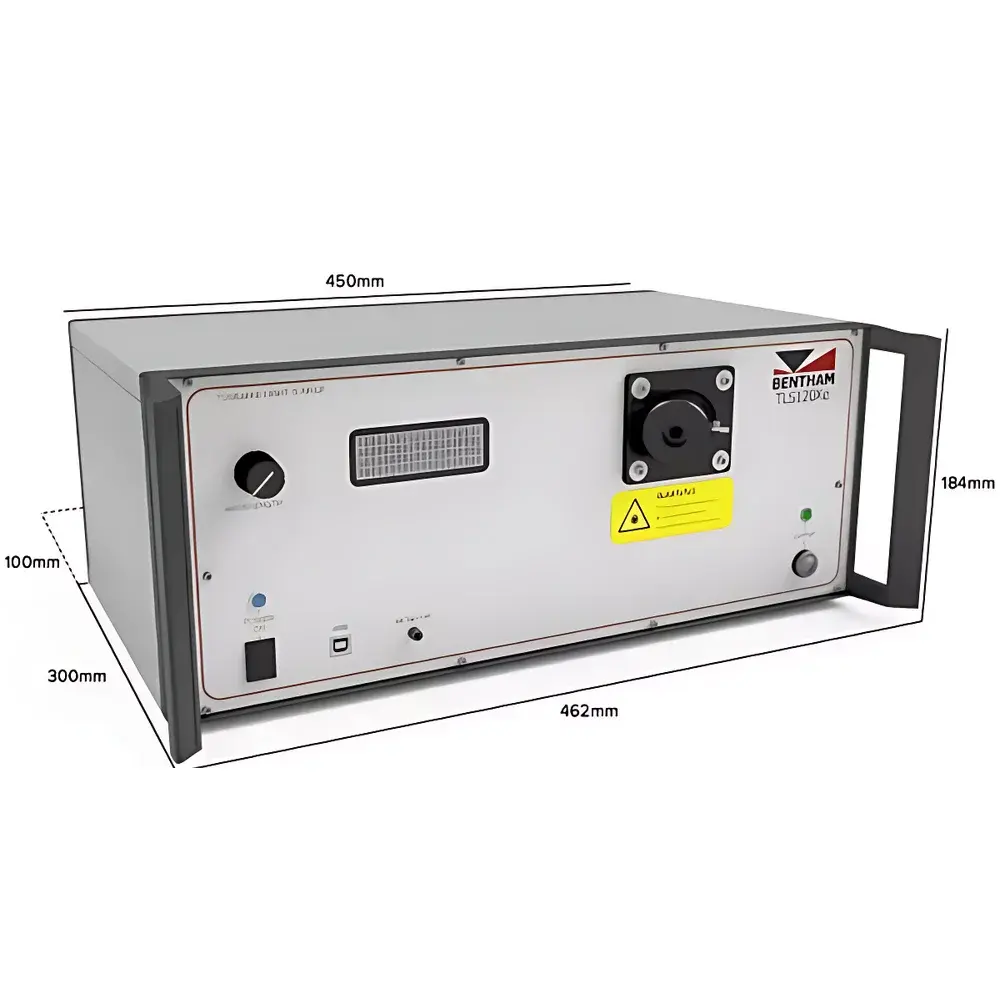
HaoLiang TLS120Xe High-Power Tunable Monochromatic Light Source (280–1100 nm)
| Origin | Imported |
|---|---|
| Manufacturer Type | Authorized Distributor |
| Light Source Type | Xenon Arc Lamp |
| Illumination Mode | External Illumination |
| Model | TLS120Xe |
| Spectral Range | 280–1100 nm |
| Output Options | SMA Fiber (250–1200 nm), UV-Grade Fiber (200–1350 nm), Liquid Light Guide (280–700 nm) |
| Slit Width Options | 0.74 mm (5 nm), 1.45 mm (10 nm), 2.9 mm (20 nm), 5.92 mm (40 nm) |
| Lamp Options | 75 W (3000 h lifetime, 5.4 A), 100 W (500 h lifetime, 7.0 A) |
Overview
The HaoLiang TLS120Xe is a high-power, monochromator-based tunable light source engineered for precision optical spectroscopy and photometric characterization in research and industrial laboratories. It utilizes a stabilized xenon arc lamp coupled with a Czerny–Turner monochromator architecture, enabling continuous wavelength selection across a broad spectral range from 280 nm (deep UV) to 1100 nm (near-infrared). The system operates on the principle of diffraction grating dispersion: broadband emission from the xenon lamp is collimated, dispersed by a ruled or holographic grating, and re-focused through an adjustable exit slit to isolate a narrow spectral band. This optical design ensures high spectral purity, excellent long-term irradiance stability (<0.5% RMS over 8 hours), and minimal thermal drift—critical for quantitative measurements such as quantum efficiency (QE) mapping, detector responsivity calibration, and thin-film optical constant determination.
Key Features
- Precision Wavelength Selection: Motorized grating rotation with absolute encoder feedback enables repeatable wavelength positioning within ±0.1 nm accuracy (dependent on slit width and calibration), traceable to NIST-traceable spectral standards.
- Thermally Stable Illumination: Constant-current power supply with active temperature regulation minimizes arc wander and intensity fluctuations—achieving <0.3% peak-to-peak noise in DC mode and <1% variation across full spectral sweep at fixed slit settings.
- Configurable Spectral Bandwidth: Interchangeable entrance/exit slits (0.74–5.92 mm) allow users to balance resolution (down to 5 nm FWHM) and radiant flux (up to 12 mW/nm at 550 nm with 100 W lamp and 40 nm slit).
- Modular Output Interface: Standardized mounting flanges support direct coupling to liquid light guides (LLG), UV-enhanced silica fibers, or SMA-terminated optical fibers—enabling seamless integration into microscopes, spectrophotometers, or custom optical benches.
- Dual-Control Architecture: Local touchscreen interface provides real-time spectrum preview and manual scan control; USB 2.0 (CDC class) enables remote operation via SCPI-compatible commands for LabVIEW, Python, or MATLAB automation.
Sample Compatibility & Compliance
The TLS120Xe is compatible with standard optical components rated for UV–NIR exposure, including fused silica lenses, MgF₂-coated mirrors, and silicon photodiodes. Its output irradiance profile conforms to ISO 9022-3 (optical instruments—environmental testing) for stable operation under ambient laboratory conditions (15–30 °C, <60% RH). While not certified for medical device use, its radiometric performance supports compliance with ASTM E308 (computing colorimetric data), ISO 13406-2 (display luminance uniformity testing), and JIS Z 8722 (spectral reflectance measurement). For GLP/GMP environments, optional audit-trail logging (via software SDK) records all wavelength setpoints, slit configurations, lamp operating hours, and timestamped irradiance readings—facilitating 21 CFR Part 11–compliant data integrity workflows when paired with validated host software.
Software & Data Management
HaoLiang provides the TLS Control Suite—a cross-platform application (Windows/macOS/Linux) supporting real-time spectral scanning, multi-point irradiance logging, and automated wavelength sweeps with user-defined step sizes (0.1–10 nm). Raw output data exports to CSV or HDF5 formats, preserving metadata including lamp age, grating position encoder counts, and thermal sensor readings. An open-source Python API (PyTLS) is available for integration into custom analysis pipelines, enabling synchronized acquisition with CCD/CMOS cameras, lock-in amplifiers, or electrometers. All firmware updates are delivered via signed binary packages with SHA-256 checksum verification to ensure system integrity.
Applications
- Quantum efficiency (QE) and spectral responsivity calibration of scientific CMOS, sCMOS, EMCCD, and InGaAs detectors
- Excitation source for fluorescence lifetime imaging (FLIM), time-resolved photoluminescence (TRPL), and upconversion studies
- In-situ monitoring of thin-film deposition processes (e.g., sputtering, ALD) via real-time reflectance/transmittance tracking
- Validation of optical filters, dichroics, and anti-reflection coatings across UV–NIR bands
- Benchmarking of solar cell external quantum efficiency (EQE) and IPCE spectra per IEC 60904-8
- Calibration reference for benchtop UV-Vis-NIR spectrophotometers and integrating sphere systems
FAQ
What lamp options are available, and how do they affect system performance?
The TLS120Xe offers two xenon lamp variants: a 75 W long-life lamp (3000 h rating, 5.4 A drive current) optimized for stability-critical applications, and a 100 W high-brightness lamp (500 h rating, 7.0 A) delivering up to 2.3× higher radiant flux in the visible range.
How is wavelength accuracy verified and maintained?
Each unit undergoes factory calibration using mercury–argon and deuterium spectral line standards. Users may perform periodic recalibration via the built-in alignment routine using optional Hg(Ar) pen-lamp accessory, ensuring traceability to primary spectral references.
Can the TLS120Xe be integrated into vacuum or controlled-atmosphere chambers?
Yes—the standard output port features a CF-35 or KF-25 vacuum flange option (custom order); fiber-coupled configurations enable feedthrough without compromising chamber integrity.
Is radiometric calibration included with purchase?
A NIST-traceable spectral irradiance certificate (covering 280–1100 nm at 10 nm intervals, ±3% uncertainty) is provided with each system; extended calibration services (including angular output profiling) are available upon request.
What safety certifications does the system meet?
The TLS120Xe complies with IEC 61010-1 (electrical safety), IEC 62471 (photobiological safety—Risk Group 3 for UV output), and CE/UKCA marking requirements for laboratory equipment. Integrated interlocks disable lamp operation when the housing is opened.




