
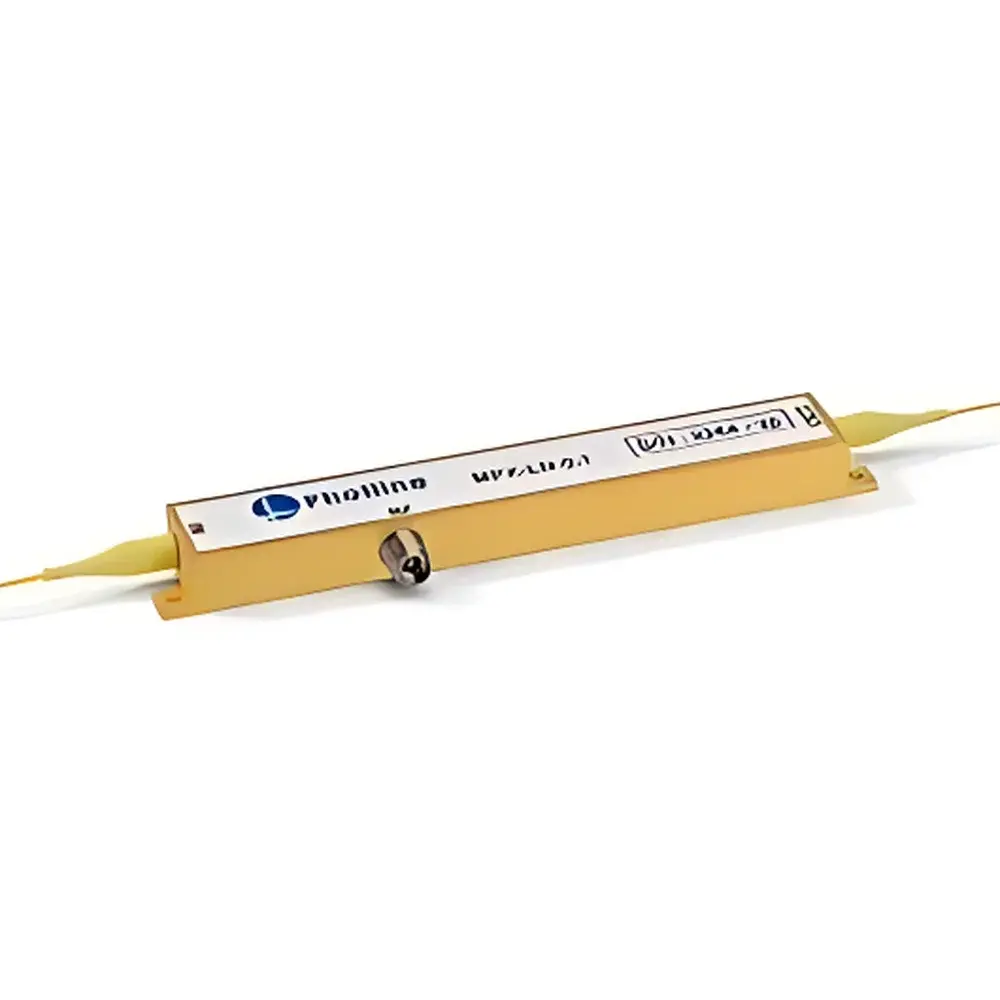
Photline LiNbO3 Electro-Optic Intensity Modulator
| Origin | France |
|---|---|
| Manufacturer Type | Authorized Distributor |
| Origin Category | Imported |
| Model | LiNbO3_EO_Intensity_Modulator |
| Pricing | Upon Request |
Overview
The Photline LiNbO3 Electro-Optic Intensity Modulator is a high-performance, fiber-coupled optical device engineered for precise amplitude modulation of laser light via the linear electro-optic (Pockels) effect in lithium niobate (LiNbO₃) crystal. Based on Mach-Zehnder interferometer (MZI) architecture—specifically X-cut waveguide design—the modulator delivers exceptional thermal and polarization stability, near-zero chirp, and high extinction ratio across multiple telecom and scientific wavelength bands. Its operation relies on voltage-induced refractive index changes in single-mode LiNbO₃ waveguides, enabling broadband analog or digital intensity modulation with minimal phase distortion. Designed for integration into demanding photonic systems, it serves as a core component in coherent communications, microwave photonics, quantum optics, ultrafast laser pulse control, and fiber sensing applications requiring deterministic, repeatable optical power switching.
Key Features
- Fiber-pigtailed, polarization-maintaining (PM) or standard single-mode input/output configurations, optimized per wavelength band (800 nm, 1060 nm, 1310 nm, 1550 nm, and 2000 nm)
- X-cut LiNbO₃ waveguide platform ensuring long-term bias point stability and low temperature drift
- Electro-optic bandwidths ranging from 1 GHz (2 µm band) up to 40 GHz (1550 nm band), supporting NRZ, RZ, DPSK, Duo-Binary, and analog RF-over-fiber modulation formats
- Typical insertion loss between 3.5 dB and 6 dB depending on model and wavelength; optimized for low Vπ (3.5–6.4 V) to reduce RF drive power requirements
- High extinction ratios up to 40 dB (MXER-LN series) and output balance ≤5% (MXDO-LN dual-output variants)
- Patented “Magic Junction” electrode design (MXER-LN) for enhanced extinction ratio and reduced drive voltage nonlinearity
- Optical power handling up to 100 mW (INR-MX-LN series), suitable for high-power ultrafast and CW laser systems
Sample Compatibility & Compliance
The modulator is compatible with industry-standard single-mode fibers (SMF-28, PM1550, HI1060, etc.) and supports both free-space collimated and fiber-coupled input configurations upon request. All devices comply with RoHS directives and are manufactured under ISO 9001-certified processes. For regulated environments—including telecom infrastructure deployment and GLP/GMP-aligned optical test labs—the modulators support traceable calibration documentation and can be integrated into systems compliant with ITU-T G.691, Telcordia GR-468-CORE, and IEC 61280-2-9 standards. While not inherently FDA 21 CFR Part 11 certified (as a hardware component), full audit trails for system-level validation are achievable when paired with Photline’s synchronized RF drivers and control software.
Software & Data Management
Photline provides the ModMaster™ control suite—a Windows-based application enabling real-time bias point stabilization, Vπ characterization, dynamic response analysis, and automated sweep acquisition. The software supports SCPI command protocol over USB or Ethernet for seamless integration into LabVIEW, Python (PyVISA), MATLAB, or custom CI/CD test automation pipelines. All modulators include factory-measured S-parameters (S21/S11) and EO transfer function data in CSV format. Firmware updates and configuration profiles are managed through secure, version-controlled repositories accessible via Photline’s customer portal—ensuring reproducibility across multi-site R&D and production deployments.
Applications
- Digital optical communications: 2.5 Gb/s to 40 Gb/s NRZ/RZ/DPSK transmitters in C-, O-, and L-bands
- Analog photonic links: 20 GHz RF-over-fiber (RoF) distribution for 5G fronthaul, radar antenna remoting, and satellite communications
- Ultrafast photonics: Pulse picking, cavity dumping, carrier suppression, and temporal pulse shaping in Ti:Sapphire and Yb-fiber laser systems
- Fiber optic sensing: Interferometric demodulation, distributed acoustic sensing (DAS), and LiDAR seed modulation
- Quantum optics: Intensity stabilization for SPDC sources, heralded photon generation, and quantum key distribution (QKD) transmitter modules
- Microwave photonics: True-time delay beamforming, photonic-assisted ADC/DAC, and harmonic generation suppression
FAQ
What wavelength bands are supported by this modulator?
Standard models operate at 800 nm, 1060 nm, 1310 nm, 1550 nm, and 2000 nm—with dedicated waveguide and fiber coupling optimized for each band.
Is the modulator polarization-sensitive?
Yes—most variants use polarization-maintaining (PM) fiber pigtails and require alignment to the slow axis; X-cut design minimizes polarization-dependent loss but does not eliminate polarization dependence.
Can it be used for analog vs. digital modulation interchangeably?
Yes—bandwidth and linearity specifications (e.g., MXAN-LN series for analog, MX-LN for digital) determine optimal use case, but all MZI-based models support both regimes within their EO bandwidth limits.
What RF driver compatibility is recommended?
Photline’s high-speed RF amplifiers (e.g., DRA series) and bias tees are characterized for impedance matching (50 Ω), rise time, and harmonic suppression to maximize modulator performance.
Do you provide optical alignment or packaging customization?
Yes—custom fiber types (e.g., PM1300, SMF-28e+), connectorization (FC/APC, SC/APC), hermetic sealing, and OEM module integration (e.g., ModBox platforms) are available under NDA.



