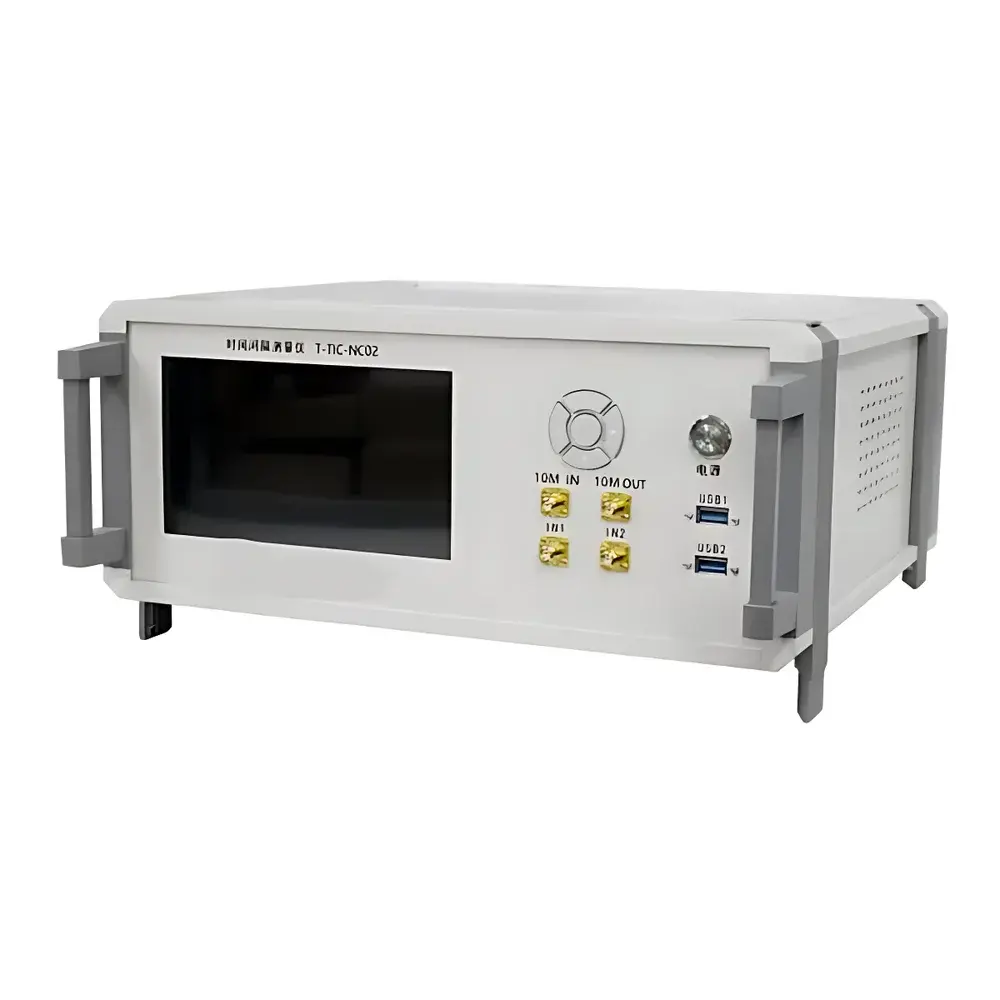
Auniontech AU-TIM-100 Ultra-High-Precision Time Interval Analyzer Module
| Brand | Auniontech |
|---|---|
| Origin | Shanghai, China |
| Model | AU-TIM-100 |
| Time Interval Stability | ≤3 ps/s |
| Uncertainty | ≤20 ps |
| Peak-to-Peak Jitter | ≤25 ps |
| Resolution | <1 ps |
| Measurement Range | 0–1 s |
| Nonlinearity | <25 ps (at 10 MHz offset of 0.01 Hz) |
| Input Interfaces | SMA-F (10 MHz Ref In/Out, LVTTL PPS IN1/IN2) |
| Output Interfaces | DB9 RS-232, RJ45 Ethernet |
| Control Interface | USB 2.0 |
| Dimensions | 145 × 347 × 300 mm |
| Power Supply | 220 VAC |
Overview
The Auniontech AU-TIM-100 Ultra-High-Precision Time Interval Analyzer Module is a metrology-grade instrument engineered for traceable, sub-picosecond time interval measurement and frequency stability analysis. Based on high-resolution time-to-digital conversion (TDC) architecture with dual-channel synchronous sampling and temperature-stabilized reference clock distribution, the AU-TIM-100 delivers deterministic latency characterization essential in time-critical infrastructure. It operates on the principle of start-stop time interval measurement between precisely defined digital edges—typically PPS (Pulse Per Second) signals referenced to a common 10 MHz rubidium or GPS-disciplined oscillator. Its design adheres to the fundamental requirements of time metrology as defined in IEEE Std 1139, ITU-T G.8262, and ISO/IEC 17025-accredited calibration practices. The module supports both standalone operation (via integrated display and local control) and remote integration into automated test systems, making it suitable for primary and secondary time laboratories, satellite ground station synchronization validation, and precision timing subsystem verification.
Key Features
- Sub-1 ps effective time resolution enabled by multi-phase interpolation TDC with real-time dead-time compensation
- Time interval stability ≤3 ps/s (Allan deviation at τ = 1 s), verified under controlled thermal environment (±0.5 °C)
- Total measurement uncertainty ≤20 ps (k = 2, coverage factor), including contributions from trigger jitter, channel skew, and reference oscillator phase noise
- Peak-to-peak time deviation ≤25 ps over 1000 consecutive measurements at 1 Hz repetition rate
- Dual independent input channels (IN1: reference PPS; IN2: device-under-test PPS), both compatible with 3.3 V LVTTL logic and <5 ns rise time
- Integrated 10 MHz reference distribution: 10 MHz IN (9–13 dBm, 50 Ω) and buffered 10 MHz OUT (13 dBm, 50 Ω) for system-wide clock synchronization
- Onboard statistical engine computing real-time min/max/mean/peak-to-peak/standard deviation and time variance (TVAR) with curve plotting
- Zero-latency initialization function—hardware button or host-command-triggered channel alignment to eliminate fixed inter-channel delay
Sample Compatibility & Compliance
The AU-TIM-100 accepts standard timing signals compliant with IEEE 1588 PTP (Precision Time Protocol) event message edge detection and NTPv4 coarse/fine timestamping workflows. Input signal compatibility includes GPS/GNSS-derived 1PPS, atomic clock outputs (e.g., HP5071A, Symmetricom SA.45s), and FPGA-generated timing pulses meeting LVTTL voltage and slew-rate specifications. The instrument conforms to electromagnetic compatibility standards IEC 61326-1 (industrial environments) and safety standard IEC 61010-1. Its measurement methodology supports traceability to national time standards (e.g., NIM, NIST, PTB) when operated with calibrated reference sources and documented environmental controls. For regulated environments, raw timestamp logs include embedded UTC timestamps, hardware serial numbers, and firmware revision identifiers—enabling full audit trails required under GLP and ISO/IEC 17025 Clause 7.7.
Software & Data Management
The AU-TIM-100 ships with cross-platform host software (Windows/Linux/macOS) supporting SCPI-over-USB, SCPI-over-TCP/IP (via RJ45), and ASCII-based serial command sets. All communication interfaces provide identical command syntax and data structure, ensuring seamless migration between lab bench and rack-mounted deployments. Timestamp datasets are exportable in CSV and HDF5 formats, with metadata headers containing acquisition parameters (sampling rate, trigger threshold, reference source ID, temperature sensor readings). Software features include configurable averaging windows, histogram-based jitter decomposition (periodic vs. random components), and TVAR computation per IEEE Std 959. Audit logging records all configuration changes, calibration events, and user-initiated zeroing operations—meeting FDA 21 CFR Part 11 requirements for electronic records when deployed with optional digital signature and role-based access modules.
Applications
- Aerospace telemetry synchronization validation across distributed avionics bays and ground support equipment
- GNSS receiver timing error budget analysis—including ionospheric delay compensation verification and multipath rejection assessment
- Calibration of time interval analyzers and phase noise analyzers against primary frequency standards
- Characterization of jitter accumulation in optical time-domain reflectometry (OTDR) and photonic delay lines
- Verification of PTP grandmaster clock performance in telecom transport networks (ITU-T G.8273.2 Class C/D compliance testing)
- Research in quantum timing networks requiring femtosecond-level relative timing stability between entangled photon detectors
FAQ
What reference clock sources are recommended for optimal uncertainty performance?
For ≤20 ps uncertainty, a GPS-disciplined OCXO with aging rate <±5 × 10⁻¹¹/month and phase noise <−150 dBc/Hz at 10 kHz offset is recommended. Internal 10 MHz output may be used only if externally disciplined.
Can the AU-TIM-100 measure time intervals shorter than 1 ns?
Yes—the instrument resolves intervals down to 0.8 ps (typ.) with linear interpolation; minimum measurable interval is limited by input signal rise time and channel trigger threshold settings.
Is firmware upgradable in the field?
Yes—firmware updates are delivered via USB stick or network push using signed binary packages; update integrity is verified via SHA-256 checksum and RSA-2048 signature validation.
Does the module support IEEE 1588 hardware timestamping?
No—it does not embed PTP protocol stack; however, it accurately measures PTP event message arrival/departure intervals when fed with hardware-extracted PPS signals from compliant PHYs.
How is channel-to-channel skew calibrated?
Skew is measured during factory calibration using a precision delay generator (Keysight 81150A) and corrected in firmware; residual skew remains <1.2 ps (2σ) across operating temperature range (15–30 °C).