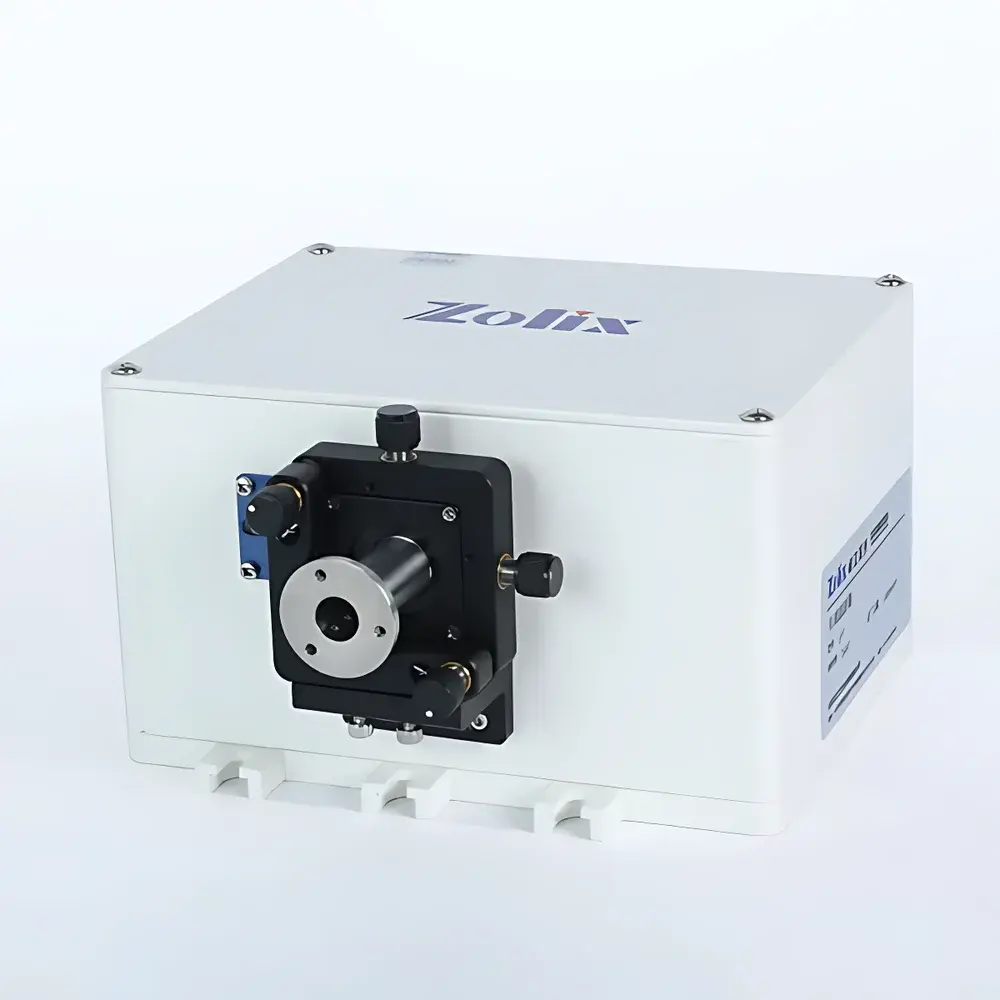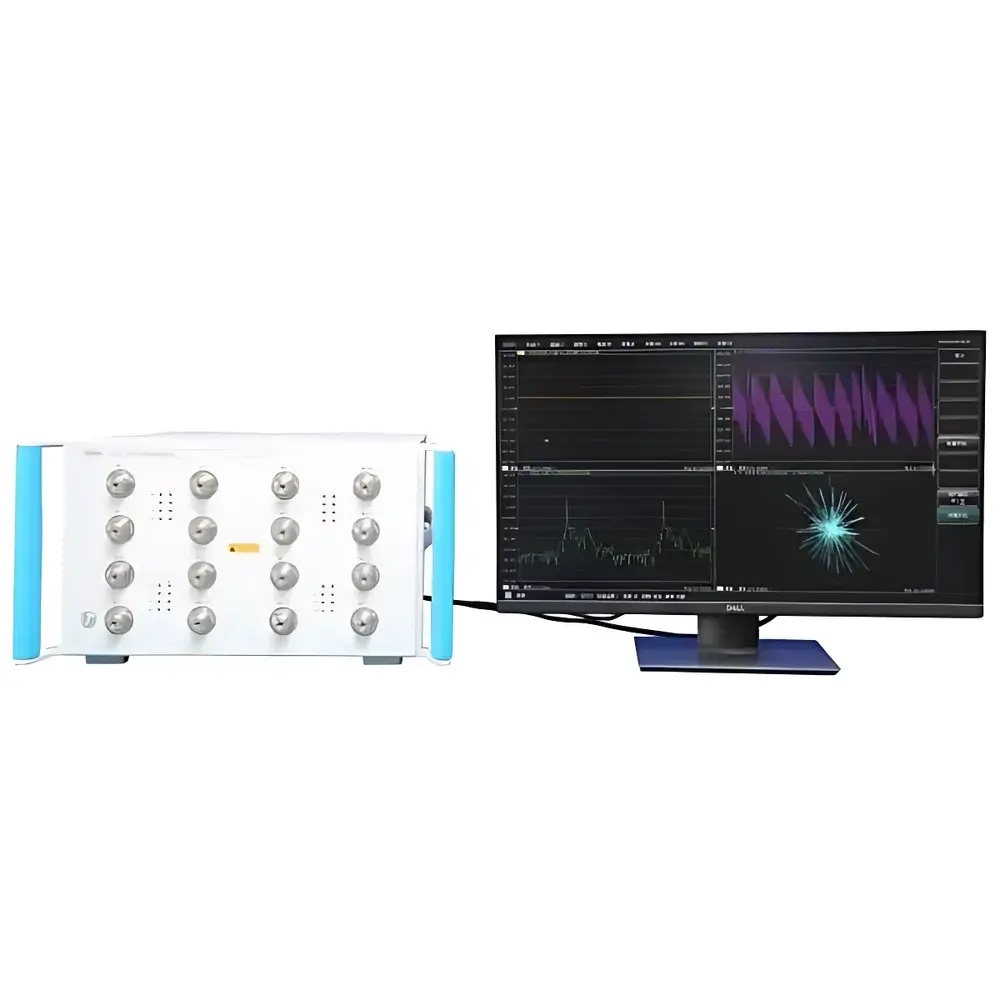
Auniontech 3650B/C/D Multi-Port Vector Network Analyzer
| Frequency Range | 10 MHz–9 GHz / 14 GHz / 20 GHz |
|---|---|
| Number of Ports | 16 |
| Brand | Auniontech |
| Origin | Shanghai, China |
| Calibration Options | SOLT, TRL, ECal, Response, Enhanced Response, Isolation, Full 2-Port |
| Display Formats | Log Magnitude, Linear Magnitude, VSWR, Phase, Group Delay, Smith Chart, Polar Plot |
| Interfaces | USB, LAN (LXI-C), GPIB, VGA |
| Dynamic Range | up to 115 dB (10 MHz–1 GHz), 90 dB (14–20 GHz) |
| IF Bandwidth | 1 Hz–30 MHz |
| Trace Noise (Amplitude) | 0.005 dB rms (1 kHz IFBW, ≥1 GHz) |
| Trace Noise (Phase) | 0.05° rms (1 kHz IFBW, ≥1 GHz) |
| Frequency Accuracy | ±1×10⁻⁷ (23°C ±3°C) |
| Output Power Range | +10 dBm to –9 dBm (frequency-dependent) |
| Directionality | up to 40 dB |
| Source & Load Match | up to 45 dB |
| Amplitude Resolution | 0.001 dB/div |
| Phase Resolution | 0.01°/div |
Overview
The Auniontech 3650B/C/D Multi-Port Vector Network Analyzer (VNA) is a high-performance, modular RF and microwave measurement platform engineered for precision characterization of complex multi-port devices across frequency bands up to 20 GHz. Based on coherent heterodyne detection with fundamental mixing architecture, the instrument delivers extended dynamic range and exceptional phase stability—critical for accurate S-parameter extraction in demanding applications such as MIMO antenna systems, high-speed interconnects, RF front-end modules, and planar passive components. Its 16-port configuration supports full N×N scattering matrix acquisition without external switching, enabling true parallel measurement of differential pairs, balanced filters, and multi-element array structures. The analyzer operates on vector error correction principles compliant with IEEE Std 1785.1–2018 (Guidelines for VNA Calibration), supporting traceable calibration via mechanical SOLT, TRL, and electronic calibration (ECal) standards.
Key Features
- Three configurable frequency models: 3650B (10 MHz–9 GHz), 3650C (10 MHz–14 GHz), and 3650D (10 MHz–20 GHz)
- 16 fully integrated RF ports with independent source and receiver paths—no external multiplexing required
- Up to 64 simultaneous measurement channels and 32 concurrent display windows; each window supports up to 16 overlaid traces
- Comprehensive calibration suite: automated guided calibration, manual SOLT/TRL, and broadband ECal (3650-02420405, 10 MHz–20 GHz, 3.5 mm)
- High-fidelity time-domain analysis (TDR/TDT) with impedance profiling, discontinuity localization, and virtual eye diagram synthesis per IEEE 802.3, PCIe, and USB specifications
- Advanced fixture de-embedding via AFR (Automatic Fixture Removal) option (3650-S07AFR), supporting both single-ended and differential fixture models
- Multi-language UI (English optional via 3650-006 firmware), LXI-C compliant LAN interface, and SCPI 1999-compliant command set for automated test system integration
- Real-time amplitude and phase trace noise performance: ≤0.005 dB rms and ≤0.05° rms (1 kHz IF bandwidth, ≥1 GHz)
Sample Compatibility & Compliance
The 3650 series accommodates coaxial (3.5 mm, SMA, N-type), waveguide (WR-90, WR-62), and probe station interfaces through standardized adapter kits and calibration kits traceable to NIST or PTB reference standards. It meets electromagnetic compatibility requirements per CISPR 11 Class A and safety compliance per IEC 61010-1:2010. For regulated environments, the platform supports audit-ready data logging with timestamped calibration records, user-access logs, and configurable report templates aligned with GLP and ISO/IEC 17025 documentation workflows. All firmware and calibration algorithms are developed under a formal design control process consistent with ISO 9001:2015 quality management systems.
Software & Data Management
Controlled via embedded Linux-based operating system, the analyzer includes native support for MATLAB® Scripting, Python API (via PyVISA), and LabVIEW™ drivers. Measurement data exports in Touchstone (S1P–S16P), CSV, HDF5, and MAT formats—with metadata tags including calibration date, environmental conditions, and operator ID. The built-in data manager enforces version-controlled storage, automatic backup to network shares (SMB/NFS), and role-based access permissions. Optional FDA 21 CFR Part 11 compliance package provides electronic signature capability, audit trail generation, and secure user authentication using LDAP/Active Directory integration.
Applications
- MIMO Antenna Characterization: Full 16×16 S-parameter matrix acquisition for beamforming verification, isolation analysis, and envelope correlation evaluation per 3GPP TR 37.804
- High-Speed Digital Interconnect Validation: TDR-based impedance profiling of PCB traces, connectors, and backplanes; virtual eye diagram generation with jitter injection and equalization modeling
- RF Filter & Duplexer Testing: Group delay flatness, passband ripple, rejection depth, and port-to-port coupling analysis across wideband operation
- Differential Device Analysis: Mixed-mode S-parameter conversion (e.g., SDD11, SDC21) for baluns, transformers, and differential amplifiers
- Automated Production Test: Integration into ATE systems via SCPI over LAN/GPIB; programmable limit testing with PASS/FAIL flagging and statistical process control (SPC) output
FAQ
What calibration standards are supported?
The 3650 series supports SOLT (Short-Open-Load-Thru), TRL (Thru-Reflect-Line), LRM (Line-Reflect-Match), and electronic calibration (ECal) using industry-standard modules such as the 3650-02420405 (10 MHz–20 GHz, 3.5 mm). Custom calibration kits can be defined via the calibration editor.
Can the instrument perform differential S-parameter measurements?
Yes—when equipped with the optional mixed-mode analysis license, the analyzer computes full 4-port differential S-parameters (e.g., SDDxx, SDCxx) from raw single-ended measurements and applies de-embedding for fixture effects.
Is time-domain analysis included by default?
Time-domain transformation (TDT) is standard; the advanced TDR analysis suite—including virtual eye generation, template testing, and jitter synthesis—is available as option 3650-S11.
Does the VNA support remote programming in production environments?
Yes—the instrument implements full SCPI 1999 command compliance and includes native drivers for LabVIEW, MATLAB, and Python. All remote interfaces (LAN, GPIB, USB-TMC) support synchronous triggering and multi-threaded command execution.
How is measurement uncertainty quantified?
Uncertainty budgets follow the GUM (Guide to the Expression of Uncertainty in Measurement, JCGM 100:2008) framework and are documented in the instrument’s calibration certificate, which includes contributions from frequency accuracy, power level stability, directivity, and match errors.