
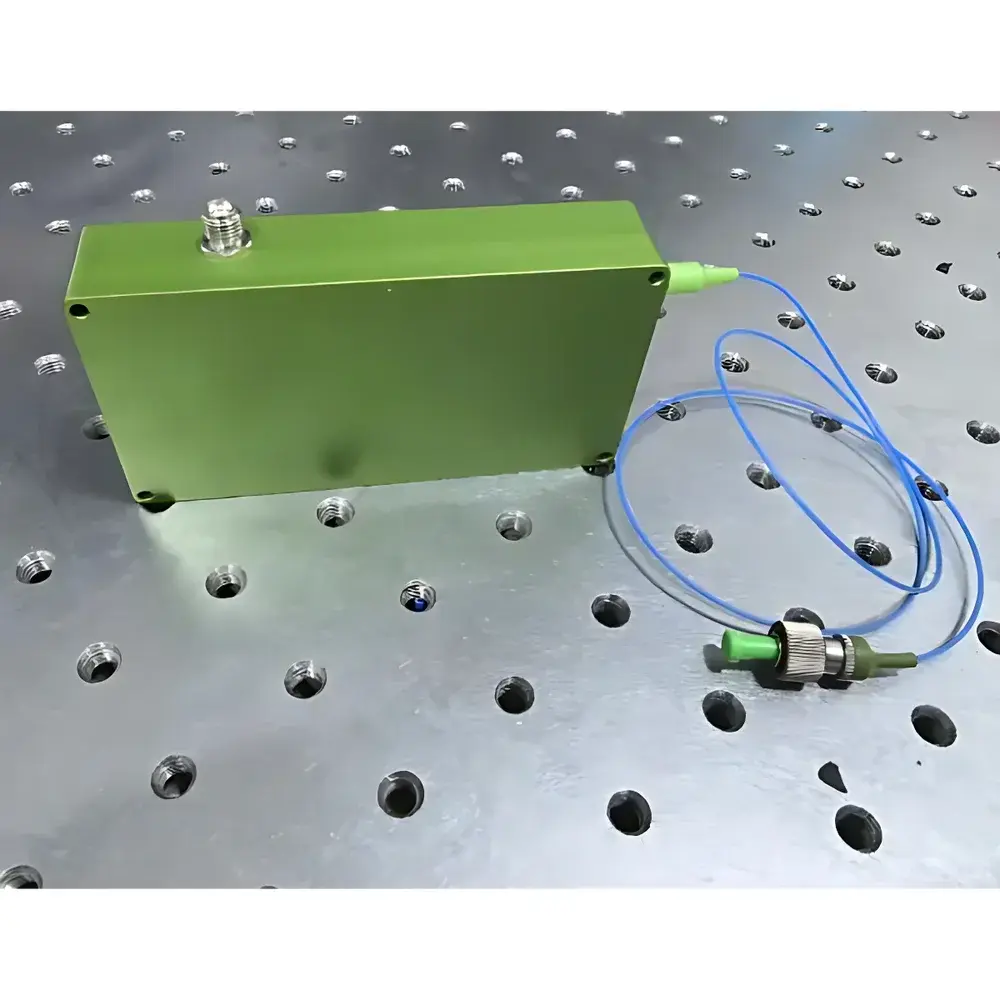
Auniontech AUL-CL-TL1550 Compact Tunable Single-Frequency Laser (C+L Band)
| Brand | Auniontech |
|---|---|
| Origin | Shanghai, China |
| Model | AUL-CL-TL1550 |
| Wavelength Range | 1527.6–1608.76 nm (C+L Band) |
| Tuning Range | 55 nm (C-band), 38.75 nm (L-band) |
| Linewidth | ≤15 kHz (typ.) |
| Output Power | +7 to +18 dBm (5–60 mW) |
| SMSR | ≥40 dB (typ. 55 dB) |
| OSNR | ≥40 dB (typ. 60 dB) |
| Frequency Accuracy | ±1.5 GHz |
| Frequency Resolution | 100 MHz (set), 1 MHz (fine tuning) |
| Fine Tuning Range | ±30 GHz |
| Wavelength Drift (No-Drift Mode) | <1 pm over 24 h |
| RIN | ≤−145 dB/Hz (10 MHz–1 GHz) |
| PER | ≥18 dB |
| Fiber Type | Panda-type PM fiber |
| Operating Temperature | 0–50 °C |
| Storage Temperature | −40–85 °C |
| Dimensions | 74 × 30 × 12 mm³ |
Overview
The Auniontech AUL-CL-TL1550 is a compact, externally cavity-stabilized tunable single-frequency laser engineered for high-precision optical measurement and sensing applications in the C+L telecommunications bands (1527.6–1608.76 nm). Leveraging mature telecom-grade semiconductor and external cavity design principles, this laser delivers narrow-linewidth (<15 kHz typ.), low-phase-noise emission with full C+L band coverage—enabling seamless wavelength scanning across 55 nm in the C-band and 38.75 nm in the L-band. Its architecture employs a temperature-stabilized distributed feedback (DFB) gain chip coupled with a high-finesse Littman-Metcalf grating cavity, ensuring mode-hop-free tuning and intrinsic frequency stability. Designed for integration into fiber-optic interferometric sensors, coherent LIDAR systems, and gas absorption spectroscopy platforms, the AUL-CL-TL1550 meets the stringent spectral purity and long-term repeatability requirements of metrology-grade instrumentation—notably supporting traceable calibration workflows under ISO/IEC 17025-aligned laboratory practices.
Key Features
- Mode-hop-free continuous scanning: Clean Scan functionality enables uninterrupted, high-resolution wavelength sweeps up to 300 GHz without mode jumps—critical for high-fidelity optical coherence tomography (OCT) and swept-source interferometry.
- Ultra-low noise operation: Whisper Mode reduces both amplitude (AM) and frequency (FM) noise floor by >15 dB below standard operation, achieving RIN ≤−145 dB/Hz and FM noise density <1 Hz²/Hz above 10 kHz—ideal for Pound-Drever-Hall locking and quantum optics experiments.
- Sub-picometer wavelength stability: No-Drift Mode maintains frequency deviation <±1 pm over 24 hours at constant ambient conditions, verified via integrated wavemeter feedback and thermal management with ±0.01 °C PID control.
- High-fidelity external modulation: Supports clean FM modulation up to 100 kHz and AM modulation up to 1 MHz with minimal sideband distortion—enabling precise heterodyne detection and dynamic line-shape analysis.
- Compact OEM-ready form factor: Encapsulated in a hermetically sealed 74 × 30 × 12 mm³ package with FC/APC-PM fiber output (PANDA type), optimized for space-constrained embedded systems and portable field-deployable instrumentation.
- Robust optical performance: Side-mode suppression ratio (SMSR) >40 dB (typ. 55 dB) and optical signal-to-noise ratio (OSNR) >40 dB (typ. 60 dB) ensure reliable operation in multi-path interference environments and dense wavelength-division multiplexed (DWDM) test configurations.
Sample Compatibility & Compliance
The AUL-CL-TL1550 is compatible with polarization-maintaining (PM) fiber-based optical setups, including Michelson, Mach-Zehnder, and Sagnac interferometers; fiber Bragg grating (FBG) and Fabry-Pérot sensor arrays; and free-space beam paths requiring collimated 1550 nm illumination. It complies with IEC 60825-1:2014 Class 1M laser safety requirements when used with appropriate fiber termination and interlocks. While not certified to FDA 21 CFR Part 11, its digital control interface supports audit-trail-capable software integration for GLP/GMP-aligned validation protocols. All spectral specifications are traceable to NIST-calibrated reference wavemeters and calibrated photodetectors per ISO/IEC 17025 procedures.
Software & Data Management
The laser ships with Auniontech’s TL-Control Suite—a Windows-based GUI application providing intuitive wavelength/frequency setpoint control, real-time power monitoring, and automated sweep sequencing. The suite supports SCPI command syntax over USB-CDC and RS-232 interfaces, enabling direct integration with LabVIEW, Python (PyVISA), MATLAB, and custom C/C++ instrument drivers. An optional SDK includes DLL libraries and example code for closed-loop wavelength stabilization using external photodiode feedback. Raw DAQ data—including instantaneous power, temperature, and piezo drive voltage—is timestamped with microsecond resolution and exportable in HDF5 or CSV formats for post-processing in scientific computing environments.
Applications
- Fiber-optic distributed acoustic sensing (DAS) and strain/temperature monitoring in oil & gas well logging;
- Coherent Doppler LIDAR for wind profiling, aerosol detection, and autonomous vehicle navigation;
- High-resolution absorption spectroscopy of trace gases (e.g., CH₄, CO₂, H₂O) using cavity-enhanced or photoacoustic techniques;
- Calibration source for optical spectrum analyzers (OSAs), wavelength meters, and DWDM channel testers;
- Seed laser for erbium-doped fiber amplifiers (EDFAs) and nonlinear frequency conversion stages;
- Research-grade interferometric displacement metrology and nanoscale vibration analysis.
FAQ
What is the guaranteed linewidth specification—and how is it measured?
The specified linewidth of ≤15 kHz (typ.) is measured via delayed self-heterodyne interferometry using a 25 km spool of SMF-28 fiber and a high-resolution RF spectrum analyzer (RBW ≤100 Hz). Measurement follows ITU-T G.698.2 Annex A guidelines.
Can the laser be operated in constant-power mode across the entire tuning range?
Yes—the internal APC loop maintains output power within ±0.05 dB over the full C+L band, compensated for gain tilt via programmable current and temperature lookup tables.
Is polarization extinction ratio (PER) maintained during wavelength tuning?
Yes—PER remains ≥18 dB across the entire tuning range due to integrated stress-engineered PM fiber pigtailing and alignment-insensitive collimation optics.
Does the device support analog modulation inputs for real-time frequency dithering?
Yes—analog FM and AM modulation inputs (0–5 V, 50 Ω) are provided on SMA connectors, supporting bandwidths up to 100 kHz (FM) and 1 MHz (AM) with <−40 dBc harmonic distortion.
What thermal management provisions exist for extended operation?
The unit incorporates a thermoelectric cooler (TEC) with dual-stage PID control, monitored by three embedded platinum RTDs. Ambient temperature compensation ensures stable operation from 0–50 °C without external chillers or forced air.





