
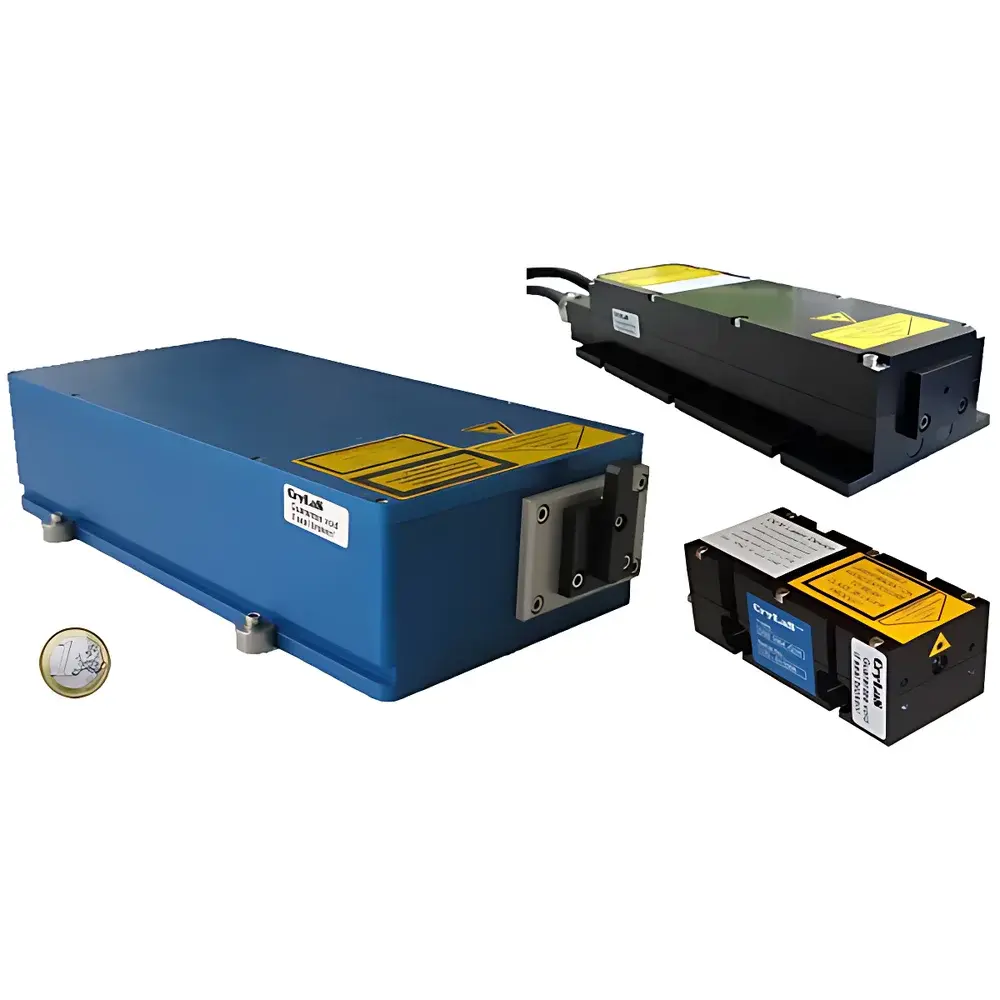
CrystaLaser FQSS 213-Q Nanosecond Q-Switched UV Laser System
| Brand | CrystaLaser |
|---|---|
| Origin | Germany |
| Manufacturer Type | Authorized Distributor |
| Origin Category | Imported |
| Model | FQSS 213-Q |
| Price Range | USD 1,400 – 7,200 (FOB) |
Overview
The CrystaLaser FQSS 213-Q is a compact, diode-pumped, passively Q-switched solid-state laser system engineered for high-repetition-rate nanosecond pulsed output at the deep ultraviolet wavelength of 213 nm. This fifth-harmonic generation (5HG) laser employs a Nd:YAG master oscillator followed by nonlinear frequency conversion stages—specifically, sequential second-harmonic generation (SHG), third-harmonic generation (THG), and sum-frequency mixing—to achieve stable, TEM00-mode UV emission. Designed for integration into demanding scientific and industrial platforms, the FQSS 213-Q delivers consistent pulse energy stability (< ±3% RMS over 8 hours), sub-nanosecond pulse widths (typically < 1.2 ns FWHM), and high beam quality (M² < 1.3). Its architecture supports both laboratory-scale instrumentation and OEM subsystem deployment in environments requiring precise UV photon delivery under controlled thermal and mechanical conditions.
Key Features
- Deep-UV output at 213 nm with average power up to 10 mW (at 1 kHz repetition rate)
- Passive Q-switching using Cr:YAG saturable absorber—no active electronics required for pulse formation
- Integrated closed-loop energy monitoring and real-time feedback control for pulse-to-pulse stability
- Compact monolithic design (140 × 80 × 60 mm) with integrated driver, cooling, and safety interlocks
- Flexible triggering: internal clock (1–5 kHz adjustable) or external TTL-compatible input (rising-edge sensitive)
- Operating modes: single-shot, burst (up to 10 pulses/burst), and continuous pulse train
- Beam specifications: collimated, circularized output; divergence < 1.5 mrad; pointing stability < 5 µrad/°C
- Compliant with IEC 60825-1:2014 Class 4 laser safety requirements; includes key-lock enable, emission indicator, and shutter interface
Sample Compatibility & Compliance
The FQSS 213-Q is compatible with standard optical tables, vacuum chambers (with optional UV-grade fused silica viewport coupling), and commercial mass spectrometry interfaces (e.g., MALDI ion sources with grounded or RF-biased targets). Its 213 nm output exhibits strong absorption in organic matrices, polymers, and biological tissues—enabling efficient ablation, desorption, and photochemical dissociation without significant thermal diffusion. The system conforms to ISO 11146-1:2019 (laser beam parameters), EN 61000-6-3:2019 (EMC emissions), and meets essential requirements of the EU Machinery Directive 2006/42/EC when integrated into host equipment. For regulated analytical workflows—including clinical proteomics or pharmaceutical impurity profiling—the laser’s pulse timing jitter (< 500 ps) and energy reproducibility support GLP-compliant data acquisition when paired with time-stamped detectors.
Software & Data Management
The FQSS 213-Q operates via RS-232 or USB-C digital interface, supporting ASCII command protocol for remote parameter configuration (repetition rate, burst count, delay settings). Optional CrystaLaser Control Suite (v3.2+) provides GUI-based monitoring of pulse energy history, temperature logs, and diagnostic fault codes—including pump diode current, crystal temperature, and shutter status. All operational events are timestamped with microsecond resolution and exportable as CSV or HDF5 files. Audit trail functionality satisfies FDA 21 CFR Part 11 requirements when deployed in GMP-regulated laboratories, provided the host PC implements electronic signature and role-based access controls.
Applications
- Laser-Induced Breakdown Spectroscopy (LIBS) for elemental analysis of conductive/non-conductive solids, aerosols, and liquids
- Matrix-Assisted Laser Desorption/Ionization Time-of-Flight (MALDI-TOF) mass spectrometry—particularly for small-molecule and peptide profiling where 213 nm minimizes matrix fragmentation
- UV photolysis studies of atmospheric chemistry, radical kinetics, and photostability testing per ISO 4892-3
- Laser capture microdissection (LCM) systems requiring diffraction-limited spot size (< 5 µm) and minimal collateral thermal damage
- Interferometric surface metrology and holographic recording using coherent 213 nm illumination
- OEM integration into semiconductor inspection tools, thin-film ablation platforms, and portable LIBS analyzers
FAQ
What is the maximum achievable pulse energy at 213 nm?
Typical pulse energy is 10–12 µJ at 1 kHz; maximum single-pulse energy reaches ~15 µJ under optimized thermal management.
Is water-cooling required?
No—air-cooling via integrated thermoelectric cooler (TEC) and heat pipe assembly is sufficient for continuous operation within ambient temperatures of 15–30 °C.
Can the laser be synchronized with external detectors?
Yes—TTL-compatible sync output (5 V, 50 Ω) provides pulse timing reference with < 2 ns jitter relative to optical output.
Does the system include beam delivery optics?
The base configuration includes collimation optics only; UV-grade focusing lenses, fiber coupling adapters, or harmonic separation filters are available as configurable options.
What maintenance intervals are recommended?
No routine optical alignment is required; annual verification of pulse energy calibration and thermal sensor accuracy is advised per ISO/IEC 17025 guidelines.





