
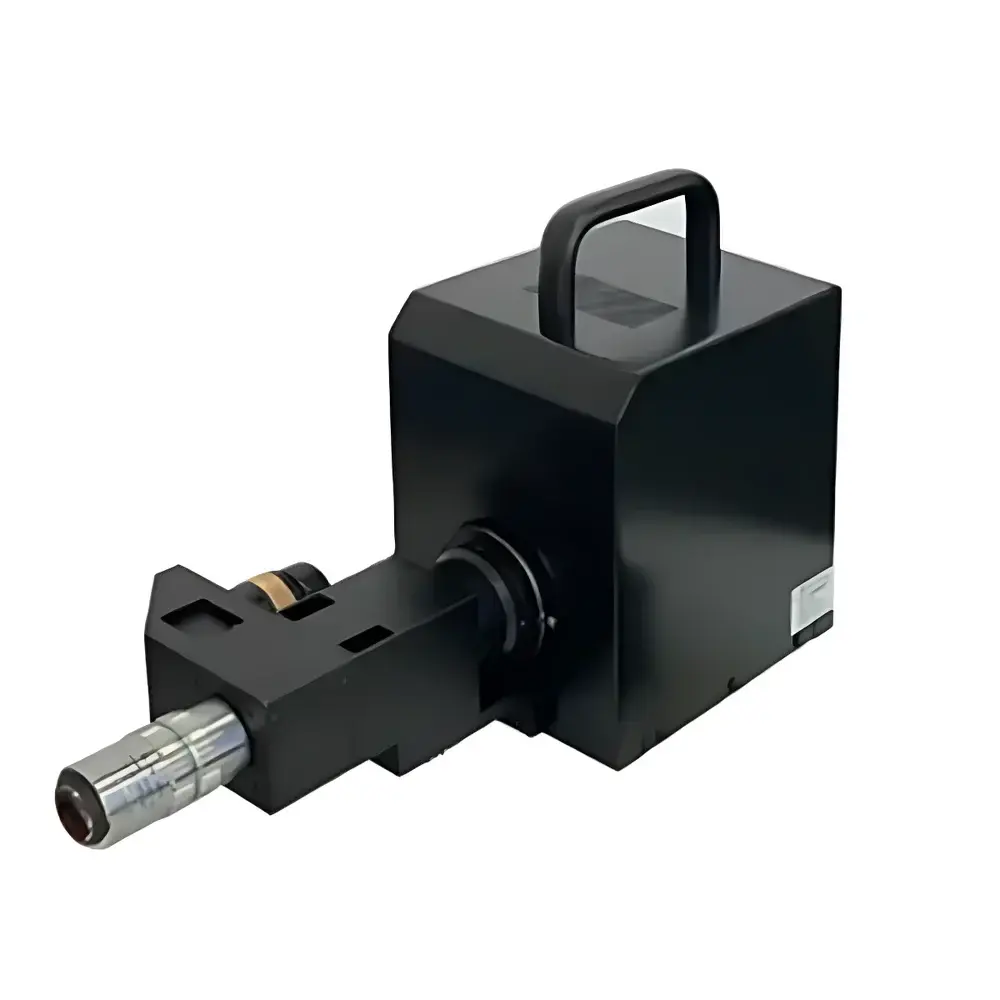
Auniontech AUS-2000 Spectral Imaging Luminance and Chromaticity Analyzer
| Brand | Auniontech |
|---|---|
| Origin | Shanghai, China |
| Model | AUS-2000 |
| Sensor Resolution | 20 MP |
| Measurement Principle | Spectral imaging + CIE 1931 XYZ tristimulus integration |
| Calibration Support | Factory pre-calibration + user-executable spectral recalibration |
| Compliance | ISO/CIE-compliant photometric and colorimetric evaluation |
| Application Scope | FPD, automotive displays, BLU, Micro-LED, Micro-OLED, Mini-LED, OLED, LCD |
Overview
The Auniontech AUS-2000 Spectral Imaging Luminance and Chromaticity Analyzer is an advanced optical measurement instrument engineered for high-fidelity spatial photometry and spectrally resolved colorimetry. Unlike conventional imaging colorimeters that rely on filtered RGB sensor responses, the AUS-2000 integrates a calibrated imaging spectrometer with a high-resolution monochrome CMOS sensor (20 megapixels), enabling simultaneous acquisition of full spectral radiance data (typically 380–780 nm at ~1 nm resolution) across every pixel in the field of view. This architecture supports traceable CIE 1931 XYZ tristimulus value computation, chromaticity coordinates (x, y, u′, v′), luminance (cd/m²), correlated color temperature (CCT), and dominant wavelength—each spatially mapped with sub-pixel registration accuracy. The system is designed for applications demanding both metrological rigor and spatial fidelity, including display qualification, uniformity analysis, and defect detection in next-generation emissive and transmissive panels.
Key Features
- Spectral imaging core: Integrated imaging spectrometer with calibrated spectral response, enabling pixel-level spectral radiance reconstruction and post-acquisition reweighting under different illuminant or observer conditions.
- 20-megapixel spatial resolution: Enables detailed mapping of luminance and chromaticity gradients across large-area displays (e.g., 12.3″ automotive clusters or 65″ UHD panels) without tiling or stitching artifacts.
- Automated exposure control: Real-time histogram-based exposure optimization ensures optimal signal-to-noise ratio across heterogeneous luminance regions (e.g., active black levels vs. peak white).
- Synchronization interface: TTL/trigger input supports frame-locked acquisition with display driving electronics, minimizing temporal aliasing and flicker-induced measurement variance.
- Flexible region-of-interest (ROI) definition: Users can define arbitrary polygons, grids, or point arrays for statistical reporting (mean, min/max, std dev, Δu′v′, ΔE00) per ROI.
- Pseudocolor visualization engine: Built-in false-color overlays for luminance (log-scale cd/m²) and chromaticity deviation (Δu′v′), supporting rapid visual assessment of uniformity and Mura defects.
Sample Compatibility & Compliance
The AUS-2000 is validated for direct measurement of self-emissive and backlit displays under controlled ambient conditions (Class I photometric environment recommended). It supports standard test patterns (e.g., full-white, quarter-white, crosshair, checkerboard) per VESA DisplayHDR, ISO 9241-307, and JEITA CP-3406. Its spectral calibration traceability aligns with CIE S 026/E:2015 and ISO/CIE 11664 series standards for colorimetry. While not inherently FDA 21 CFR Part 11 compliant out-of-the-box, audit-ready data export (CSV, HDF5, TIFF) and optional software logging modules support GLP/GMP-aligned workflows in regulated R&D and production QA environments.
Software & Data Management
The bundled AUS-Control Suite provides a deterministic, scriptable interface for automated test sequences, batch processing, and pass/fail thresholding. All raw spectral cubes (λ × x × y) and derived photometric maps are stored with embedded metadata (exposure time, integration time, lens ID, calibration timestamp, user-defined tags). Export formats include ANSI-compliant CSV for statistical process control (SPC), multi-layer TIFF for image analysis platforms (e.g., MATLAB, Python OpenCV), and HDF5 for scalable archival. Optional SDK (C++/Python) enables integration into factory automation systems (SECS/GEM, OPC UA) and custom dashboard development.
Applications
- Quantitative uniformity assessment of Micro-LED, Micro-OLED, and Mini-LED displays—including pixel-level luminance variation, chromaticity shift with viewing angle, and thermal drift profiling.
- Mura detection and classification via spatial gradient analysis and chromaticity clustering algorithms applied to u′v′ deviation maps.
- Backlight unit (BLU) characterization: hotspot identification, edge-lit vs. direct-lit uniformity comparison, and phosphor aging monitoring via spectral centroid tracking.
- FPD yield analysis: correlation of spatial photometric outliers with electrical test data (e.g., TFT leakage, driver IC mismatch) using synchronized coordinate referencing.
- R&D validation of HDR tone mapping, local dimming algorithms, and wide-gamut rendering pipelines under perceptually uniform color spaces (e.g., CIELAB, CAM16-UCS).
FAQ
Does the AUS-2000 require periodic recalibration? Why?
Yes—annual spectral recalibration against NIST-traceable standards is recommended to maintain CIE-compliant photometric accuracy; the integrated spectrometer’s responsivity drifts <0.15%/year under typical lab conditions.
Can the AUS-2000 measure angular-dependent color shifts?
Yes, when mounted on a motorized goniometer stage (optional accessory), it captures full 2D angular distribution data (Lv(θ,φ), CIE x(θ,φ), y(θ,φ)) compliant with CIE 127:2007 Annex B.
Is raw spectral data accessible for custom analysis?
Yes—every acquired frame includes a full hyperspectral data cube (wavelength × horizontal pixels × vertical pixels), exported in vendor-neutral HDF5 format with calibrated radiance units (W·sr⁻¹·m⁻²·nm⁻¹).
How does the AUS-2000 handle high-dynamic-range display measurements?
Through multi-exposure bracketing and pixel-wise HDR fusion, extending effective dynamic range beyond 1,000,000:1 while preserving chromaticity integrity across intensity levels.
What lens options are supported?
Standard telecentric lenses (f = 50 mm, 100 mm, 200 mm) optimized for display metrology; custom focal lengths and working distances available upon request.




