HengaoDe H18390 Triple-Station Stainless Steel Vacuum Filtration Assembly
| Brand | HengaoDe |
|---|---|
| Origin | Beijing, China |
| Manufacturer Type | Authorized Distributor |
| Country of Origin | China |
| Model | H18390 |
| Price | USD 75 (FOB) |
Overview
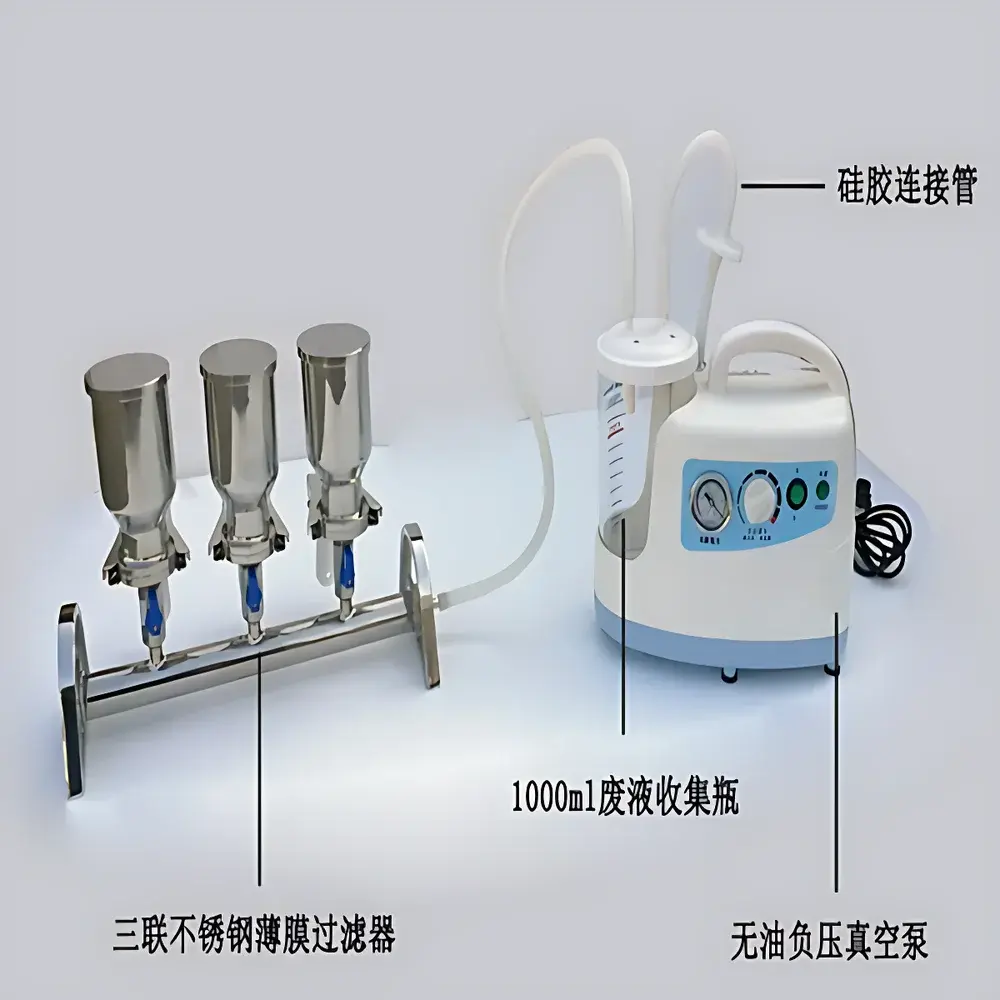
The HengaoDe H18390 Triple-Station Stainless Steel Vacuum Filtration Assembly is an engineered laboratory solution for parallel or sequential vacuum-assisted liquid filtration. Designed for high-throughput analytical workflows, it operates on the principle of controlled negative pressure applied across multiple independent filtration channels—each equipped with a dedicated valve and pressure-regulated inlet. This architecture enables precise, reproducible separation of particulates, precipitates, or microbial cells from aqueous or organic solvents without cross-contamination. Unlike single-station systems, the triple-station configuration reduces total assay time by up to 67% when processing matched sample sets—a critical advantage in QC labs performing ASTM D4177-compliant filtrate clarity testing or ISO 7218 microbiological membrane filtration. The unit integrates seamlessly into GLP-compliant environments where traceability, material compatibility, and operational consistency are mandated.
Key Features
- Three independent stainless steel filtration stations with individual quarter-turn isolation valves—enabling selective operation of one, two, or all three channels without system depressurization.
- Structural integrity ensured by 2 mm-thick SUS304 stainless steel filter cups and 4 mm-walled industrial-grade tubing; surface-finished to Ra ≤ 0.4 µm via mirror polishing for full cleanability and autoclave compatibility (121°C, 20 min).
- Integrated vacuum regulation: analog negative pressure gauge (range: 0–760 mmHg) paired with a continuously adjustable needle valve for fine-tuned suction control—critical for delicate samples such as protein aggregates or fragile biofilms.
- Overflow protection mechanism prevents backflow into the vacuum source; coupled with a high-efficiency oil-free piston pump delivering ≥60 L/min free-air displacement and ultimate vacuum ≤5 mbar.
- Thermal safety circuit automatically interrupts power if internal temperature exceeds 65°C; resumes operation only after passive cooling to ≤45°C—eliminating risk of thermal degradation to gasket materials or filter membranes.
Sample Compatibility & Compliance
The H18390 accommodates standard 47 mm or 50 mm diameter membrane filters (cellulose acetate, PVDF, PTFE, nylon) and accepts common glass or polypropylene filter flasks (100–1000 mL). Its inert wetted path complies with USP for extractables profiling and meets FDA 21 CFR Part 11 requirements when used with validated electronic lab notebooks (ELN) for audit-trail documentation. The assembly supports method validation per ISO/IEC 17025:2017 for filtration efficiency testing (e.g., turbidity reduction, particle retention at ≥0.22 µm), and is routinely deployed in pharmaceutical water system monitoring (USP ) and environmental wastewater analysis (EPA Method 1603).
Software & Data Management
While the H18390 is a hardware-only filtration platform (no embedded firmware), its pressure-regulation interface and modular design enable integration with third-party vacuum controllers (e.g., KNF N86 KT.18) equipped with RS232 or analog 4–20 mA output. When paired with validated data acquisition software (e.g., LabVIEW 2022 SP1 with IEC 62443-3-3 cybersecurity certification), real-time vacuum stability logs, valve actuation timestamps, and operator ID tracking satisfy ALCOA+ data integrity criteria. Calibration records—including annual verification of pressure gauge linearity (±1.5% FS per ISO 9001:2015 Annex A.7) and leak-rate testing (<1 × 10⁻³ mbar·L/s)—are maintained in accordance with GMP Annex 11.
Applications
- Pharmaceutical: Sterile filtration validation, endotoxin removal studies, and bioburden testing per USP using membrane-based microbial recovery.
- Environmental: EPA-approved suspended solids (TSS) quantification in wastewater effluents and drinking water sources.
- Food & Beverage: Yeast and mold enumeration in juice concentrates per AOAC 977.27; clarification of fermentation broths prior to HPLC analysis.
- Academic Research: Parallel preparation of nanoparticle dispersions for DLS characterization, or solvent exchange in MOF synthesis protocols.
- Quality Control Labs: Routine filter integrity testing (bubble point, diffusion rate) for process validation under ISO 13408-2.
FAQ
Is the H18390 compatible with aggressive solvents such as chloroform or concentrated nitric acid?
Yes—SUS304 stainless steel provides resistance to oxidation and pitting in most organic solvents and dilute mineral acids. For prolonged exposure to >30% HNO₃ or halogenated hydrocarbons, consult the material compatibility chart (per ASTM G128) and consider optional electropolished finishing.
Can the unit be sterilized in an autoclave?
All stainless steel components (cups, manifolds, tubing) withstand standard autoclaving cycles (121°C, 15 psi, 20 min). Silicone gaskets require replacement after ≥5 cycles; Viton® O-rings are recommended for extended steam exposure.
What vacuum pumps are certified for use with this assembly?
Oil-free diaphragm pumps meeting ISO 8573-1 Class 0 purity (e.g., KNF N86, Welch 2055) are validated. Rotary vane pumps are not recommended due to oil mist contamination risk.
Does the system include filter membranes or flasks?
No—the H18390 is supplied as a complete filtration manifold only. Compatible 47 mm filter holders, glass flasks, and sterile membranes must be procured separately per application-specific requirements.
How often does the pressure gauge require recalibration?
Annual calibration against a NIST-traceable deadweight tester is required. Field verification using a calibrated digital manometer (±0.1% FS) is recommended before each high-stakes validation run.
Related Products