
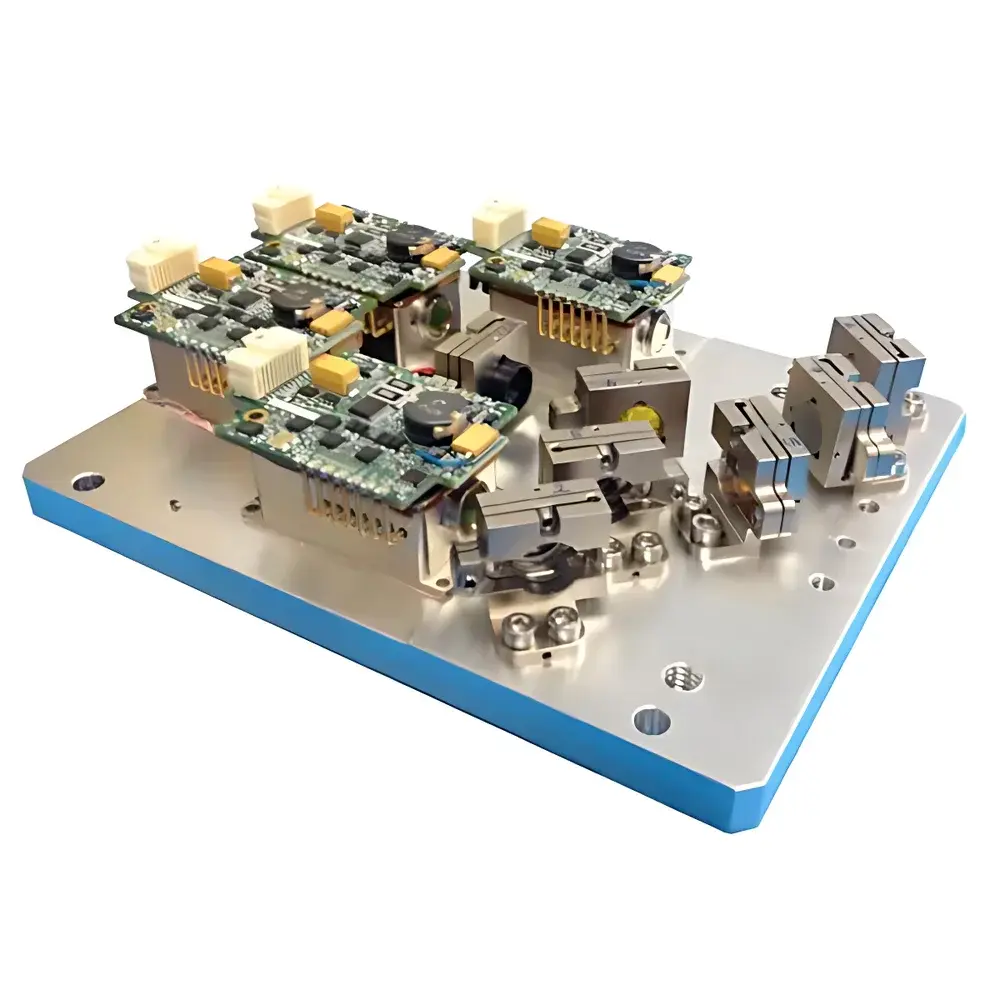
Auniontech LT-M & mQCL Tunable Pulsed Mid-Infrared External Cavity Quantum Cascade Laser (EC-QCL) System
| Brand | Auniontech |
|---|---|
| Origin | Shanghai, China |
| Model | LT-M / mQCL |
| Wavelength Range | 5.4–12.8 µm |
| Spectral Linewidth | <2 cm⁻¹ |
| Spectral Accuracy/Repeatability | <2 cm⁻¹ / <±0.5 cm⁻¹ (LT-M), <±0.2 cm⁻¹ (mQCL) |
| Max Peak Power | 150 mW (LT-M, 4-tuner) |
| Avg. Power | 0.5–20 mW (8% duty cycle) |
| Pulse Width | 20–300 ns |
| Repetition Rate | up to 3 MHz (LT-M, water-cooled), up to 1 MHz (mQCL) |
| Beam Profile | TEM₀₀ (mQCL), single spatial mode (LT-M) |
| Beam Dimensions | 2 mm × 4 mm, collimated |
| Polarization | Vertical, extinction ratio >100:1 |
| Tuning Modes | Static, Step Tune (<1 ms for 10 cm⁻¹ step), Sweep Tune (>25 cm⁻¹/ms linear scan) |
| Triggering | Internal, external, direct pulse control |
| Power Stability | <5% pulse-to-pulse (typ.), <0.05% over 10 ms @1 MHz (LT-M) |
| Wavenumber Stability | <±0.2 cm⁻¹ over 1 hr @25°C (mQCL) |
| Temp. Coefficients | <±0.01% / °C (power), <0.01 cm⁻¹ / °C (wavenumber) |
| Package Dimensions | LT-M: 6.25″ × 5″ × 4.9″ |
| mQCL | 7″ × 5″ × 5″ |
| Cooling | Integrated fan (LT-M), thermally managed enclosure (mQCL) |
Overview
The Auniontech LT-M and mQCL series are benchtop and OEM-integrated tunable pulsed mid-infrared external cavity quantum cascade lasers (EC-QCLs), engineered for high-fidelity, high-speed spectroscopic analysis across the 5.4–12.8 µm spectral window. Operating on the principle of intersubband transitions in engineered semiconductor heterostructures, these lasers deliver narrow-linewidth (<2 cm⁻¹), polarization-maintained, diffraction-limited output with precise electronic and mechanical wavelength control via a rotating diffraction grating within a Littrow-configuration external cavity. Unlike broadband thermal sources or Fourier-transform infrared (FTIR) systems, EC-QCLs function as pre-dispersed, wavelength-agile illumination sources—each laser pulse is spectrally defined *prior* to interaction with the sample, enabling shot-noise-limited detection, rapid spectral acquisition, and immunity to ambient stray light. This architecture supports both discrete-wavelength targeting and continuous wavenumber sweeps at rates exceeding 25 cm⁻¹/ms, making it ideal for time-resolved absorption spectroscopy, standoff chemical sensing, and real-time multicomponent gas analysis.
Key Features
- Wide, continuous tuning range spanning 5.4–12.8 µm (1750–1850 cm⁻¹), covering fundamental vibrational bands of critical analytes including NO, CO, CH₄, NH₃, H₂O, VOCs, explosives (e.g., PETN, RDX), chemical warfare agent simulants (e.g., DMMP, methyl salicylate), and biomarkers (e.g., acetone, ammonia, isoprene)
- High spectral fidelity: <2 cm⁻¹ linewidth and <±0.5 cm⁻¹ absolute wavenumber repeatability (LT-M); <±0.2 cm⁻¹ long-term stability (mQCL) under controlled thermal conditions
- Pulsed operation with adjustable width (20–300 ns), repetition rate (up to 3 MHz), and duty cycle (up to 8%), optimized for lock-in detection, photoacoustic spectroscopy, and heterodyne measurements
- TEM₀₀ (mQCL) or single-spatial-mode (LT-M) collimated output (2 × 4 mm), vertically polarized (extinction ratio >100:1), with pointing stability <5 µrad RMS over 8 hours
- Three operational modes: Move Tune (manual), Step Tune (discrete wavenumber selection with <1 ms settling per 10 cm⁻¹ step), and Sweep Tune (linear, programmable scans)
- Integrated triggering architecture: internal clock, TTL-compatible external trigger input, and direct pulse gating for synchronization with detectors, modulators, or data acquisition systems
- Compact, fan-cooled (LT-M) or thermally managed (mQCL) packaging—designed for laboratory deployment, field-portable instrumentation, and OEM integration into handheld or UAV-mounted chemical detection platforms
Sample Compatibility & Compliance
These EC-QCL systems are compatible with transmission, reflection, attenuated total reflectance (ATR), and photoacoustic sampling configurations for gases, liquids, thin films, and solid surfaces. They support non-contact, non-destructive interrogation without sample preparation—enabling direct headspace analysis of sealed containers, in situ monitoring of industrial exhaust streams, and real-time breath analysis. The systems comply with IEC 60825-1:2014 (laser safety Class IV), RoHS Directive 2011/65/EU, and CE marking requirements. For regulated environments—including GLP/GMP-compliant laboratories and FDA-regulated diagnostic development—the mQCL platform supports optional audit-trail-enabled firmware and timestamped spectral metadata export, facilitating alignment with 21 CFR Part 11 principles when integrated with validated software stacks.
Software & Data Management
Both LT-M and mQCL platforms ship with LaserTune™ control software (Windows-based), offering GUI-driven wavelength selection, scan programming, pulse parameter configuration, and real-time power monitoring. APIs (C/C++, Python, LabVIEW) enable full automation and integration into custom spectroscopic workflows. Spectral data are exported in standardized formats (CSV, HDF5) with embedded calibration metadata—including wavenumber axis, pulse timing stamps, detector synchronization signals, and environmental sensor readings (optional). When deployed in multi-laser arrays or hyperspectral imaging systems, the software supports spectral library matching using least-squares fitting, principal component analysis (PCA), and supervised machine learning models trained on reference absorption cross-sections (e.g., HITRAN, NIST databases).
Applications
- Standoff Chemical Detection: Identification of trace vapors and surface residues of explosives, TICs, and CWAs at distances up to 300 m using reflective IR spectroscopy and multivariate pattern recognition algorithms
- Medical Breathomics: Quantitative detection of disease-associated volatiles (e.g., NO in asthma, acetone in diabetes, aldehydes in lung cancer) with sub-ppb sensitivity and second-scale measurement cycles
- Industrial Process Control: In-line monitoring of combustion byproducts (NO, CO, unburnt hydrocarbons) in furnaces, turbines, and incinerators; real-time feedback for emission compliance (EPA Method 320, ISO 12039)
- Environmental Monitoring: Open-path atmospheric sensing of greenhouse gases (CH₄, N₂O) and urban pollutants (ozone precursors, aromatic VOCs) using dual-laser differential absorption techniques
- Biomedical Imaging: High-contrast mid-IR microscopy of tissue sections and live cells—leveraging strong water absorption contrast and lipid/protein vibrational signatures without staining or fixation
- Materials Characterization: Surface contaminant mapping on semiconductors, pharmaceutical tablets, and polymer films via QCL-based reflection-absorption FTIR hybrid modalities
- Fundamental Research: Time-resolved kinetics of transient species (e.g., iC₄H₈ post-shock) in shock tubes and plasma reactors using high-bandwidth absorption spectroscopy
FAQ
What distinguishes an EC-QCL from a DFB-QCL or an FTIR source?
EC-QCLs provide broad, continuous tunability with high spectral brightness and narrow linewidth—unachievable with fixed-wavelength DFB-QCLs or low-brightness thermal sources. Unlike FTIR, which disperses broadband light after interaction, EC-QCLs deliver pre-selected monochromatic pulses, enabling higher signal-to-noise ratios, faster acquisition, and immunity to scattering artifacts.
Can these lasers be integrated into portable or battery-operated instruments?
Yes—the mQCL variant is specifically designed for SWaP-constrained applications. Its thermally managed enclosure, low-voltage DC input (24 V), and absence of cryogenic cooling enable seamless integration into handheld chemical identifiers and drone-mounted surveillance systems.
Do you provide spectral calibration services or certified reference spectra?
Auniontech offers NIST-traceable wavenumber calibration using stabilized gas cells (e.g., N₂O, CO) and provides spectral response characterization reports. Custom calibration against user-specific analyte libraries is available upon request.
Is laser-induced fluorescence or photothermal interference a concern in biological samples?
No—QCLs operate in the mid-IR, where electronic excitation and autofluorescence are negligible. Their high photon energy per pulse (vs. NIR) enables strong vibrational excitation without photodamage, and their narrow bandwidth avoids spectral overlap with endogenous fluorophores.
What level of technical support is provided for OEM integration?
Auniontech supplies comprehensive integration kits—including mechanical mounting interfaces, electrical pinout schematics, FPGA-ready timing diagrams, and application notes for common detection modalities (lock-in, PAS, MCT, InSb)—alongside direct engineering consultation for system-level validation and regulatory documentation support.






