
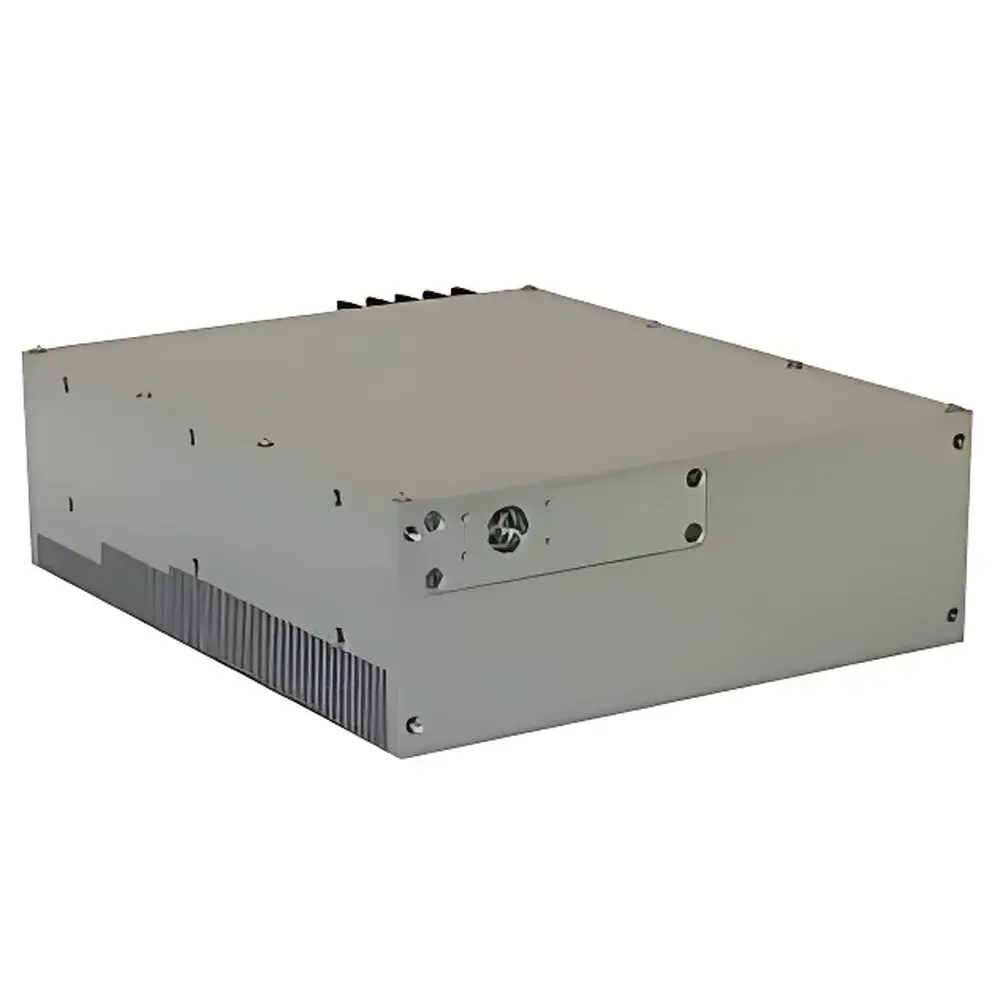
Bright Solutions Wedge HB/XB/HF/XF Series Nanosecond Q-Switched DPSS Lasers
| Brand | Bright Solutions |
|---|---|
| Origin | Italy |
| Type | Diode-Pumped Solid-State (DPSS) Q-Switched Laser |
| Wavelengths | 1064 nm, 532 nm, 355 nm |
| Pulse Width | 500 ps – 3 ns |
| Max Pulse Energy | 4 mJ |
| Max Peak Power | 4 MW |
| Repetition Rate | Single-shot to 100 kHz |
| Beam Quality (M²) | <1.5–2.0 |
| Cooling | Air-cooled with thermostatic fan |
| Footprint | 8 × 9 × 19 cm (XF/HF) to 26 × 25 × 10 cm (HB/XB) |
| Weight | 2–10 kg |
| Polarization | Linear (>100:1), optional circular |
Overview
The Bright Solutions Wedge series comprises a family of compact, diode-pumped solid-state (DPSS) nanosecond Q-switched lasers engineered for high-reliability operation in industrial, scientific, and defense environments. Leveraging Bright Solutions’ proprietary fast electro-optic Q-switching technology, these lasers deliver precise temporal control over pulse generation—enabling sub-nanosecond to low-nanosecond pulse widths (down to <500 ps) with exceptional shot-to-shot stability and minimal timing jitter. The core architecture integrates a Nd:YAG or Nd:YVO₄ gain medium with intracavity harmonic generation, supporting fundamental output at 1064 nm and harmonics at 532 nm and 355 nm. Unlike flashlamp-pumped systems, the fully diode-pumped design ensures low thermal load, high wall-plug efficiency, and long-term power stability—critical for applications demanding consistent ablation thresholds or time-resolved signal acquisition.
Key Features
- High pulse energy up to 4 mJ (Wedge HB @ 1064 nm) with peak power exceeding 4 MW
- Flexible pulse duration: configurable from <500 ps (Wedge XF/HF) to <1.5 ns (Wedge HB/XB), optimized for material interaction studies and nonlinear conversion efficiency
- Repetition rate range spanning single-shot triggering to continuous burst modes at up to 100 kHz (Wedge HF/XF), programmable via TTL or analog input
- Fully air-cooled operation with intelligent thermostatic fan control—no external chiller or water lines required
- Robust monolithic mechanical design with vibration-damped housing; qualified for operation in ambient temperatures from 15 °C to 35 °C and relative humidity ≤80% non-condensing
- Beam quality maintained at M² < 1.5 (Wedge HF/XF) and < 2.0 (Wedge HB/XB), enabling tight focusing for high-intensity microprocessing
- Polarization extinction ratio >100:1 (linear); optional circular polarization module available for isotropic material processing
Sample Compatibility & Compliance
The Wedge platform is compatible with a broad spectrum of optically transparent and absorbing materials—including fused silica, borosilicate glass, sapphire, silicon wafers, polymer films, and biological tissues—making it suitable for both research-grade characterization and production-line integration. All models comply with IEC 60825-1:2014 (Laser Product Safety) and are CE-marked per Directive 2014/30/EU (EMC) and 2014/35/EU (LVD). For regulated environments—including ISO 13485-certified medical device manufacturing or GLP-compliant spectroscopic analysis—the system supports optional hardware-based interlock interfaces and firmware logging aligned with FDA 21 CFR Part 11 requirements for electronic records and signatures.
Software & Data Management
Laser operation is managed through Bright Solutions’ proprietary Wedge Control Suite—a Windows-based application providing real-time monitoring of pulse energy, repetition rate, internal temperature, and Q-switch trigger status. The software enables full remote configuration via USB 2.0 or RS-232, supports scripting (Python/LabVIEW SDK included), and exports timestamped measurement logs in CSV format for traceability. Optional OEM integration kits include TTL-synchronized digital outputs for synchronization with high-speed cameras, spectrometers, or scanning galvanometers—ensuring phase-locked data capture in LIBS, LIDAR, or time-of-flight mass spectrometry setups.
Applications
- Glass internal engraving: Sub-surface modification using tightly focused 1064 nm pulses induces controlled micro-fracture networks without surface damage
- Thin-film removal & selective ablation: Precise energy deposition enables layer-by-layer removal of ITO, DLC, or photoresist with minimal substrate heating
- LIDAR & rangefinding: High peak power and short pulse width yield superior spatial resolution and signal-to-noise ratio in eye-safe 1550 nm OPO-pumped configurations
- Laser-induced breakdown spectroscopy (LIBS): Stable pulse-to-pulse energy (<±1.5% RMS) ensures reproducible plasma generation for quantitative elemental analysis
- Nonlinear optics pumping: Harmonic generation (SHG, THG) and optical parametric oscillation (OPO) benefit from narrow spectral bandwidth (<0.1 nm FWHM) and Gaussian spatial profile
- Terahertz generation: Phase-matched difference-frequency mixing in ZnTe or DAST crystals requires precisely timed, polarized picosecond–nanosecond pulses
FAQ
What is the typical pulse-to-pulse energy stability for Wedge lasers?
Energy stability is specified as ≤±1.5% RMS over 8 hours under constant ambient conditions, measured with a calibrated pyroelectric sensor traceable to NIST standards.
Can the Wedge laser be synchronized with external equipment?
Yes—each model provides TTL-compatible sync output (rise time <5 ns) and accepts external trigger signals with adjustable delay (0–100 ms, 10 ns resolution).
Is beam pointing stability guaranteed over temperature variation?
Beam pointing drift is limited to <5 µrad/°C within the operational temperature range, verified by collimated beam profiling over 24-hour thermal cycling.
Are OEM integration services available?
Bright Solutions offers custom mechanical mounting solutions, electrical interface redesign, and firmware-level API development for embedded system integration.
Does the laser support wavelength tuning?
Fixed-wavelength operation only; however, third-harmonic (355 nm) and fourth-harmonic (266 nm) modules are available as add-on options for select models.



