
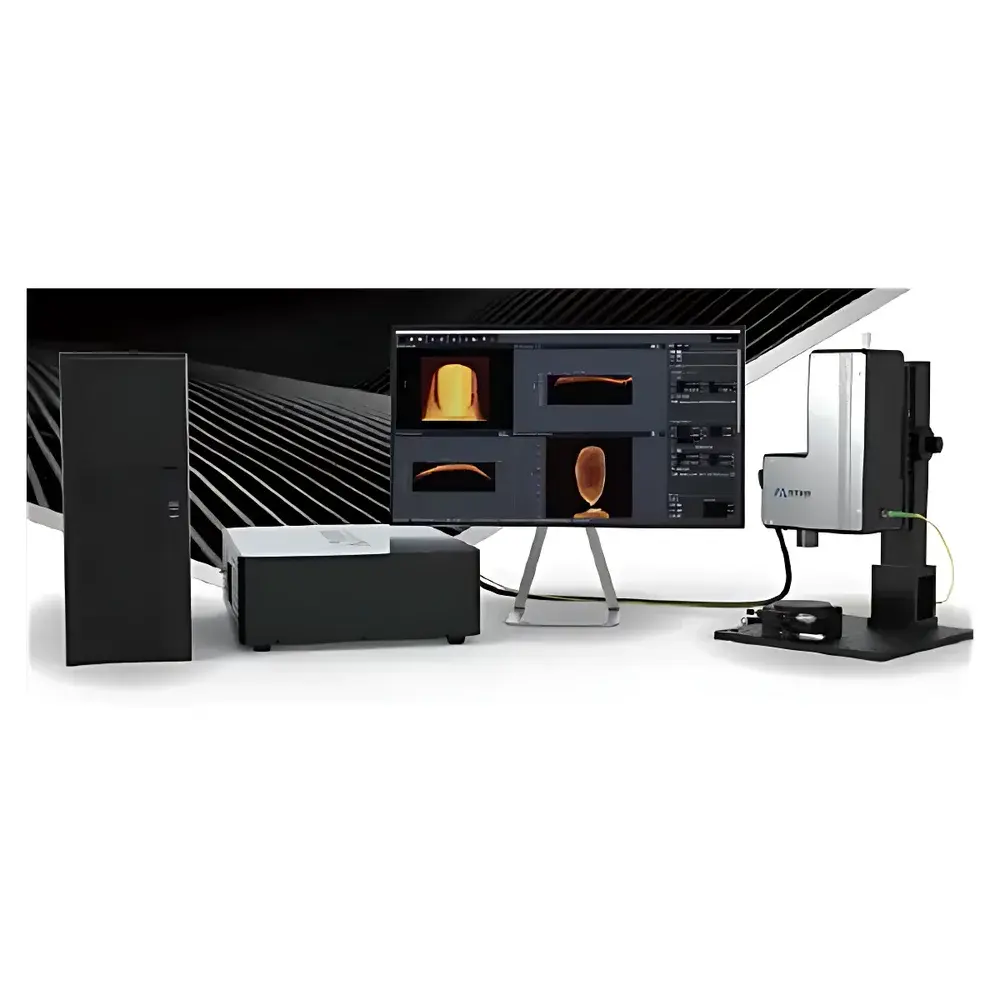
Auniontech LingMou OCT-3D High-Precision Optical Coherence Tomography Imaging System
| Brand | Auniontech |
|---|---|
| Origin | Shanghai, China |
| Model | OCT-3D |
| Type | Spectral-Domain & Full-Field Swept-Source OCT System |
| Central Wavelengths | 775 nm (FF-SS-OCT), 840–870 nm (SD-OCT) |
| Axial Resolution | 3.2–16 µm (air) |
| Imaging Depth (air) | 2.15–11.3 mm |
| A-scan Rate | up to 248 kHz (SD-OCT) |
| Full-field frame rate | up to 2100 Hz (FF-SS-OCT) |
| Lateral Resolution | 3.5–10 µm |
| Scan Range | 5×5 to 28.9×28.9 mm² |
| Software | LM-OCT Suite with real-time 3D rendering, multi-planar reformatting (XY/YZ/XZ), contrast adjustment, and raw data export (HDF5, TIFF, CSV) |
| Compliance | Designed for ISO/IEC 17025-aligned lab environments |
Overview
The Auniontech LingMou OCT-3D High-Precision Optical Coherence Tomography Imaging System is a dual-modality platform engineered for non-contact, label-free, micrometer-scale 3D structural imaging of transparent and semi-transparent materials. It implements two complementary OCT architectures: Spectral-Domain OCT (SD-OCT) for high-speed point-scanning volumetric acquisition, and Full-Field Swept-Source OCT (FF-SS-OCT) for parallel en-face imaging with accelerated volumetric throughput. Both modalities rely on low-coherence interferometry—exploiting broadband light sources and interference fringe analysis—to quantify optical path length differences between reference and sample arms. This enables depth-resolved backscattering intensity mapping without physical sectioning or staining. The system resolves sub-surface features—including layer interfaces, delaminations, voids, coating thickness gradients, and microstructural inhomogeneities—with axial resolutions ranging from 3.2 µm to 16 µm (in air), and lateral resolutions down to 3.5 µm. Its design prioritizes industrial robustness, measurement repeatability, and compatibility with automated integration into production-line inspection workflows.
Key Features
- Dual OCT architecture: Selectable SD-OCT (point-scanning) or FF-SS-OCT (full-field) configuration based on application requirements for speed, depth, or resolution trade-offs
- Modular hardware design: Interchangeable scan modules, spectrometers, and objective optics allow customization of working distance (7.5–125 mm), field-of-view (5×5 to 28.9×28.9 mm²), and depth range (2.15–11.3 mm in air)
- High-fidelity spectral detection: SD-OCT spectrometers feature k-linear dispersion, 2048-pixel CMOS line sensors, and USB 3.0 or Camera Link interfaces supporting line rates up to 250 kHz
- Real-time 3D visualization: LM-OCT software provides live volumetric rendering, orthogonal slice navigation (XY/YZ/XZ), adjustable gamma and dynamic range, and quantitative depth profiling
- Raw data fidelity: All acquisitions are stored in open-format HDF5 containers with embedded metadata (wavelength calibration, dispersion compensation parameters, trigger timestamps)
- Industrial-grade stability: Rigid optomechanical housing, temperature-stabilized laser sources, and vibration-damped translation stages ensure measurement consistency across shifts and environmental fluctuations
Sample Compatibility & Compliance
The LingMou OCT-3D accommodates a broad spectrum of optically accessible samples: glass substrates, polymer films, pharmaceutical tablet coatings, ophthalmic lenses, semiconductor wafers with dielectric stacks, carbon fiber composites, ceramic thermal barrier coatings, and microfluidic devices. It requires no sample preparation beyond standard optical mounting and is insensitive to non-absorbing surface contaminants. For regulatory compliance, the system supports traceable calibration routines (NIST-traceable reference mirrors), configurable audit trails, and timestamped acquisition logs aligned with GLP and GMP documentation practices. While not certified as medical device hardware, its performance characteristics meet ASTM F2794 (standard guide for OCT in materials characterization) and ISO 15630-3 (optical metrology of layered structures). Data export formats comply with FDA 21 CFR Part 11 requirements when deployed with validated IT infrastructure.
Software & Data Management
The LM-OCT software suite runs on Windows-based industrial PCs pre-installed with NVIDIA GPU acceleration. It implements real-time dispersion compensation, motion correction algorithms for stage drift compensation, and GPU-accelerated Fourier-domain reconstruction. Users may define region-of-interest (ROI) masks for localized thickness mapping, generate cross-sectional profiles with sub-pixel interpolation, and export calibrated B-scans or volumetric datasets in HDF5, TIFF stack, or CSV formats. Batch processing scripts (Python API included) enable automated defect classification pipelines when integrated with external machine learning frameworks. All software updates undergo version-controlled release cycles with documented change logs, and configuration files are digitally signed to prevent unauthorized modification.
Applications
- Industrial quality assurance: Thickness uniformity mapping of anti-reflective coatings on display panels; subsurface crack detection in tempered glass; interlayer delamination assessment in laminated composites
- Pharmaceutical process control: Quantitative measurement of enteric coating thickness on oral solid dosage forms; monitoring of film integrity during fluid-bed granulation
- Optoelectronics manufacturing: Inspection of lens element alignment and adhesive bondline integrity in camera modules; waveguide layer registration in silicon photonics wafers
- Advanced materials R&D: 3D porosity analysis in aerogels; fiber orientation mapping in thermoplastic composites; thermal oxidation layer growth kinetics in high-temperature alloys
- Academic research: Time-lapse structural evolution in hydrogels; developmental morphology studies in ex vivo tissue models; refractive index tomography of micro-optical elements
FAQ
What distinguishes SD-OCT from FF-SS-OCT in this system?
SD-OCT acquires depth information sequentially via focused beam scanning, offering higher axial resolution and deeper penetration; FF-SS-OCT captures entire en-face planes simultaneously using a swept laser and area detector, enabling faster volumetric rates for large-area surveys.
Can the system be integrated into an automated production line?
Yes—the platform provides TTL-triggered acquisition, Ethernet/IP communication protocols, and programmable I/O ports compatible with PLCs and motion controllers for synchronized stage positioning and image capture.
Is raw interferogram data accessible for custom algorithm development?
Yes—HDF5-formatted interferograms include full spectral interferograms, calibration vectors, and system geometry parameters, enabling advanced signal processing outside the LM-OCT environment.
Does the system support quantitative refractive index estimation?
Not natively; however, the high-fidelity depth-resolved scattering data can serve as input for inverse scattering models when combined with prior knowledge of material dispersion properties.
What maintenance is required for long-term operational stability?
Annual recalibration of dispersion compensation and axial scaling is recommended; optical components require periodic inspection for contamination but no routine alignment under stable environmental conditions.





