
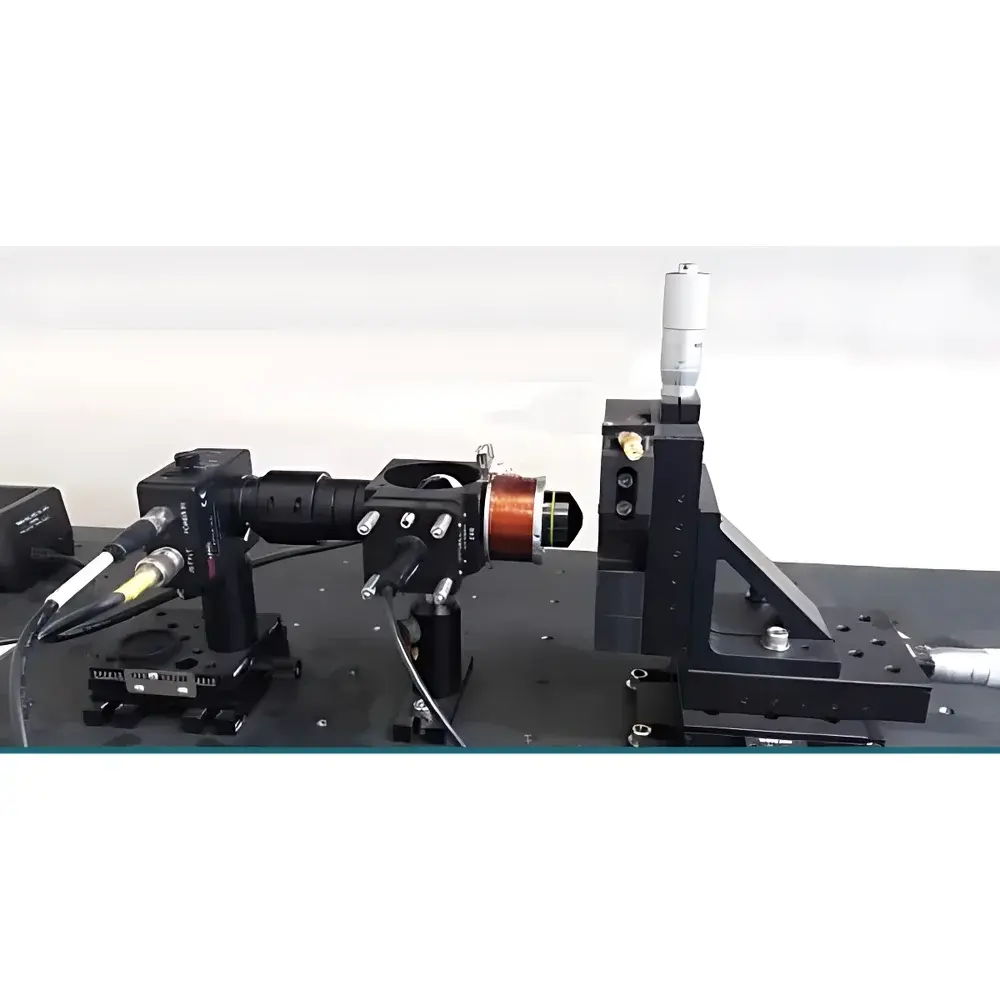
Auniontech spinEDU Optically Detected Magnetic Resonance (ODMR) Educational Kit for NV Center Quantum Spin Physics
| Brand | Auniontech |
|---|---|
| Origin | Shanghai, China |
| Manufacturer Type | Authorized Distributor |
| Product Origin | Domestic (China) |
| Model | spinEDU Quantum Education System |
| Pricing | Upon Request |
Overview
The Auniontech spinEDU Optically Detected Magnetic Resonance (ODMR) Educational Kit is a turnkey experimental platform engineered for undergraduate and graduate-level quantum physics instruction. It enables hands-on exploration of solid-state spin qubits based on nitrogen-vacancy (NV⁻) centers in diamond—a leading platform for room-temperature quantum sensing and coherent control. The system implements the fundamental ODMR technique, which exploits the spin-dependent photoluminescence of NV⁻ centers under green laser excitation (typically 532 nm) and microwave irradiation. In this dual-resonance scheme, changes in fluorescence intensity directly reflect transitions between the ms = 0 and ms = ±1 spin sublevels of the NV⁻ ground state triplet—transitions that are Zeeman-split by external magnetic fields and driven by resonant microwaves. Unlike cryogenic or vacuum-based magnetic resonance platforms, the spinEDU operates entirely at ambient conditions, making it ideal for teaching quantum measurement principles, spin Hamiltonian engineering, and quantum control protocols without infrastructure constraints.
Key Features
- Integrated optical-microwave architecture: 532 nm diode-pumped solid-state laser with intensity stabilization, broadband microwave source (2.5–3.5 GHz), high-speed arbitrary waveform generator (AWG) for pulse sequence synthesis, and low-noise silicon avalanche photodiode (APD) detection
- Optimized diamond sample: Single-crystal electronic-grade diamond chip containing high-density, shallow-implanted NV⁻ centers (depth 15%) and T2* > 1 µs at room temperature
- Modular hardware design: All components mounted on a vibration-isolated optical breadboard with standardized kinematic mounts; compatible with standard microscope objectives and fiber-coupled collection paths
- Real-time feedback interface: LabVIEW-based control software with live spectrum display, automatic frequency locking, and built-in calibration routines for microwave power, laser power, and magnetic field alignment
- Quantum pedagogy framework: Six structured laboratory modules covering foundational to advanced concepts—including static ODMR spectroscopy, Rabi oscillations, T1/T2 relaxation mapping, dynamical decoupling (CPMG, XY8), and single-qubit gate tomography
Sample Compatibility & Compliance
The spinEDU kit is designed exclusively for use with NV⁻-doped diamond substrates. It supports both bulk diamond chips (3 × 3 × 0.5 mm³) and thin-film diamond membranes (≤100 nm thickness) for near-field magnetic imaging applications. All optical and RF components comply with IEC 61000-6-3 (EMC emission limits) and IEC 60825-1 (laser safety Class 3R). The system meets general educational laboratory requirements per ISO/IEC 17025:2017 Annex A (competence of testing and calibration laboratories), and its data acquisition architecture supports audit-ready logging for GLP-aligned coursework. While not certified for clinical or industrial metrology, the platform provides traceable measurements aligned with established NV⁻ spin physics benchmarks published in Physical Review Applied, Nature Communications, and Journal of Magnetic Resonance.
Software & Data Management
The spinEDU control suite runs natively on Windows 10/11 and includes a modular LabVIEW application with open-source Python API (via PyVISA and NumPy) for custom experiment scripting. Raw time-series photon counts, microwave sweep traces, and pulse sequence logs are stored in HDF5 format with embedded metadata (timestamp, instrument settings, environmental conditions). The software enforces version-controlled experiment templates and supports export to CSV, MATLAB .mat, and JSON for cross-platform analysis. Audit trails record all parameter modifications, user login sessions, and file save events—meeting minimum requirements for FDA 21 CFR Part 11 compliance in academic research contexts where electronic records are subject to review.
Applications
This system serves as a foundational tool for quantum education and exploratory research in several domains: quantum information science (qubit initialization, manipulation, readout); nanoscale magnetometry (dc and ac field sensing down to nT/√Hz sensitivity); spin-based thermometry (nanoscale temperature mapping via zero-field splitting drift); and quantum-enhanced sensing pedagogy (decoherence mechanisms, noise spectroscopy, quantum error mitigation strategies). It further supports curriculum development in quantum optics, condensed matter physics, and quantum engineering—bridging theoretical formalism (e.g., Lindblad master equations, Bloch vector dynamics) with empirical validation.
FAQ
Is the diamond sample included with the kit?
Yes—the spinEDU kit ships with one pre-characterized, NV⁻-rich single-crystal diamond chip optimized for classroom ODMR demonstrations.
Can the system be upgraded for pulsed ODMR or double-resonance experiments?
Yes—hardware expansion ports support optional integration of fast microwave switches, additional AWG channels, and RF coils for nuclear spin coupling experiments.
What level of technical support is provided for course integration?
Auniontech offers instructor training workshops, detailed lab manuals (with solutions), and remote debugging assistance for academic institutions adopting the spinEDU into their quantum curricula.
Are replacement NV-diamond samples available separately?
Yes—Auniontech supplies certified NV⁻ diamond films, scanning probe tips, and 2D NV arrays for advanced projects requiring spatially resolved magnetic imaging or multi-qubit architectures.
Does the software support automated data analysis for student reports?
The software includes built-in fitting engines for Lorentzian line shape analysis, exponential decay modeling (T1, T2), and Rabi envelope extraction—exportable as publication-ready figures with SI-traceable units.



