
Auniontech High-Power Narrow-Linewidth Semiconductor Laser Chips & Modules
| Brand | Auniontech |
|---|---|
| Origin | Shanghai, China |
| Manufacturer Type | Authorized Distributor |
| Product Type | Domestic |
| Model | High-Power Tunable Narrow-Linewidth Semiconductor Laser |
| Core Components | III-V/Si Hybrid External Cavity Laser Chips, Gain Chips, BOA (Booster Optical Amplifier) Chips, Integrated Resonator-Based Self-Injection Locked Lasers |
| Wavelength Options | O-, S-, C-, L-bands (standard) |
| Output Power | >20 mW (C-band, bare chip) |
| Linewidth | Instantaneous linewidth ~kHz |
| Relative Intensity Noise (RIN) | < −145 dBc/Hz @ 3 MHz–26 GHz |
| Tuning Range | >100 nm @ 1580 nm (gain chip + external cavity) |
| Packaging | COC (Chip-on-Carrier) or packaged modules only (no bare die supplied) |
| Spectral Purity | SMSR > 40 dB |
| Spectral Width (−20 dB) | ≤ 0.1 nm |
| Thermal Wavelength Drift | 0.08 nm/°C |
| Beam Divergence (FWHM) | Fast axis 28°, Slow axis 23° |
| Operating Current (typ.) | 300 mA @ 25°C |
| Threshold Current (typ.) | ≤30 mA |
| Slope Efficiency (typ.) | 0.35 W/A |
| Forward Voltage (typ.) | 1.8 V @ 250 mA |
| Center Wavelength Tolerance | ±0.5 nm @ 50 mW |
Overview
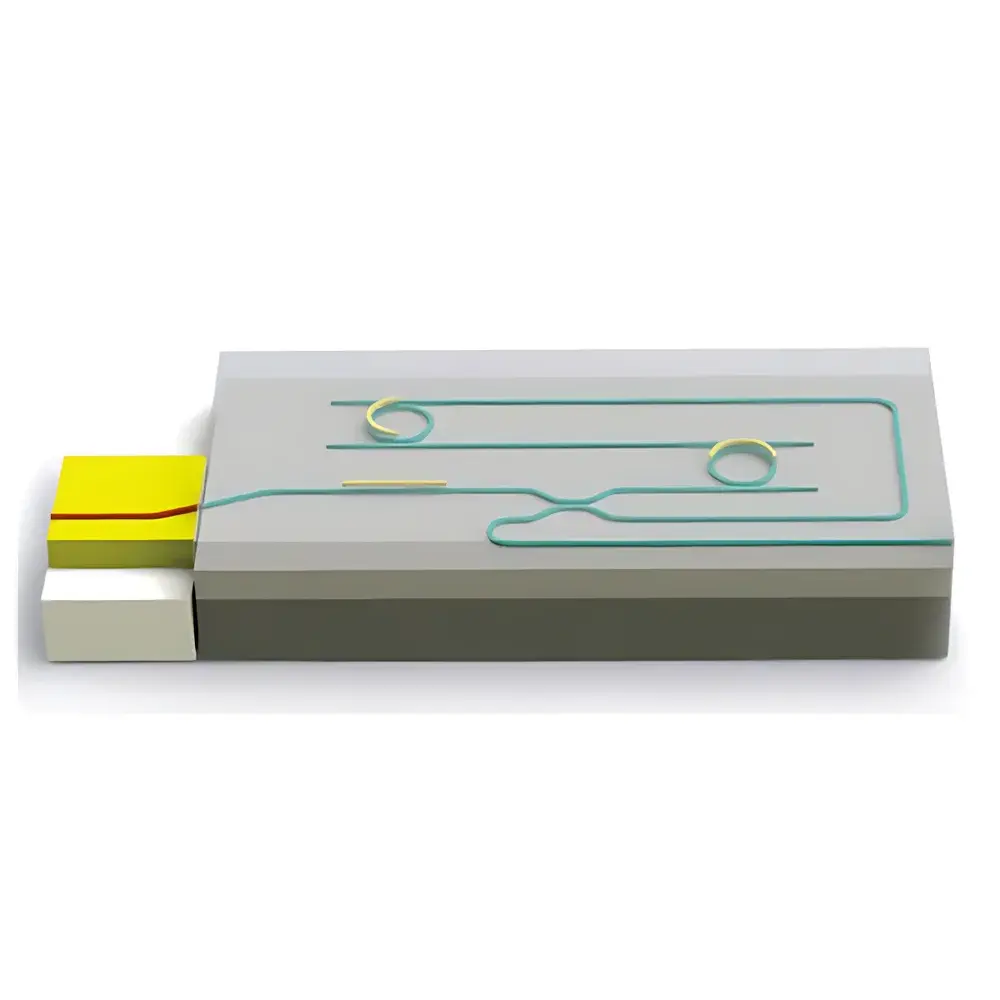
The Auniontech High-Power Narrow-Linewidth Semiconductor Laser Chips & Modules represent a class of integrated photonic light sources engineered for precision applications requiring spectral purity, wide tunability, and high optical output stability. These devices leverage heterogeneous integration of III-V active materials with low-loss silicon photonics waveguides—combining the high quantum efficiency of direct-bandgap semiconductors with the scalability and passive control advantages of silicon-based planar lightwave circuits. The core architecture supports two primary configurations: (1) hybrid external-cavity lasers (ECLs), where gain chips are coupled to on-chip or fiber-pigtailed gratings, etalons, or ring resonators to achieve broad wavelength tuning across O-, S-, C-, and L-bands; and (2) self-injection locked lasers, in which high-Q passive resonators provide delayed optical feedback to the gain section, suppressing phase noise and narrowing the intrinsic linewidth to sub-100 Hz levels—validated via independent measurement using the SYCATUS A0040 linewidth analyzer. This dual-path design enables co-optimization of coherence length, power scalability, and thermal/mechanical robustness—critical for coherent optical communications, LiDAR ranging, microwave photonics signal generation, and quantum sensing platforms.
Key Features
- Heterogeneous III-V/silicon integration enabling compact footprint, low propagation loss, and compatibility with wafer-scale packaging processes
- Wide wavelength coverage: standard bands include O (1260–1360 nm), S (1460–1530 nm), C (1530–1565 nm), and L (1565–1625 nm); custom wavelengths available at 780 nm, 850 nm, 1310 nm, 1550 nm, and 1580 nm
- High output power: ≥20 mW from chip-level C-band emission; ≥100 mW with integrated booster optical amplifier (BOA); ≥200 mW in fully packaged self-injection locked 1550 nm modules
- Exceptional spectral performance: instantaneous linewidth in kHz range; integrated linewidth <100 kHz; intrinsic linewidth measured at ~100 Hz under stabilized conditions
- Low relative intensity noise (RIN) of <−145 dBc/Hz over 3 MHz–26 GHz bandwidth, supporting high-fidelity analog photonic links
- High side-mode suppression ratio (SMSR) >40 dB ensures single-longitudinal-mode operation without mode hopping under thermal or current modulation
- Thermally stable operation with wavelength drift coefficient of 0.08 nm/°C, facilitating open-loop temperature control in field-deployable systems
- Standard COC (chip-on-carrier) mounting or fully hermetic TO-can/module packaging—no bare-die supply per product specification
Sample Compatibility & Compliance
These laser chips and modules are designed for integration into both research-grade and industrial photonic subsystems. They comply with JEDEC JESD22-A108F reliability standards for temperature cycling and JESD22-A101D for steady-state humidity testing. While not certified to IEC 60825-1 (laser safety) or FDA 21 CFR Part 1040.10 out-of-box, all packaged variants support optional Class 1 or Class 3B enclosure integration per customer system-level requirements. The devices meet RoHS Directive 2011/65/EU and REACH Regulation (EC) No. 1907/2006 for hazardous substance restrictions. For regulated environments—including GLP-compliant optical metrology labs or GMP-aligned photonics manufacturing lines—full traceability documentation (lot-specific test reports, MSL ratings, and burn-in data) is provided upon request. No ITAR or EAR export restrictions apply to standard configurations; dual-use variants require case-by-case ECCN review.
Software & Data Management
Auniontech provides comprehensive characterization datasets—including LIV (light-current-voltage), spectral scan sweeps, linewidth histograms, and RIN spectra—for each production lot. These files follow IEEE Std 1673-2019 metadata conventions and are delivered in HDF5 format with embedded calibration coefficients. Optional LabVIEW™ and Python SDKs enable automated parameter sweeping (wavelength, current, temperature) and real-time lock-point monitoring for self-injection systems. All firmware interfaces adhere to SCPI command syntax, ensuring interoperability with Keysight, Thorlabs, and Newport instrument controllers. Audit trails for calibration events and configuration changes comply with FDA 21 CFR Part 11 requirements when deployed within validated software environments (e.g., MATLAB Production Server or NI TestStand).
Applications
- Coherent optical communications (DP-QPSK, 16-QAM transceivers) requiring narrow-linewidth local oscillators
- Fiber-optic sensing (distributed acoustic sensing, interferometric strain monitoring) demanding long coherence lengths (>10 km)
- Frequency-modulated continuous-wave (FMCW) LiDAR for autonomous vehicles and robotics
- Microwave photonics: optical generation of mmWave signals via heterodyning or photonic frequency combs
- Atomic physics experiments (e.g., Rb/Cs magneto-optical traps) requiring precise 780/850 nm stabilization
- Photonic integrated circuit (PIC) testing and wafer-level probe station validation
- Optical time-domain reflectometry (OTDR) with enhanced dynamic range through low-RIN illumination
FAQ
Are bare-die chips available for flip-chip bonding or custom PIC integration?
No. Per product specifications, only COC-mounted chips and fully packaged modules are supplied. Bare-die handling is excluded due to sensitivity to electrostatic discharge and mechanical stress during dicing/packaging.
What is the maximum allowable drive current for continuous-wave operation at 25°C?
The recommended absolute maximum DC current is 450 mA. Derating is required above 40°C ambient; consult the thermal resistance curve in the datasheet for pulsed operation guidelines.
Can the laser be operated in wavelength-swept mode for OCT applications?
Yes—when integrated with external cavity elements (e.g., MEMS-tuned filters or SG-DBR structures), sweep rates up to 100 kHz over 100 nm are achievable. On-chip tuning alone does not support high-speed sweep; external actuation is required.
Is there an option for polarization-maintaining (PM) fiber pigtailing?
Yes. PM-fiber-coupled modules with extinction ratio >20 dB are available as a build-to-order variant (lead time: 12 weeks).
Do you provide aging data or MTTF estimates under accelerated life testing?
Accelerated life test results (5000 h @ 65°C, 85% RH) show 250,000 hours at 40°C case temperature.




