
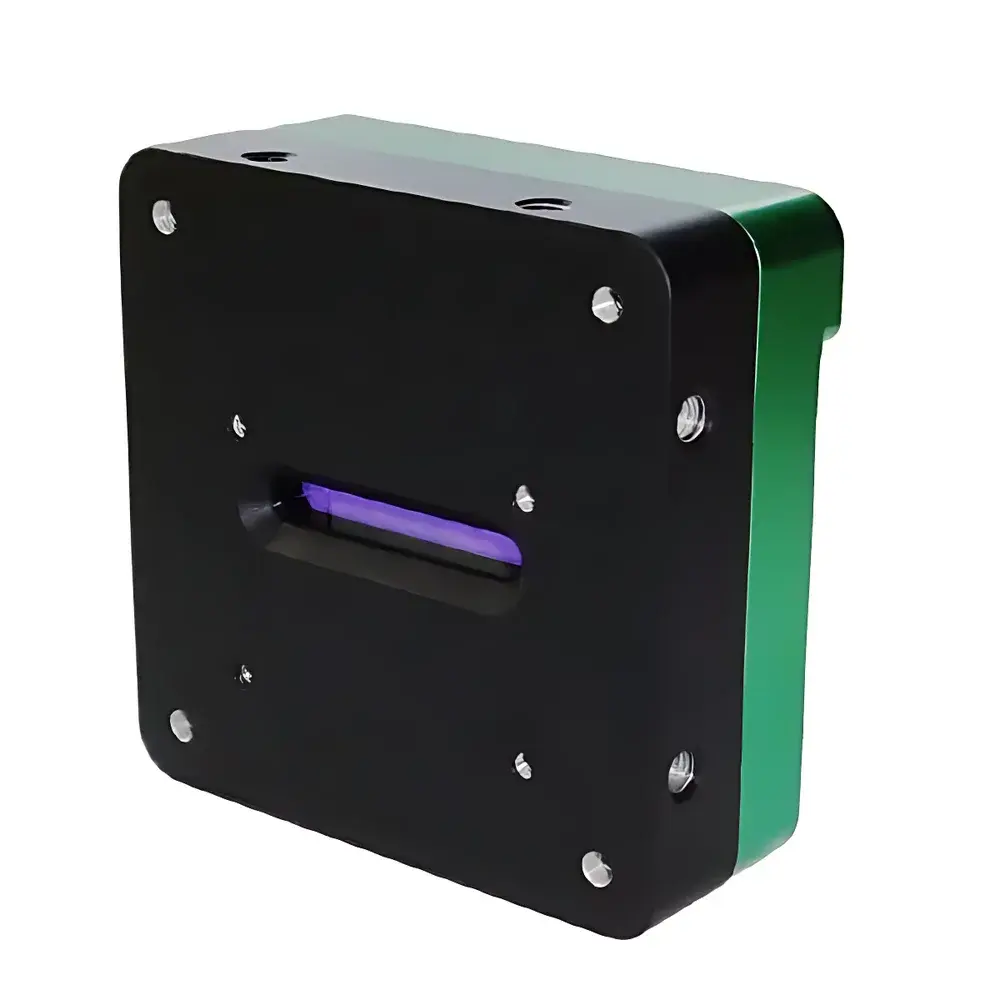
Auniontech OctoPlus Series OCT-Dedicated Line-Scan Camera
| Brand | Auniontech |
|---|---|
| Origin | Shanghai, China |
| Model | OctoPlus OCT Line-Scan Camera |
| Sensor Type | Monochrome CMOS linear array |
| Resolution | 2048 pixels |
| Pixel Sizes | 10 µm × 20 µm or 10 µm × 200 µm |
| Full Well Capacity | 140 ke⁻ or 200 ke⁻ |
| Interface | Camera Link (Base/Medium/Full) or USB 3.0 |
| Line Rate Options | 20 kL/s, 80 kL/s, 130 kL/s, 250 kL/s |
| Bit Depth | 10-bit, 11-bit, or 12-bit |
| ROI Configurability | Yes |
| Package Options | Ceramic or Organic substrate |
| Power Supply | 10–15 V DC |
Overview
The Auniontech OctoPlus Series is a purpose-engineered line-scan camera platform designed exclusively for spectral-domain optical coherence tomography (SD-OCT) systems. Operating on the principle of high-speed, single-line acquisition synchronized with spectrometer dispersion, the OctoPlus enables real-time, high-fidelity axial scanning by capturing interference spectra from backscattered light across a broad wavelength band. Its modular architecture supports precise matching to custom-built or commercial diffraction-grating-based spectrometers—ensuring optimal pixel-wavelength mapping, minimal aliasing, and maximal signal fidelity. Unlike generic industrial line-scan cameras, the OctoPlus integrates optical and electronic design parameters (e.g., pixel aspect ratio, full-well capacity, and readout timing) specifically to address the demanding SNR, dynamic range, and temporal stability requirements of clinical and research-grade OCT imaging.
Key Features
- 2048-pixel monochrome CMOS linear sensor optimized for near-infrared (NIR) spectral bands commonly used in OCT (800–1350 nm)
- Two pixel geometry variants: standard 10 µm × 20 µm for balanced resolution and sensitivity; elongated 10 µm × 200 µm for enhanced light collection efficiency in low-flux spectrometer configurations
- Selectable full-well capacities (140 ke⁻ / 200 ke⁻) to accommodate varying illumination intensities and integration times without saturation
- Four line rate options—from 20 kL/s for high-dynamic-range static imaging to 250 kL/s for real-time volumetric OCT at >100 fps frame rates—enabling application-specific speed–sensitivity trade-offs
- Configurable bit depth (10/11/12-bit) supporting both high-speed acquisition and quantitative intensity calibration
- Hardware-level region-of-interest (ROI) selection to reduce data bandwidth and improve effective frame rate without sacrificing axial resolution
- Dual packaging options: hermetic ceramic housing for long-term thermal and mechanical stability in OEM integration; organic substrate variant for cost-sensitive prototyping and educational platforms
- Standardized Camera Link (Base/Medium/Full) and USB 3.0 interfaces ensure compatibility with industry-standard frame grabbers and embedded vision systems, with deterministic latency and robust error handling
Sample Compatibility & Compliance
The OctoPlus camera is compatible with all SD-OCT architectures utilizing transmission or reflective diffraction gratings, including free-space and fiber-coupled spectrometer designs. It supports alignment-free integration via standardized mechanical mounting interfaces and TTL-synchronized trigger I/O. While not a medical device itself, the OctoPlus complies with CE marking requirements for electromagnetic compatibility (EN 61326-1) and safety (EN 61010-1), and its design facilitates system-level compliance with ISO 13485 quality management standards when integrated into Class IIa or IIb OCT instruments. Sensor quantum efficiency curves are provided per batch to support traceable calibration under ISO/IEC 17025-accredited laboratory conditions.
Software & Data Management
Auniontech provides a comprehensive SDK supporting Windows and Linux environments, with native drivers for HALCON, MATLAB Image Acquisition Toolbox, and Python (via GenICam-compliant wrappers). The SDK includes tools for pixel non-uniformity correction (NUC), dark current subtraction, and real-time line-rate optimization. All configuration parameters—including gain, offset, exposure time, and ROI—are programmable via register-level access or high-level API calls. Audit trails for parameter changes can be exported in CSV or HDF5 format, supporting GLP/GMP-aligned documentation workflows. Firmware updates are delivered via signed binary packages to ensure integrity and version control in regulated development environments.
Applications
- Research-grade spectral-domain OCT systems for ophthalmology, dermatology, and endoscopic imaging
- OEM integration into compact, portable OCT devices targeting point-of-care diagnostics
- Development of swept-source OCT hybrid architectures requiring high-speed line-scan reference channels
- Calibration and validation of spectrometer optical path differences (OPD) and dispersion compensation algorithms
- Quantitative scattering spectroscopy in turbid media, where high SNR and linear response over 4+ decades of intensity are critical
- Time-resolved interferometric metrology in MEMS and microfluidic device characterization
FAQ
Is the OctoPlus camera suitable for time-domain OCT (TD-OCT) systems?
No—the OctoPlus is engineered exclusively for spectral-domain detection architectures and lacks the gated detection capability required for TD-OCT.
Can I use the OctoPlus with third-party spectrometers?
Yes, provided the spectrometer’s output focal plane matches the specified pixel pitch and field height; mechanical and optical interface drawings are supplied upon NDA.
Does the camera support hardware triggering for synchronization with laser sources?
Yes—TTL-compatible input and output trigger lines support external start/stop, line synchronization, and frame strobe signals with sub-microsecond jitter.
What is the typical dark current specification at 25°C?
Typical dark current is ≤0.5 e⁻/pixel/s at 25°C ambient, measured with 12-bit mode and maximum integration time.
Are calibration certificates available for individual units?
Yes—NIST-traceable responsivity and linearity calibration reports are available as an optional service, compliant with ISO/IEC 17025 requirements.





