
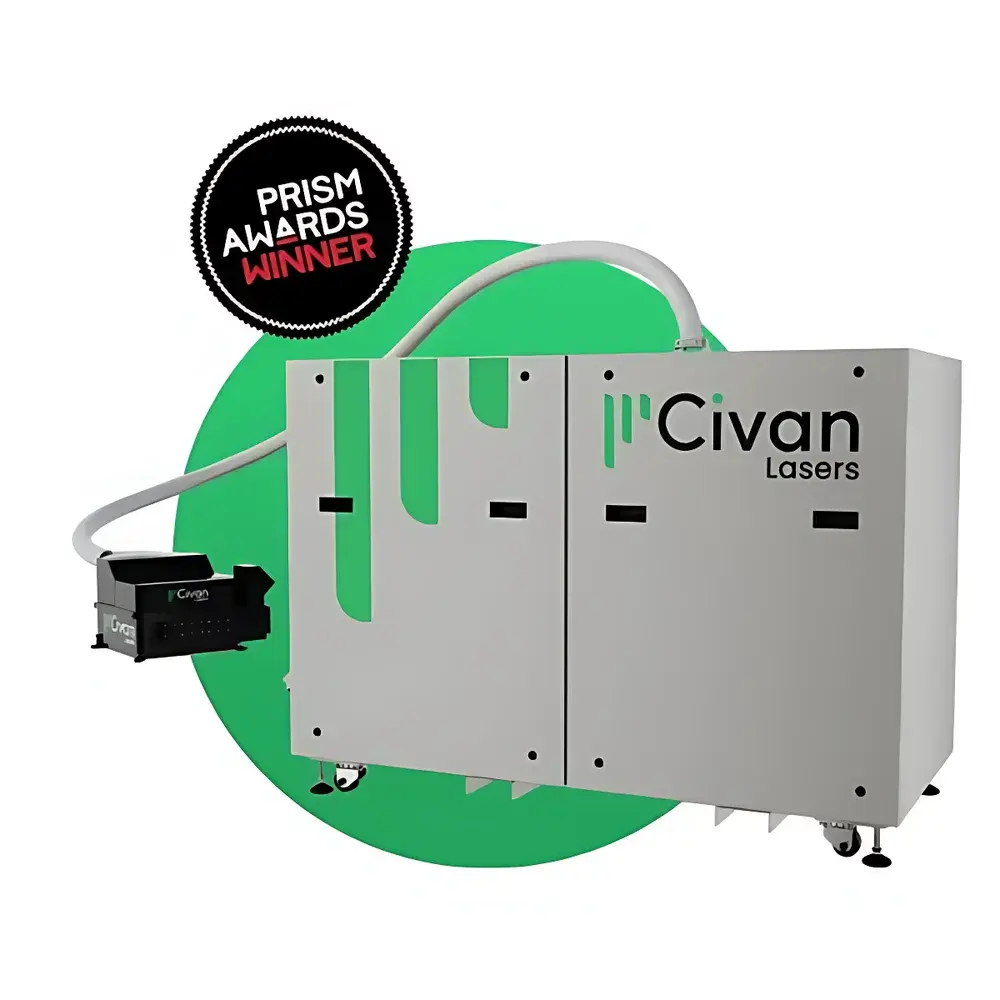
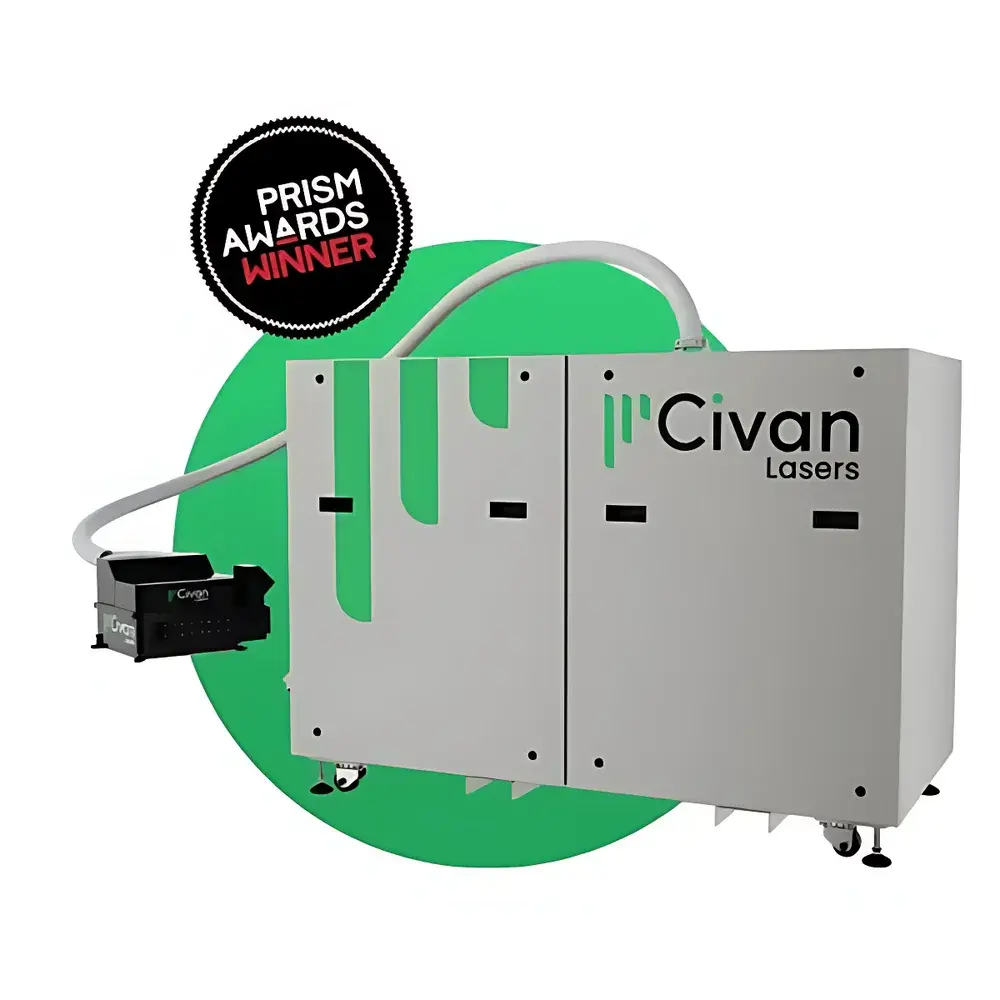
Civan DBL Series High-Power Dynamic Beam Modulation Laser System
| Brand | Civan |
|---|---|
| Power Options | 7 kW / 14 kW / 28 kW |
| Operation Mode | CW & Modulated |
| Polarization | Circular |
| Wavelength | 1064 ± 1 nm |
| Beam Delivery | Free-space collimated output |
| Beam Shape Control | Software-defined static & dynamic profiles (up to 50 MHz shape update rate) |
| Focus Tuning | Dynamic depth-of-focus adjustment via optical phase control |
| Core Technology | Coherent Beam Combination (CBC) + Optical Phased Array (OPA) |
| Compliance | Designed for industrial integration per ISO 11553-1 (laser safety), IEC 60825-1, and compatible with GLP/GMP-aligned process documentation workflows |
Overview
The Civan DBL Series High-Power Dynamic Beam Modulation Laser System is an industrial-grade laser source engineered for precision deep-penetration welding and additive manufacturing applications requiring real-time, physics-based beam control. Unlike conventional fixed-beam or mechanically scanned lasers, the DBL leverages coherent beam combination (CBC) and two-dimensional optical phased array (OPA) technology to manipulate beam intensity distribution, focal position, and temporal shape profile—all without moving parts. This enables deterministic control over key melt pool dynamics: heat distribution, solidification velocity, vapor plume stability, and keyhole geometry. The system operates at 1064 ± 1 nm in continuous-wave (CW) or high-frequency modulated modes, delivering scalable output power (7–28 kW) with circular polarization optimized for consistent coupling into reflective metals including Al 3xxx, 5xxx, and 6xxx alloys. Its architecture supports closed-loop process adaptation through programmable shape sequencing, making it suitable for high-mix, low-volume production environments where weld integrity, repeatability, and thermal management are critical design constraints.
Key Features
- Real-time beam shaping at up to 50 MHz update rate—enabling sub-millisecond modulation of intensity distribution, focal depth, and spatial frequency
- Coherent Beam Combination (CBC) architecture delivering scalable output power while maintaining diffraction-limited beam quality (M² < 1.2 typical)
- Optical Phased Array (OPA)-based focus steering—allowing dynamic depth-of-focus tuning without mechanical actuators or adaptive optics
- Software-defined beam morphology: users generate custom static and time-varying beam profiles (e.g., ring, donut, multi-lobed, scanning-line composites) via intuitive GUI
- Full digital interface (EtherCAT/RS422) for integration into PLC-controlled production lines and Industry 4.0 data acquisition systems
- Compliant with IEC 60825-1:2014 (Class 4 laser product) and ISO 11553-1:2013 (safety requirements for laser processing machines)
Sample Compatibility & Compliance
The DBL Series is validated for use with high-reflectivity, thermally conductive materials common in electric vehicle (EV) and aerospace manufacturing—including aluminum alloys (3xxx, 5xxx, 6xxx), copper, stainless steels, and dissimilar metal joints. Its low-heat-input capability minimizes distortion in thin-wall structures (e.g., battery cooling plates) while enabling single-pass full-penetration welding of steel up to 70 mm thickness. All models meet CE marking requirements for machinery directive 2006/42/EC and electromagnetic compatibility (EMC) directive 2014/30/EU. For regulated industries, the system supports audit-ready operation logs, user access control, and electronic signature functionality aligned with FDA 21 CFR Part 11 and EU Annex 11 expectations when integrated with compliant MES or QMS platforms.
Software & Data Management
Civan’s BeamDesigner™ software provides a deterministic beam programming environment supporting both offline profile synthesis and real-time parameter streaming during operation. Users define beam sequences using parametric shape libraries or import custom ASCII-based intensity maps. Each shape can be assigned dwell time, repetition frequency, and spatial offset—enabling synchronized motion between beam modulation and robotic path planning. Process data—including shape timestamping, power feedback, and external sensor triggers (e.g., pyrometer, weld camera)—is logged in HDF5 format for traceability and post-process statistical analysis. Optional API integration (Python/C++ SDK) allows embedding beam control logic directly into proprietary process optimization algorithms or digital twin simulations.
Applications
- Battery cooling plate welding: Achieves defect-free seams at feed rates >25 m/min on Al 3003/3004 substrates, eliminating porosity, humping, and microcracking
- Thick-section structural welding: Single-pass full-penetration of 25–70 mm steel plates—replacing multi-pass GMAW or SAW with reduced HAZ, lower distortion, and no flux residue
- Metal additive manufacturing: Enables controlled melt pool stabilization during directed energy deposition (DED) of high-thermal-conductivity alloys
- Dissimilar metal joining: Mitigates intermetallic formation through spatiotemporal heat input modulation across interface zones
- Repair welding of high-value components: Localized thermal management preserves base material microstructure adjacent to repair zones
FAQ
What beam shapes can be generated?
Static profiles (circle, ring, square, hexagon) and dynamic composites (rotating rings, oscillating lines, Lissajous patterns) are supported; arbitrary intensity distributions may be imported as ASCII matrices.
Is the system compatible with existing robotic welding cells?
Yes—EtherCAT and RS422 interfaces enable synchronization with KUKA, ABB, Fanuc, and Universal Robots controllers via standardized motion coordination protocols.
How is beam calibration maintained over time?
Built-in reference photodiode array and automated alignment routine ensure long-term beam shape fidelity; recalibration interval is 500 operational hours or per preventive maintenance schedule.
Can the DBL be used for non-welding applications?
While optimized for high-power material processing, its beam agility supports selective surface texturing, localized annealing, and controlled ablation in R&D settings—subject to optical delivery configuration.
Does the system support FDA 21 CFR Part 11 compliance?
The laser itself does not include embedded electronic records; however, its digital interface and logging capabilities are designed to integrate seamlessly with validated Part 11-compliant MES/QMS platforms.





