
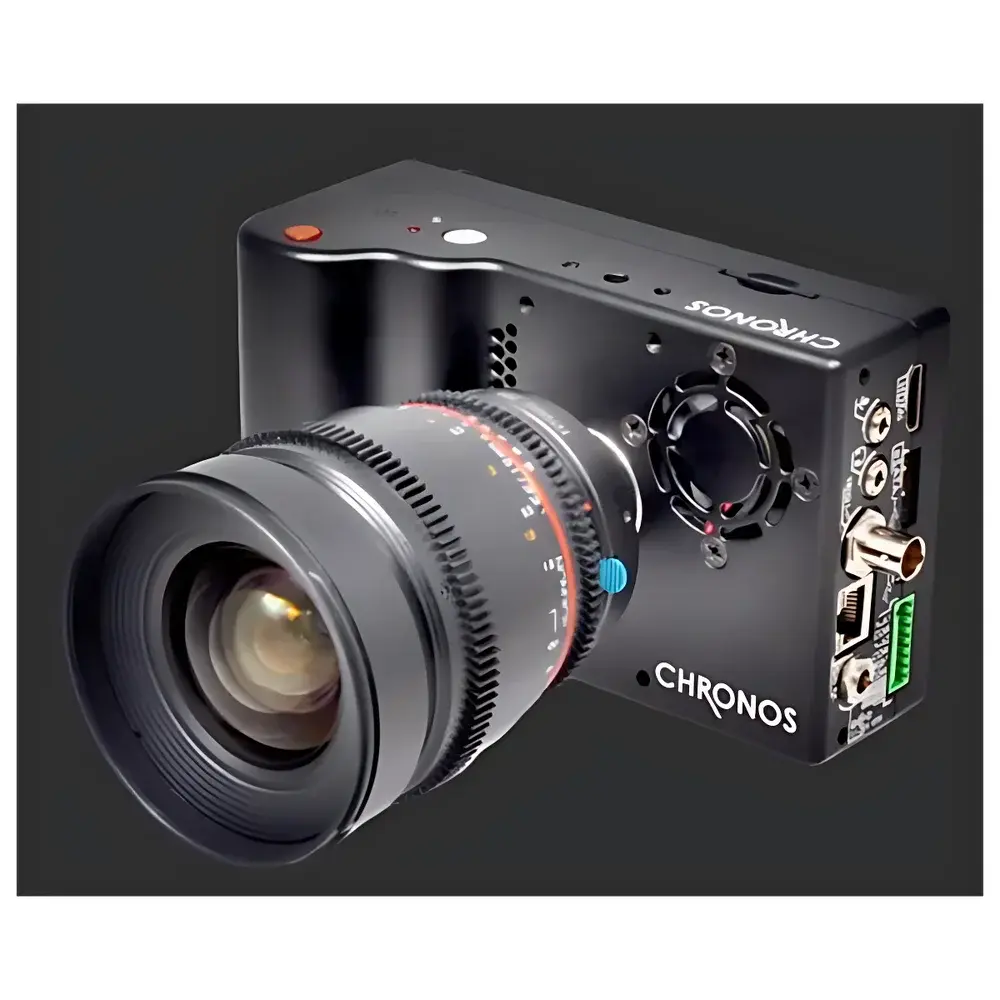
Auniontech Chronos 1.4 High-Speed CMOS Camera
| Brand | Auniontech |
|---|---|
| Origin | Shanghai, China |
| Model | Chronos 1.4 |
| Max Resolution | 1280 × 1024 @ 1069 fps |
| Pixel Throughput | 1.4 Gpx/s |
| Output Formats | CinemaDNG RAW, H.264, H.265 |
| Interface | USB 3.2 Gen 2 |
| Sensor Type | Global Shutter CMOS |
| Onboard Storage | SD card slot (UHS-II supported) |
| Display | 5" capacitive touchscreen (800 × 480) |
| Power | 19 V / 40 W adapter (up to 1 hr battery operation with optional pack) |
| Lens Mount | CS-mount (C-mount adapter included) |
| Compliance | CE, FCC, RoHS |
Overview
The Auniontech Chronos 1.4 is a high-performance, open-architecture high-speed CMOS camera engineered for scientific imaging, industrial diagnostics, and cinematic slow-motion capture. It operates on a global-shutter CMOS sensor architecture optimized for temporal fidelity—eliminating motion skew and rolling shutter artifacts common in consumer-grade sensors. With a sustained pixel throughput of 1.4 gigapixels per second, the system delivers deterministic frame timing and sub-microsecond exposure control, enabling precise synchronization with external triggers (TTL, LVDS), lasers, or pulsed light sources. Its design targets applications requiring both spatial fidelity (up to 1280 × 1024 at 1069 fps) and temporal resolution (up to 21,600 fps at reduced ROI), making it suitable for time-resolved analysis in fluid dynamics, impact mechanics, combustion studies, and biomechanics.
Key Features
- Global shutter CMOS sensor with programmable exposure times from 1 µs to 10 s, ensuring artifact-free imaging of fast transient events.
- Real-time onboard preview via integrated 5-inch capacitive touchscreen (800 × 480), supporting intuitive touch-based parameter adjustment without host dependency.
- Hardware-accelerated image pipeline: all capture, buffering, and encoding (H.264/H.265/CinemaDNG) occur within the camera’s FPGA and ARM-based processing unit—no host CPU load required during recording.
- Fully open software ecosystem: complete source code for firmware, GUI application, and SDK (C/C++, Python bindings) is publicly available under permissive licensing, enabling user-driven feature development, calibration customization, and integration into automated test benches.
- Robust mechanical architecture: magnesium alloy chassis (1.32 kg), IP52-rated ingress protection, and passive/active thermal management ensure stable operation in lab, field, and production-floor environments.
- Flexible storage architecture: supports UHS-II SD cards (up to 1 TB) for extended recording; optional NVMe SSD module enables direct-to-disk RAW capture at full sensor bandwidth.
Sample Compatibility & Compliance
The Chronos 1.4 is compatible with standard C-mount and CS-mount optics via included mechanical adapter, permitting integration with macro lenses, telecentric objectives, schlieren mirrors, and fiber-coupled illumination systems. It meets electromagnetic compatibility requirements per EN 55032 Class B and EN 55035 for residential and light-industrial deployment. Firmware implements non-volatile audit logging for configuration changes and recording sessions—supporting GLP-aligned documentation practices. While not certified for FDA 21 CFR Part 11, its deterministic trigger latency (< 1.2 µs jitter), timestamped metadata embedding (IEEE 1588 PTP optional), and reproducible exposure sequencing make it suitable for ISO/IEC 17025-accredited laboratories performing method validation in materials testing and aerodynamic visualization.
Software & Data Management
The camera ships with Chronos Capture Suite—a cross-platform (Windows/macOS/Linux) application built on Qt and leveraging Vulkan-accelerated rendering for low-latency playback. All recorded clips embed embedded metadata including exposure time, gain, temperature, GPS (if enabled), and hardware trigger timestamps. CinemaDNG sequences are compliant with Adobe DNG Specification 1.7 and support demosaicing in Resolve, DaVinci, MATLAB, and Python (via rawpy or libraw). The SDK provides low-level access to sensor registers, ROI definition, LUT upload, and real-time histogram streaming—enabling closed-loop control in custom DAQ systems. Export workflows support batch conversion to TIFF stacks, HDF5 volumes (with attribute preservation), and FFmpeg-compatible containers for archival or ML preprocessing pipelines.
Applications
- Fluid Dynamics & Combustion: Time-resolved schlieren and shadowgraph imaging of shockwave propagation, droplet breakup, and flame front instabilities at >10,000 fps.
- Materials Testing: High-fidelity capture of fracture propagation, tensile failure modes, and microstructural deformation under dynamic loading (e.g., Hopkinson bar experiments).
- Biomechanics & Animal Locomotion: Quantitative kinematic analysis of wingbeat cycles, tendon recoil, and neuromuscular response using markerless tracking frameworks (DeepLabCut, SLEAP).
- Industrial QA/QC: In-line inspection of high-speed assembly processes (e.g., solder jetting, valve actuation, packaging seal integrity) with sub-frame event tagging.
- Aerospace & Ballistics: Projectile tracking, parachute deployment sequencing, and turbine blade vibration modal analysis under operational conditions.
- Academic Research: Used in university labs for undergraduate physics demonstrations (e.g., Newton’s cradle, cavitation collapse) and graduate-level experimental fluid mechanics courses.
FAQ
Does the Chronos 1.4 support external hardware triggering?
Yes—it features dual TTL/LVDS trigger inputs with configurable polarity, delay, and pulse width, enabling synchronization with laser pulses, piezoelectric actuators, or oscilloscope markers.
Can I modify the firmware or add custom image processing algorithms?
Absolutely—the full firmware source (ARM Cortex-M7 + FPGA HDL), build toolchain, and bootloader documentation are provided under MIT license.
What is the maximum continuous recording duration at full resolution?
At 1280 × 1024 @ 1069 fps (~1.4 Gpx/s), a 512 GB UHS-II SD card supports ~22 seconds of uncompressed CinemaDNG; H.265 compression extends this to >3 minutes with <1% PSNR loss relative to RAW.
Is the camera compatible with third-party machine vision libraries like OpenCV or HALCON?
Yes—the SDK includes GenICam-compliant interface wrappers and native drivers for Linux V4L2 and Windows DirectShow, allowing seamless integration into existing CV pipelines.
Does it support time-stamping with GPS or PTP for multi-camera synchronization?
GPS time injection is supported via UART; IEEE 1588 Precision Time Protocol (PTPv2) is implemented in firmware v2.3+ for sub-100 ns inter-camera skew correction across Ethernet-linked arrays.



