
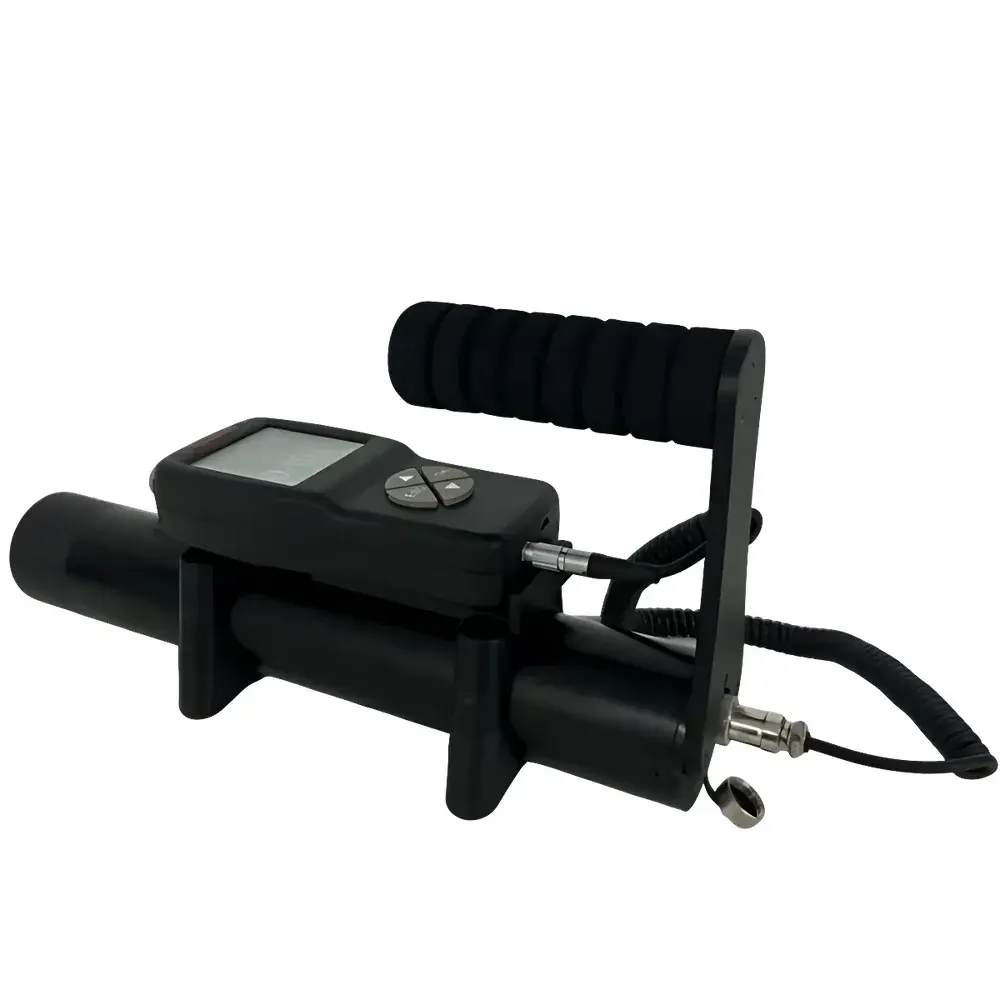
SMACH LX100D Portable Radiation Survey Meter
| Brand | SMACH |
|---|---|
| Model | LX100D |
| Type | Portable Dose Rate Meter |
| Detector | Plastic Scintillator |
| Measured Radiation | X-ray and γ-ray |
| Dose Rate Range | 100 nSv/h to 10 Sv/h |
| Sensitivity | 100 cps/μSv/h |
| Energy Response | 25 keV – 7.0 MeV |
| Intrinsic Relative Error | ≤10% |
| Operating Temperature | −40 °C to +55 °C |
| IP Rating | IP65 |
| Battery Life | 12 h continuous operation |
| Communication Interfaces | RS232, RS485, Bluetooth, LoRa, ZigBee, Cellular, Wi-Fi |
Overview
The SMACH LX100D Portable Radiation Survey Meter is a high-performance, field-deployable instrument engineered for real-time measurement of ambient dose equivalent rate H*(10) from X-ray and gamma radiation fields. It employs a fast-response plastic scintillation detector coupled with advanced pulse-processing algorithms—specifically designed to resolve both low-intensity background radiation and high-dose-rate transient pulses (e.g., pulsed fluoroscopy or radiological emergency scenarios) within a single unified measurement architecture. Unlike gas-filled detectors limited by dead-time saturation, the LX100D leverages the high light-yield and nanosecond decay time of organic scintillators to achieve exceptional count-rate capacity (>10⁶ cps), enabling accurate quantification across an unprecedented 11-decade dose rate span—from environmental monitoring levels (100 nSv/h) to life-threatening acute exposure conditions (10 Sv/h). Its design complies with IEC 60846-1:2014 requirements for portable dose rate meters used in radiation protection applications.
Key Features
- Plastic scintillator detector optimized for broad-energy response (25 keV–7.0 MeV) with built-in energy compensation filters to minimize angular and spectral dependence;
- Millisecond-level response time enabled by low-energy filtration and real-time pulse-counting algorithms, supporting dynamic field assessment in pulsed radiation environments;
- Adaptive pulse-frequency smoothing and saturation recovery logic extend effective linear range while maintaining ≤10% intrinsic relative error across full scale;
- Temperature-stabilized electronics and electromagnetic interference (EMI)-hardened circuitry ensure operational reliability in extreme field conditions (−40 °C to +55 °C);
- Isotropic angular response verified per ISO 4037-3:2019; no correction factors required for off-axis irradiation up to ±60°;
- Self-calibration mode using LED-based stability monitoring—no radioactive reference source needed for routine verification;
- User-configurable alarm thresholds with dual-level audio/visual alerts for dose rate overload and detector fault conditions;
- IP65-rated enclosure with optional custom housing materials (e.g., stainless steel, carbon-fiber reinforced polymer) for nuclear facility, military NBC, or marine deployment;
- Dual isolated digital interfaces (RS232 and RS485) for simultaneous local diagnostics and networked telemetry integration;
- Modular wireless expansion support—including Bluetooth 5.0, LoRaWAN Class C, IEEE 802.15.4 (ZigBee), LTE-M/NB-IoT, and IEEE 802.11n—for seamless integration into centralized radiation monitoring platforms.
Sample Compatibility & Compliance
The LX100D is validated for use in mixed-field environments where X- and γ-radiation dominate—such as radiotherapy bunkers, nuclear power plant auxiliary buildings, decommissioning sites, border radiation portals, and tactical NBC reconnaissance units. It meets the functional and performance criteria outlined in IEC 60846-1:2014 (Radiation protection instrumentation — Dose rate meters and monitors for X-, γ-, and neutron radiation) and aligns with national implementation standards including GB/T 10257–2022 (China) and ANSI N42.17A (USA). While not intrinsically safe for Zone 0/1 explosive atmospheres, its non-sparking design and low-power architecture permit deployment in Class I, Division 2 hazardous locations when installed per NEC Article 500 guidelines. Data logging integrity supports GLP-compliant audit trails when paired with SMACH’s optional secure firmware module (FIPS 140-2 Level 1 certified).
Software & Data Management
The LX100D operates with SMACH’s RadiationLink™ embedded firmware, offering on-device data storage (≥10,000 timestamped records), configurable averaging intervals (1 s to 60 min), and automatic metadata tagging (GPS coordinates, temperature, battery status). The companion desktop application—RadView Pro—supports raw pulse stream export (CSV, HDF5), spectral unfolding post-processing, and compliance reporting templates aligned with IAEA Safety Reports Series No. 46 and EURADOS Technical Report 2020-01. All firmware updates are cryptographically signed and delivered via secure OTA channels compliant with NIST SP 800-193 guidelines. Remote configuration and real-time telemetry are compatible with industry-standard SCADA protocols (Modbus RTU/TCP, MQTT v3.1.1) and cloud platforms including AWS IoT Core and Azure IoT Hub.
Applications
- Routine radiation surveys in hospitals (LINAC vaults, PET/CT control rooms, brachytherapy suites);
- Emergency response dosimetry during radiological dispersal device (RDD) or nuclear facility incident scenarios;
- Decommissioning and waste characterization at legacy nuclear sites;
- Mobile monitoring on naval vessels, armored vehicles, or UAV-mounted payloads;
- Long-term environmental surveillance networks deployed near uranium processing facilities or spent fuel storage casks;
- Quality assurance testing of shielding integrity in industrial radiography enclosures;
- Research-grade pulse-height analysis in accelerator-based beamline diagnostics (when operated in event-mode).
FAQ
Does the LX100D require annual calibration with a traceable radioactive source?
No—its LED-based stability verification allows daily functional checks without reference sources. However, traceable calibration against 137Cs or 60Co is recommended every 12 months per ISO/IEC 17025:2017 requirements.
Can it distinguish between X-ray and γ-ray spectra?
No—it measures total H*(10) without spectral discrimination. For energy-resolved analysis, pair with SMACH’s LX-Spectra add-on module.
Is the device suitable for neutron detection?
Not natively. The plastic scintillator exhibits negligible thermal/fast neutron sensitivity. Optional Li-glass or He-3 proportional tube adapters are available upon request.
What cybersecurity certifications does the firmware hold?
The embedded firmware conforms to IEC 62443-4-2 SL2 and includes secure boot, encrypted parameter storage, and role-based access control (RBAC) for configuration changes.
How is GPS synchronization handled in underground or shielded environments?
Internal high-stability TCXO maintains time accuracy ±2 ppm over temperature; GNSS-assisted timing resumes automatically upon signal reacquisition, with seamless UTC timestamp continuity preserved in logged data.
Related Products







