
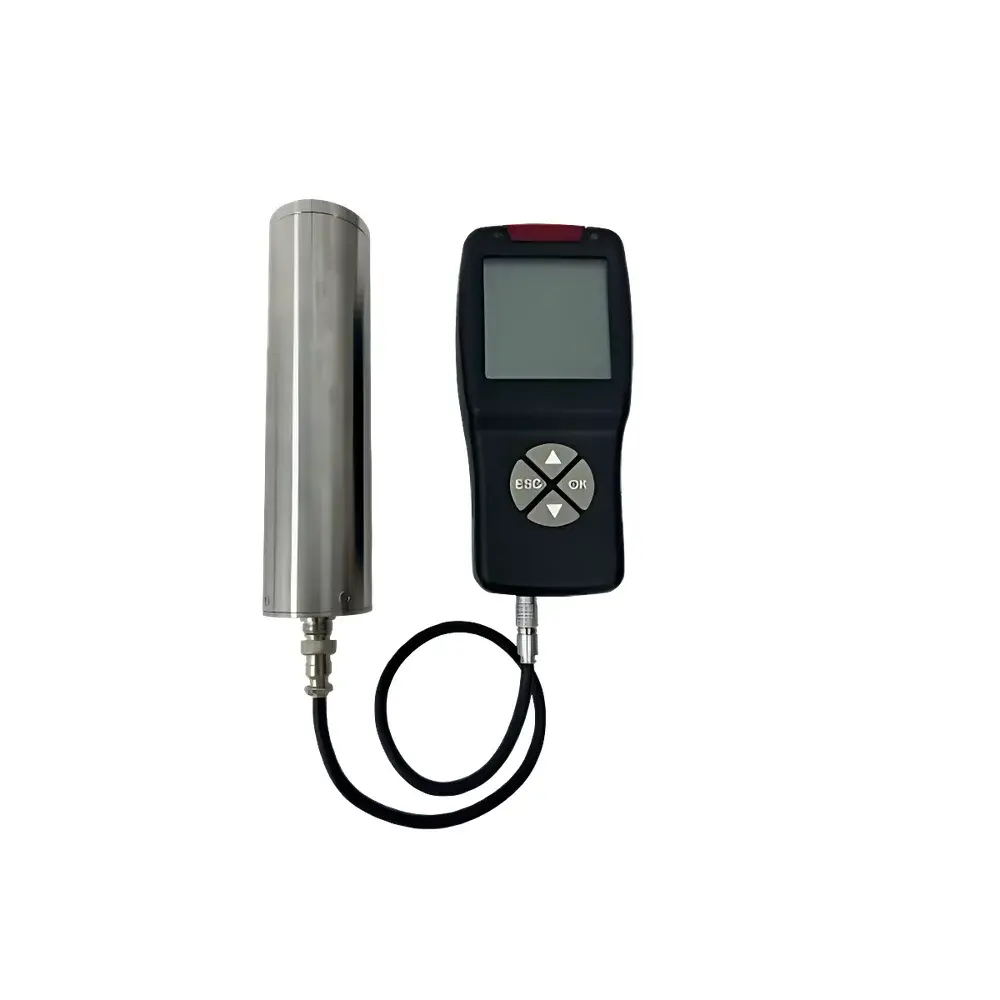
SMACH RG391 Wound Contamination Monitor
| Brand | SMACH |
|---|---|
| Origin | Fujian, China |
| Model | RG391 |
| Instrument Type | Portable Alpha/Beta Radiation Contamination Monitor |
| Detector Type | Silicon Semiconductor |
| Measurement Range | 1–99,999 counts per second (cps) |
| Detection Efficiency | α ≥ 35%, β ≥ 40% |
| Alpha Energy Range | 2–6 MeV |
| Background | α < 1 cpm, β < 60 cpm (at 0.25 µSv/h ambient dose rate) |
| Adjustable Alpha Alarm Threshold | 1–200 cpm |
| Dose Rate Range (Host) | 0.01 µSv/h – 10 mSv/h |
| Operating Temperature | −20 °C to +50 °C |
| Relative Humidity | ≤95% RH at 35 °C |
| Active Detection Area | 3.14 cm² |
| Power Supply | Rechargeable Lithium-ion Battery |
| IP Rating | IP67 (Waterproof & Dustproof Enclosure) |
Overview
The SMACH RG391 Wound Contamination Monitor is a purpose-engineered portable radiation detection instrument designed for rapid, in-situ assessment of alpha and beta surface contamination on human skin—particularly at wound sites following potential radiological exposure. It operates on the principle of direct ionization detection using a high-purity silicon semiconductor detector, optimized for low-energy charged particle discrimination and quantitative activity measurement in counts per second (cps). Unlike general-purpose survey meters, the RG391 integrates anatomically adaptive probe geometry and real-time threshold-based alarm logic specifically calibrated for clinical triage and occupational health response in nuclear medicine, emergency response, and fuel cycle facilities. Its compact form factor, low intrinsic background (<1 cpm for alpha), and stable energy response across 2–6 MeV enable reliable detection of common alpha emitters (e.g., plutonium-239, americium-241) and medium-energy beta emitters (e.g., strontium-90/ytrium-90, phosphorus-32) without requiring external scintillation coupling or gas-filled proportional counters.
Key Features
- High-sensitivity silicon semiconductor detector with 3.14 cm² active window area, engineered for optimal alpha/beta discrimination and minimal dead-time distortion at high count rates.
- Adjustable alpha-specific alarm threshold (1–200 cpm), configurable via intuitive front-panel interface to align with facility-specific action levels per IAEA Safety Guide RS-G-1.8 and NCRP Report No. 161.
- Ruggedized stainless-steel housing rated IP67, ensuring operational integrity in humid, dusty, or decontamination environments typical of field deployment.
- Integrated rechargeable lithium-ion battery system supporting continuous operation >12 hours at typical background conditions; battery status and charging state indicated via LED and on-screen iconography.
- Real-time cps readout with automatic range scaling (1–99,999 cps), logarithmic display option, and internal timestamped data logging (up to 10,000 records) compliant with ALARA documentation requirements.
- Low-background design validated under controlled 0.25 µSv/h gamma fields: α < 1 cpm, β < 60 cpm—meeting ANSI N42.33-2022 criteria for personal contamination monitors.
Sample Compatibility & Compliance
The RG391 is validated for direct contact scanning of intact and compromised epidermis, including lacerations, abrasions, and surgical incisions. Its non-invasive probe geometry minimizes mechanical trauma while maintaining consistent source-to-detector distance during dynamic scanning. The instrument complies with ISO 2889:2015 (Radiation protection — Instruments for monitoring radioactivity on skin and clothing), IEC 60846-2:2014 (Radiation protection instrumentation — Ambient and/or directional dose equivalent (rate) meters and/or monitors for beta, X and gamma radiation — Part 2: Beta radiation), and supports audit-ready recordkeeping aligned with GLP and ICH GCP Annex 13 for clinical radiological safety assessments. It is not intended for internal contamination assessment or gamma spectroscopy.
Software & Data Management
Data export is supported via USB-C interface to Windows-compatible desktop software (RG391 Manager v2.1), enabling CSV-formatted export of time-stamped cps logs, alarm events, and calibration metadata. Software features include customizable report templates (per facility SOP), overlay of regulatory thresholds (e.g., DOE Order 458.1 limits), and batch validation against reference sources (²⁴¹Am, ⁹⁰Sr/⁹⁰Y). All firmware updates and configuration changes are digitally signed and logged with user ID and timestamp, satisfying FDA 21 CFR Part 11 electronic record/electronic signature (ERES) traceability requirements for regulated environments.
Applications
- Radiation emergency medical response: Rapid screening of first responders and casualties post-incident for wound-associated contamination.
- Nuclear medicine departments: Routine pre- and post-procedure checks for staff handling unsealed alpha/beta radiopharmaceuticals (e.g., ²²⁵Ac, ¹⁷⁷Lu).
- Fuel fabrication and reprocessing facilities: Personnel monitoring during maintenance, glovebox breach response, or spent fuel handling.
- Border and customs radiological screening: Secondary inspection of individuals with suspected contact with orphan sources or illicit materials.
- Decommissioning and remediation projects: Verification of decon efficacy on personnel prior to exit from controlled zones.
FAQ
Is the RG391 suitable for detecting gamma radiation?
No—the RG391 is optimized exclusively for alpha and beta particle detection using a silicon semiconductor. Gamma sensitivity is intentionally minimized to reduce interference and improve signal-to-noise ratio for low-energy charged particles.
Does the instrument require annual calibration traceable to national standards?
Yes—calibration must be performed annually using certified alpha (²⁴¹Am) and beta (⁹⁰Sr/⁹⁰Y) reference sources traceable to NIST or equivalent national metrology institutes. Calibration certificates include uncertainty budgets per ISO/IEC 17025.
Can the RG391 be used in wet or saline environments (e.g., decon showers)?
Yes—its IP67-rated enclosure permits temporary submersion (1 m for 30 min) and operation in high-humidity or saline aerosol conditions common in radiological decontamination protocols.
What is the minimum detectable activity (MDA) for plutonium-239 on skin?
Under typical conditions (20 s counting, 1 cm² probe contact), MDA is ≤0.04 Bq/cm² for ²³⁹Pu (alpha), calculated per ANSI N13.30 methodology using measured efficiency and background.
Is firmware update capability available in the field?
Yes—updates are delivered via encrypted USB drive and installed through the onboard menu; all versions are version-controlled and documented in the device’s internal audit log.
Related Products







