
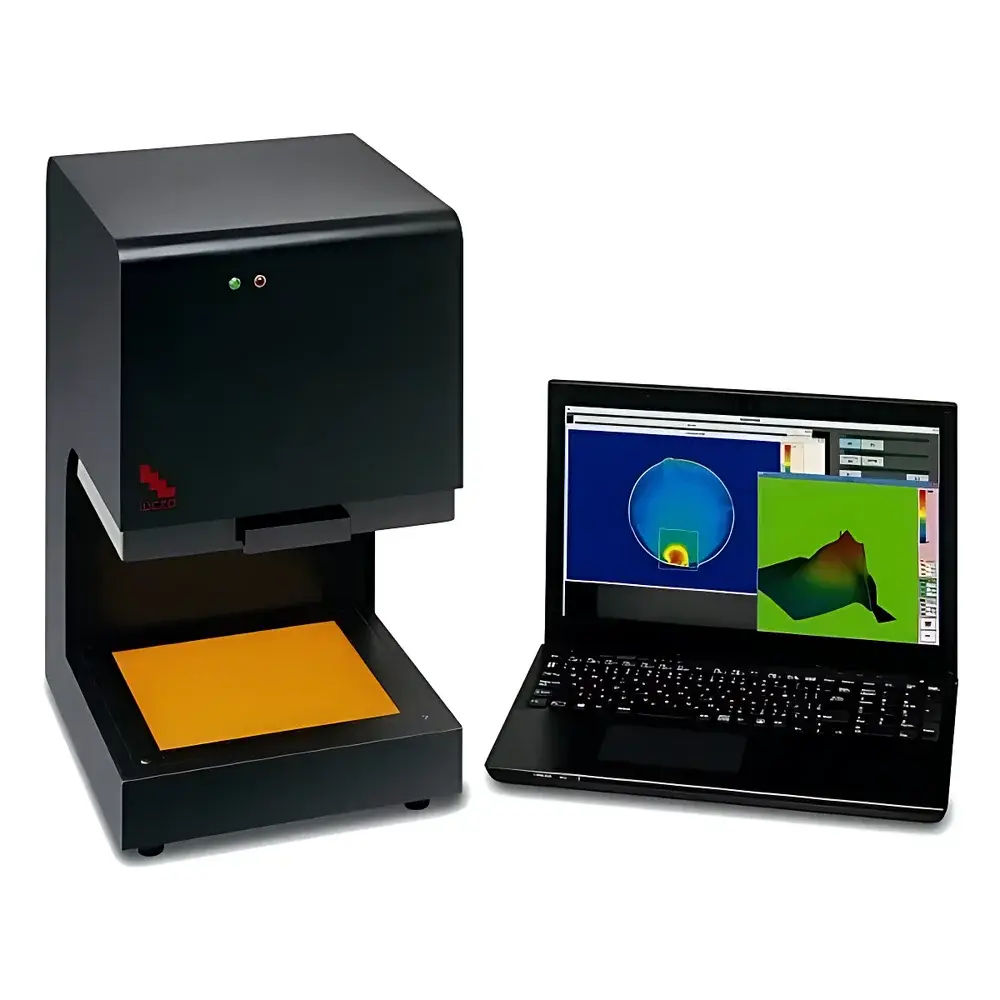
Auniontech LSM-9000LE Automated 2D Stress Imaging System
| Brand | Auniontech |
|---|---|
| Origin | Imported (Non-Chinese) |
| Manufacturer Type | Authorized Distributor |
| Model | LSM-9000LE |
| Price Range | USD 42,000 – 70,000 (FOB) |
Overview
The Auniontech LSM-9000LE is a fully automated, quantitative 2D stress imaging system designed for non-destructive evaluation of birefringence and retardation in transparent optical materials, polymer components, glass substrates, and crystalline wafers. It operates on the principle of full-field circular polarization interferometry—combining a linear polarizer and a quarter-wave plate to generate a uniform circularly polarized illumination field. Unlike conventional Senarmont or visual nulling methods that rely on manual analyzer rotation and subjective brightness judgment, the LSM-9000LE acquires phase retardation magnitude (in nanometers) and slow-axis orientation (in degrees) simultaneously at every pixel across the entire field of view. This eliminates operator-dependent variability and enables traceable, spatially resolved metrology compliant with ISO 11477 (Optics and photonics — Measurement of retardation of wave plates) and ASTM F2836 (Standard Practice for Measuring Birefringence in Transparent Plastics). The system is engineered for precision in production QA/QC labs, R&D facilities developing optical coatings or display substrates, and academic laboratories investigating residual stress in amorphous polymers or tempered glass.
Key Features
- Full-field, pixel-level acquisition of retardation (0–500 nm range typical) and slow-axis orientation (0–180°, ±0.5° angular resolution)
- Integrated high-stability LED light source (630 nm center wavelength, <1% intensity drift over 8 hours), ensuring long-term photometric consistency and eliminating filament replacement cycles
- Motorized, software-controlled polarization optics module enabling automatic calibration and measurement sequence execution without manual intervention
- High-sensitivity monochrome CCD camera (12-bit dynamic range, 1392 × 1040 active pixels) optimized for low-noise retardation mapping under controlled illumination
- Robust mechanical architecture with vibration-damped optical baseplate and thermal stabilization for repeatable measurements across ambient temperature fluctuations (15–30°C)
- Compliance-ready design supporting audit trails, user access levels, and electronic signatures per FDA 21 CFR Part 11 when operated with optional validation package
Sample Compatibility & Compliance
The LSM-9000LE accommodates planar transparent samples up to 200 mm × 200 mm and thicknesses from 0.1 mm to 25 mm—including float glass, borosilicate wafers, PMMA lenses, polycarbonate enclosures, and epoxy-encapsulated optoelectronic assemblies. Sample mounting requires no coupling gels or vacuum chucks; gravity-based placement on the calibrated stage suffices. Measurement data conforms to GLP/GMP documentation requirements when paired with the optional IQ/OQ protocol suite. All optical components meet RoHS Directive 2011/65/EU standards, and the system’s electromagnetic compatibility complies with EN 61326-1:2013 for laboratory environments.
Software & Data Management
Control and analysis are performed via Auniontech’s proprietary StressView Pro v4.2 software (Windows 10/11, 64-bit). The interface supports real-time false-color retardation maps, vector-field overlays for slow-axis direction, cross-sectional line profiles, and region-of-interest (ROI) statistical reporting (mean, std dev, min/max). Raw image stacks (TIFF, 16-bit) and processed datasets (CSV, HDF5) are timestamped and stored with embedded metadata—including instrument ID, calibration date, operator login, and environmental sensor logs (optional external hygrothermograph integration). Audit trail functionality records all parameter modifications, measurement initiations, and report exports, satisfying traceability mandates under ISO/IEC 17025:2017 Clause 7.11.
Applications
- Quantification of residual stress gradients in tempered architectural glass and smartphone cover lenses
- Process validation of injection-molded optical components (e.g., LED collimators, VR headset waveguides)
- In-process monitoring of annealing uniformity in fused silica blanks for EUV lithography masks
- Failure analysis of delamination-induced birefringence in laminated solar panel encapsulants
- Characterization of photoelastic response in 3D-printed polymer prototypes under mechanical load
- Calibration reference generation for handheld stress analyzers used in field service applications
FAQ
Does the LSM-9000LE require periodic recalibration by the user?
No—factory calibration is retained via internal reference standards. Annual verification using NIST-traceable retardation plates is recommended for ISO 17025 accreditation.
Can it measure curved or non-planar samples?
Only flat, parallel-faced samples yield valid quantitative results. Slight wedge angles (<0.1°) may be compensated via software tilt correction.
Is the system compatible with cleanroom Class 1000 environments?
Yes—the enclosure meets IP42 ingress protection, and optional stainless-steel stage variants are available for controlled environments.
What file formats are supported for export to third-party analysis tools?
CSV (retardation + angle matrices), TIFF (raw and processed images), and MATLAB .mat files with full metadata headers.
How is measurement uncertainty determined for a given sample?
Uncertainty budgets follow GUM (JCGM 100:2018) methodology and include contributions from pixel noise, LED stability, polarization extinction ratio, and stage repeatability—typically ±1.2 nm for retardation and ±0.8° for axis orientation at 95% confidence.



