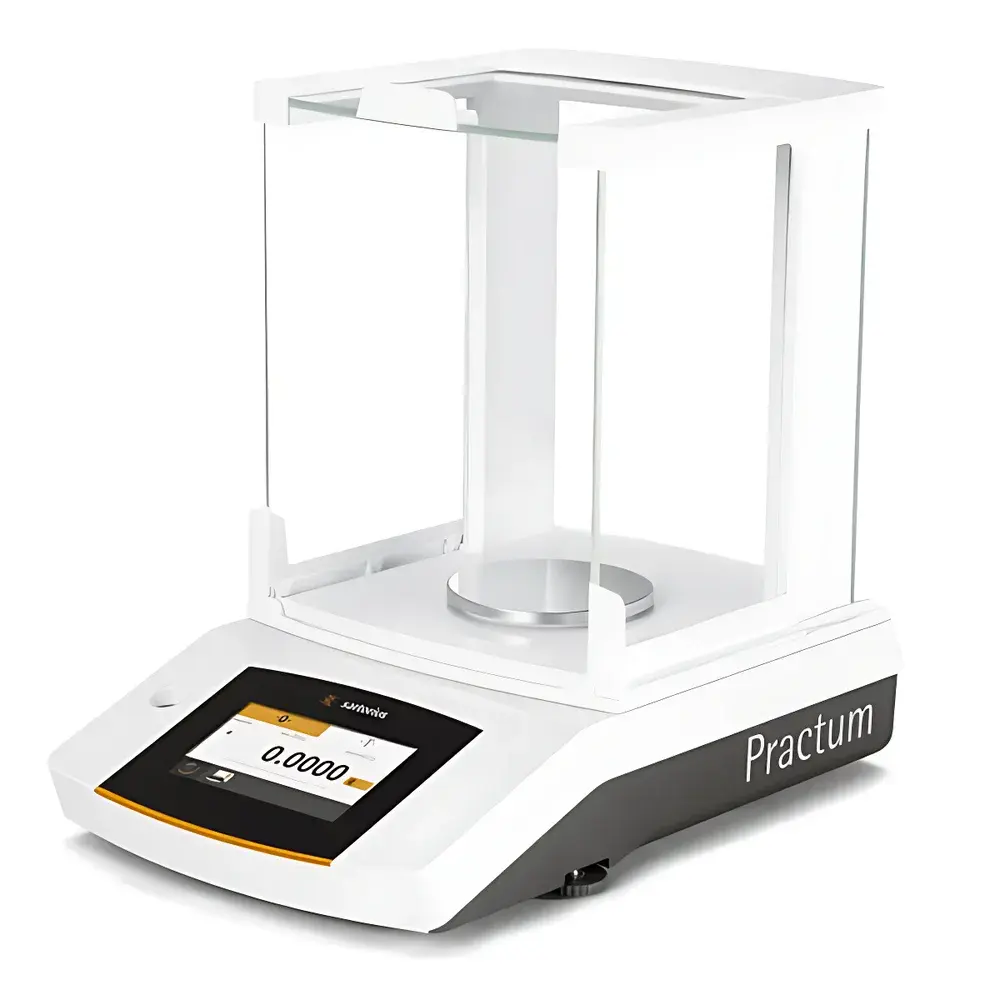
Sartorius Practum213-1CN Precision Balance
| Brand | Sartorius |
|---|---|
| Origin | Shanghai, China |
| Model | Practum213-1CN |
| Maximum Capacity | 210 g |
| Readability | 1 mg |
| Linearity | ±1 mg |
| Pan Diameter | 120 mm |
| Repeatability | 1 mg |
| Calibration | External |
| Dimensions (W × D × H) | 218 × 360 × 320 mm |
| Interface | USB |
Overview
The Sartorius Practum213-1CN is a high-reliability precision balance engineered for routine laboratory weighing tasks requiring consistent 1 mg readability and robust performance under variable environmental conditions. Built upon Sartorius’ decades of metrological expertise, this balance employs electromagnetic force compensation (EMFC) technology — the industry-standard principle for analytical and precision balances — ensuring stable, drift-resistant measurements across its full 210 g capacity range. Designed for ISO/IEC 17025-compliant laboratories, the Practum213-1CN meets fundamental requirements for traceable mass measurement in quality control, academic instruction, pharmaceutical formulation, and materials testing. Its rigid mechanical architecture, integrated anti-vibration damping, and optimized air-draft shielding minimize sensitivity to ambient disturbances such as airflow turbulence or floor-borne vibrations — critical for reproducible results in non-ideal lab spaces.
Key Features
- Electromagnetic force compensation sensor with 1 mg readability and ≤1 mg repeatability — verified per OIML R 76-1 and ASTM E898-22 protocols.
- Large 120 mm diameter stainless steel weighing pan accommodates voluminous containers, reaction flasks, or density kits without compromising stability.
- Dual-level leveling system: oversized front-mounted leveling feet paired with a highly visible bubble level indicator enable rapid, intuitive horizontal alignment — essential for maintaining metrological integrity.
- Integrated lower hook for below-pan weighing (e.g., density determination of solids using Archimedes’ principle with optional density kit).
- USB interface compliant with CDC (Communication Device Class) standard — enables direct data export to Microsoft Excel®, LIMS, or ELN platforms without proprietary drivers.
- Regulatory lock function: password-protected menu restriction prevents unauthorized configuration changes — supports GLP/GMP training environments and student labs.
- Peak hold mode: captures and retains maximum displayed value during dynamic or transient weighing events (e.g., live animal weighing, powder dispensing, or unstable sample placement).
- Stabilization-assisted weighing algorithm: dynamically adjusts filtering and response time to compensate for minor mechanical instability — validated for use on standard lab benches without active isolation tables.
Sample Compatibility & Compliance
The Practum213-1CN supports diverse sample forms including powders, granules, liquids, viscous suspensions, and solid objects — from microgram-scale aliquots to 210 g reference standards. Its sealed sensor housing and corrosion-resistant pan surface comply with IP42-rated ingress protection for resistance to dust and incidental splashes. The balance conforms to international regulatory frameworks including ISO 9001:2015 (quality management), ISO/IEC 17025:2017 (testing and calibration laboratories), and USP / guidelines for analytical balance qualification. While external calibration is required, the device supports traceable calibration using certified weights meeting ASTM E617 Class M2 or better — enabling full audit readiness for FDA 21 CFR Part 11–governed workflows when paired with compliant data acquisition software.
Software & Data Management
Data output via USB follows standard HID-compliant serial communication (ASCII format), allowing seamless integration with third-party laboratory informatics systems. No proprietary software installation is necessary; raw weight values, timestamps, and operation modes (e.g., % deviation, piece counting, density mode) are transmitted as plain-text strings. Optional Sartorius LabX Lite software (freely downloadable) provides basic audit trail functionality, user-defined report templates, and configurable auto-print intervals — supporting ALCOA+ principles (Attributable, Legible, Contemporaneous, Original, Accurate) for regulated environments. All data logs include operator ID, timestamp, balance ID, and calibration status flags — facilitating retrospective review during internal audits or regulatory inspections.
Applications
- Quantitative sample preparation in QC/QA labs (e.g., reagent weighing for HPLC mobile phase preparation, tablet formulation, or catalyst dosing).
- Teaching laboratories: ideal for undergraduate chemistry and physics courses due to intuitive interface, pedagogical lock mode, and tolerance-based checkweighing functions.
- Density determination of solids using optional Sartorius density kit (requires immersion basket and sinker assembly).
- Counting identical parts (e.g., screws, tablets, or electronic components) with automatic average-piece-weight calculation and statistical uncertainty estimation.
- Deviation analysis: comparative weighing against master standards to calculate % difference — used in stability studies and batch release testing.
- Dynamic weighing scenarios including live organism monitoring, filtration residue quantification, and gravimetric moisture analysis.
FAQ
What calibration weights are recommended for the Practum213-1CN?
External calibration requires certified Class M2 or better weights (per ASTM E617), with nominal values covering at least 5%, 50%, and 100% of full scale (i.e., 10 g, 100 g, and 210 g).
Is internal calibration available on this model?
No — the Practum213-1CN relies exclusively on external calibration; it does not feature a built-in motorized calibration mass.
Can the balance be connected to a networked LIMS?
Yes — via USB-to-serial adapter or direct USB connection to a host PC running compatible middleware (e.g., LabWare, STARLIMS, or custom Python scripts using pySerial).
Does the device support GLP-compliant audit trails?
When used with Sartorius LabX Lite or equivalent validated software, full electronic records — including user login, calibration history, and weight events — meet ALCOA+ data integrity criteria.
What is the operating temperature range?
10–30 °C, with relative humidity ≤80 % RH (non-condensing), per IEC 61000-6-3 EMC compliance specifications.