
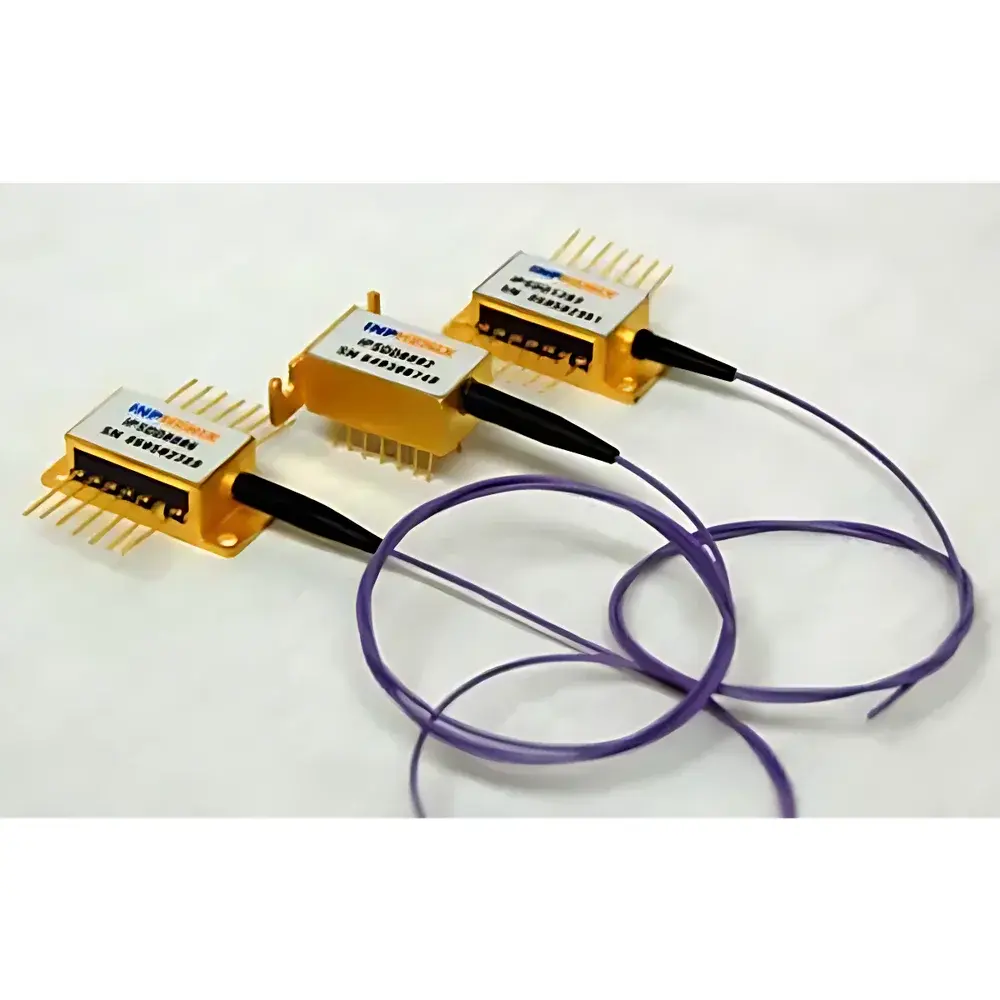
Auniontech SLD-700-1700 Superluminescent Diode Broadband Light Source
| Brand | Auniontech |
|---|---|
| Origin | Shanghai, China |
| Manufacturer Type | Authorized Distributor |
| Product Origin | Domestic (China) |
| Model | OCT-Grade SLD Module |
| Pricing | Upon Request |
Overview
The Auniontech SLD-700-1700 is a high-stability, fiber-coupled superluminescent diode (SLD) broadband light source engineered for applications demanding low temporal coherence, high spatial coherence, and spectrally smooth output. Unlike laser diodes, SLDs operate on the principle of amplified spontaneous emission (ASE) in a semiconductor waveguide without optical feedback—achieved through anti-reflection (AR)-coated facets and angled waveguide termination. This architecture suppresses cavity resonance, preventing narrow-linewidth lasing and enabling broad, Gaussian-like spectral profiles with typical full-width-at-half-maximum (FWHM) bandwidths ranging from 20 nm to over 100 nm, depending on center wavelength and design. The device delivers stable optical power (>10 mW typical coupled into single-mode fiber) across its operational range—from 700 nm to 1700 nm—with optimized variants for key biomedical and industrial bands: 800 nm (ophthalmic OCT), 1050 nm (deeper retinal and choroidal imaging), 1310 nm (cardiovascular and dermatological OCT), and 1550 nm (fiber-optic sensing, WDM-PON seeding, and low-water-absorption tissue imaging). Its low coherence length (<20 µm at 1310 nm) ensures high axial resolution in interferometric systems while maintaining robustness against speckle noise and parasitic interference.
Key Features
- Fiber-pigtailed output with FC/APC or FC/PC connector options for low back-reflection integration
- Thermoelectric cooler (TEC) stabilization and precision current control for long-term power and spectral stability (±0.5% RMS over 8 hours)
- Integrated monitoring photodiode with analog voltage output for real-time power feedback
- Compliance with IEC 60825-1:2014 Class 1 laser safety requirements when operated within specified drive conditions
- Compact OEM module housing (90 × 70 × 25 mm) with standardized 0–5 V analog control interface and RS-232 digital communication port
- Qualified for continuous operation under GLP-compliant laboratory environments and medical device development workflows
Sample Compatibility & Compliance
The SLD-700-1700 is compatible with standard single-mode fibers (SMF-28, HI1060, PM980) and polarization-maintaining fiber variants upon request. It meets essential electromagnetic compatibility (EMC) standards per EN 55032:2015 and EN 61000-3-2:2019. For medical applications—including optical coherence tomography systems intended for regulatory submission—the module supports traceable calibration documentation and can be supplied with ISO/IEC 17025-accredited spectral characterization reports (center wavelength, FWHM, spectral flatness, roll-off). While not itself a finished medical device, it conforms to critical subsystem requirements referenced in ISO 13485:2016 and FDA guidance for OCT light sources used in Class II diagnostic instruments.
Software & Data Management
Auniontech provides the SLD Control Suite—a cross-platform (Windows/macOS/Linux) application supporting both GUI-driven operation and script-based automation via Python SDK (PySLD). The software enables precise current ramping, TEC setpoint adjustment, real-time power logging, and spectral drift trending. All parameter changes and operational events are timestamped and logged with audit-trail capability compliant with FDA 21 CFR Part 11 Annex 11 requirements when deployed on validated systems. Export formats include CSV, HDF5, and XML for integration into LabVIEW, MATLAB, or custom OCT reconstruction pipelines.
Applications
- Optical Coherence Tomography (OCT): Axial resolution enhancement in ophthalmic, intravascular, and dermatological imaging systems; supports spectral-domain (SD-OCT) and swept-source (SS-OCT) architectures.
- White-Light Interferometry: Surface topography measurement, thin-film thickness analysis, and chromatic dispersion characterization of optical coatings and waveguides.
- Fiber-Optic Sensing: Distributed temperature/strain monitoring in structural health monitoring (SHM) of bridges, pipelines, and aerospace composites using interferometric or FBG interrogation schemes.
- Fiber-Optic Gyroscopes (FOGs): Low-coherence seed source for closed-loop interferometric rotation sensing in avionics-grade inertial navigation units.
- WDM-PON Testing & Deployment: Broadband source for characterizing insertion loss, polarization-dependent loss (PDL), and channel uniformity in passive optical networks.
FAQ
What is the typical coherence length of the SLD-700-1700 at 1310 nm?
Coherence length is approximately 15–18 µm (FWHM definition), calculated from measured spectral bandwidth (~55 nm) using the relation Lc ≈ λ²/Δλ.
Can this SLD be integrated into an FDA-submitted OCT system?
Yes—when configured with documented calibration, thermal derating data, and failure mode analysis, it serves as a qualified subsystem component meeting IEC 62304:2015 software lifecycle and ISO 14971:2019 risk management requirements.
Is polarization-maintaining (PM) fiber output available?
PM-fiber versions (e.g., PM980 or Panda-type) are offered as custom configurations with extinction ratio >20 dB and alignment verification report.
Does the module support TTL-triggered modulation?
An optional external modulation input (0–5 V, up to 1 MHz bandwidth) is available for pulsed operation or synchronization with camera acquisition triggers.
What is the recommended operating lifetime under continuous drive?
Rated MTTF exceeds 25,000 hours at nominal drive current and case temperature ≤35 °C, per Telcordia GR-468-CORE reliability testing protocol.




