
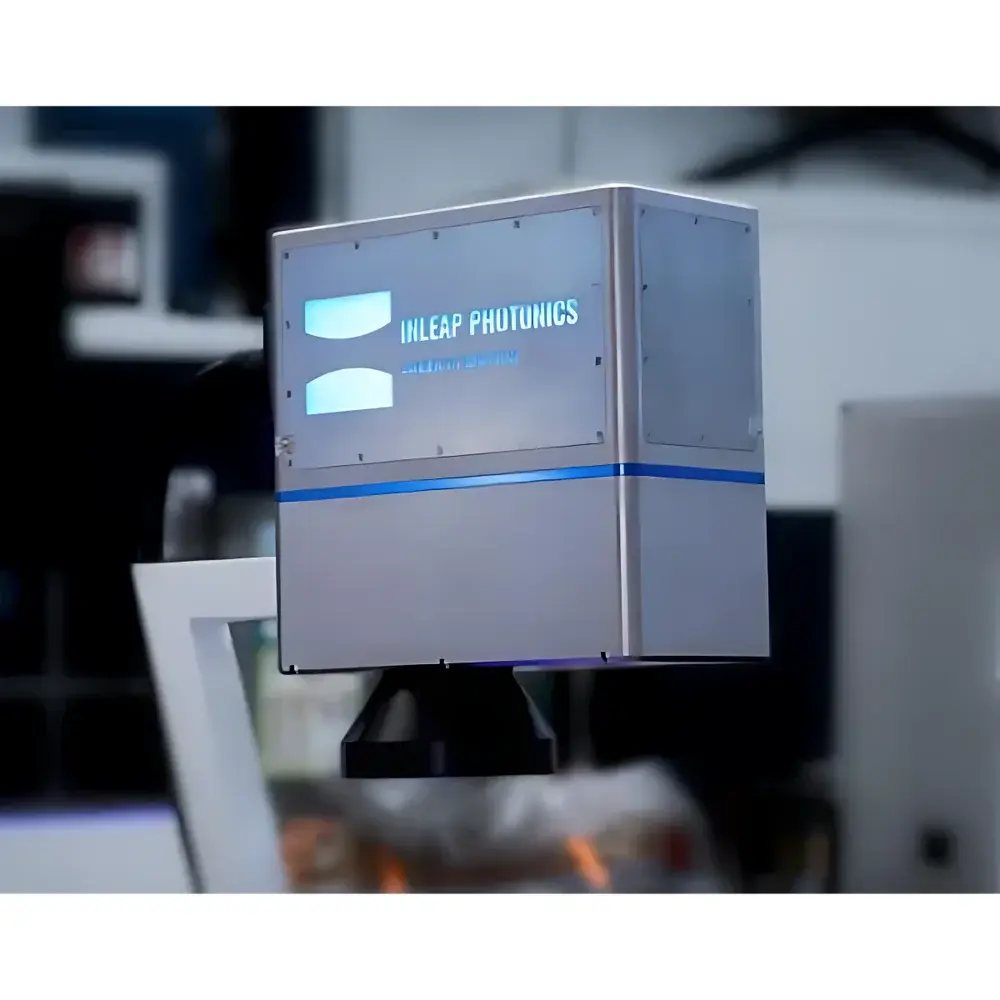
FASTLIGHT High-Speed Laser Beam Steering System by Auniontech
| Brand | Auniontech |
|---|---|
| Origin | Shanghai, China |
| Manufacturer Type | Authorized Distributor |
| Product Category | Domestic |
| Model | FASTLIGHT Pixel-Based Beam Steering System |
| Steering Frequency | Up to 200 kHz (pixel-switching rate) |
| Power Handling | Up to 2000 W CW at 1070 nm |
| Beam Spot Size | Down to 50 µm (single pixel) |
| Pixel Array | Configurable 1D/2D matrix, up to 1000 pixels |
| Maximum Jump Velocity | 200,000 m/s (over 100 mm array length) |
| Optical Compatibility | Compatible with commercial CW & pulsed lasers, f-θ lenses, galvanometers, polygon scanners |
Overview
The FASTLIGHT High-Speed Laser Beam Steering System by Auniontech is a solid-state, pixel-addressable beam positioning platform engineered for industrial laser materials processing. Unlike conventional galvanometric scanners relying on mechanical inertia-limited mirror rotation, FASTLIGHT employs a monolithic, micro-structured optical switching architecture—effectively a spatial light modulator (SLM)-derived beam routing engine—to achieve deterministic, non-mechanical laser spot placement. Its core principle is pixel-wise, electro-optically or thermo-optically controlled beam redirection across a discrete 1D or 2D array of optical channels. This enables sub-millisecond dwell-to-dwell transitions and eliminates settling time, vibration, and wear associated with moving parts. Designed for integration into high-throughput manufacturing lines—including battery electrode structuring, semiconductor annealing, and LPBF-based additive manufacturing—the system delivers repeatable, programmable irradiation patterns without sacrificing average power or beam quality.
Key Features
- Pure solid-state architecture: No moving mirrors or motors; fully static optical path ensures long-term alignment stability and zero maintenance downtime.
- 2500× faster steering than standard galvanometers: Achieves effective jump velocities exceeding 200,000 m/s across a 100 mm baseline, enabling ultra-rapid sequential addressing of up to 1000 discrete beam positions.
- Sub-50 µm spot fidelity: Maintains diffraction-limited focus consistency across all addressed pixels when paired with industry-standard f-θ lenses or telecentric optics.
- Full CW/pulsed laser compatibility: Rated for continuous-wave operation up to 2000 W at 1070 nm, with thermal management optimized for high-duty-cycle industrial lasers (e.g., fiber, disk, or direct-diode sources).
- Dynamic power modulation per pixel: Integrated analog/digital control interface supports real-time, position-synchronized laser power adjustment—critical for multi-material processing or heat-affected zone (HAZ) minimization.
- Configurable 1D/2D addressing: Supports linear scan profiles (e.g., foil scribing, LIBS line scanning) and rasterized 2D field coverage (e.g., annealing large-area TFT backplanes or welding motor stator laminations).
Sample Compatibility & Compliance
FASTLIGHT is compatible with standard industrial laser wavelengths (1030–1080 nm, with custom variants available for UV/visible/NIR), and interfaces seamlessly with OEM laser controllers via TTL, analog voltage, or EtherCAT protocols. The optical train preserves M² < 1.3 beam propagation characteristics and supports polarization-maintaining configurations upon request. System design adheres to IEC 60825-1:2014 (laser safety) and ISO 11553-1:2013 (machine safety for laser processing equipment). When integrated into automated production cells, the controller firmware supports audit-trail logging and configurable user access levels—facilitating compliance with ISO 9001 quality management systems and internal GLP/GMP documentation requirements.
Software & Data Management
The FASTLIGHT Control Suite provides a Windows-based GUI and SDK (C/C++, Python, LabVIEW) for defining pixel maps, dwell times, power profiles, and trajectory sequences. Pattern generation supports DXF import, parametric scripting, and real-time synchronization with motion stages or encoder feedback. All configuration files and execution logs are timestamped and stored in SQLite format, enabling traceability for process validation. Optional OPC UA server integration allows bidirectional data exchange with MES/SCADA platforms. Firmware updates are performed over secure HTTPS with SHA-256 signature verification, satisfying basic cybersecurity hygiene requirements for Industry 4.0 deployment.
Applications
- Battery manufacturing: High-speed cutting and welding of Cu/Al foils, tab welding, and anode/cathode edge trimming—reducing thermal distortion through precise dwell control.
- Semiconductor processing: Localized laser annealing of polysilicon layers, selective dopant activation, and wafer-level trimming of thin-film resistors.
- Additive manufacturing: Pixel-synchronized powder bed preheating and melt pool stabilization in LPBF systems, improving layer adhesion and reducing residual stress.
- LIBS and spectroscopy: Rapid line-scanning for elemental mapping on moving substrates (e.g., coated steel strips, recycled battery cathodes).
- Surface functionalization: Controlled micro-texturing of medical implants or mold inserts using stochastic or periodic pixel address patterns.
FAQ
What laser sources are compatible with FASTLIGHT?
FASTLIGHT supports fiber, disk, and direct-diode lasers operating between 1030 nm and 1080 nm (standard), with custom designs available for 532 nm, 355 nm, or broadband sources.
Can FASTLIGHT replace a galvanometer scanner in existing systems?
Yes—mechanical footprint and flange dimensions are designed for drop-in replacement; electrical interface adapters and mounting kits are provided for common OEM scanner housings.
Is beam pointing stability affected by ambient temperature fluctuations?
The monolithic optical substrate uses low-thermal-expansion materials (e.g., ULE or Zerodur), and active thermal compensation algorithms maintain pointing accuracy within ±0.5 µrad over 15–35 °C ambient range.
How is calibration performed and maintained?
Factory calibration includes pixel-to-position mapping with interferometric verification; users can perform field recalibration using built-in camera-assisted alignment routines and NIST-traceable reference targets.
Does FASTLIGHT support FDA 21 CFR Part 11 compliance?
While the base system does not include electronic signatures, the optional Audit Trail Module logs all parameter changes, user actions, and execution events with tamper-proof timestamps—enabling customers to build compliant workflows per Part 11 Annex 11 guidelines.




