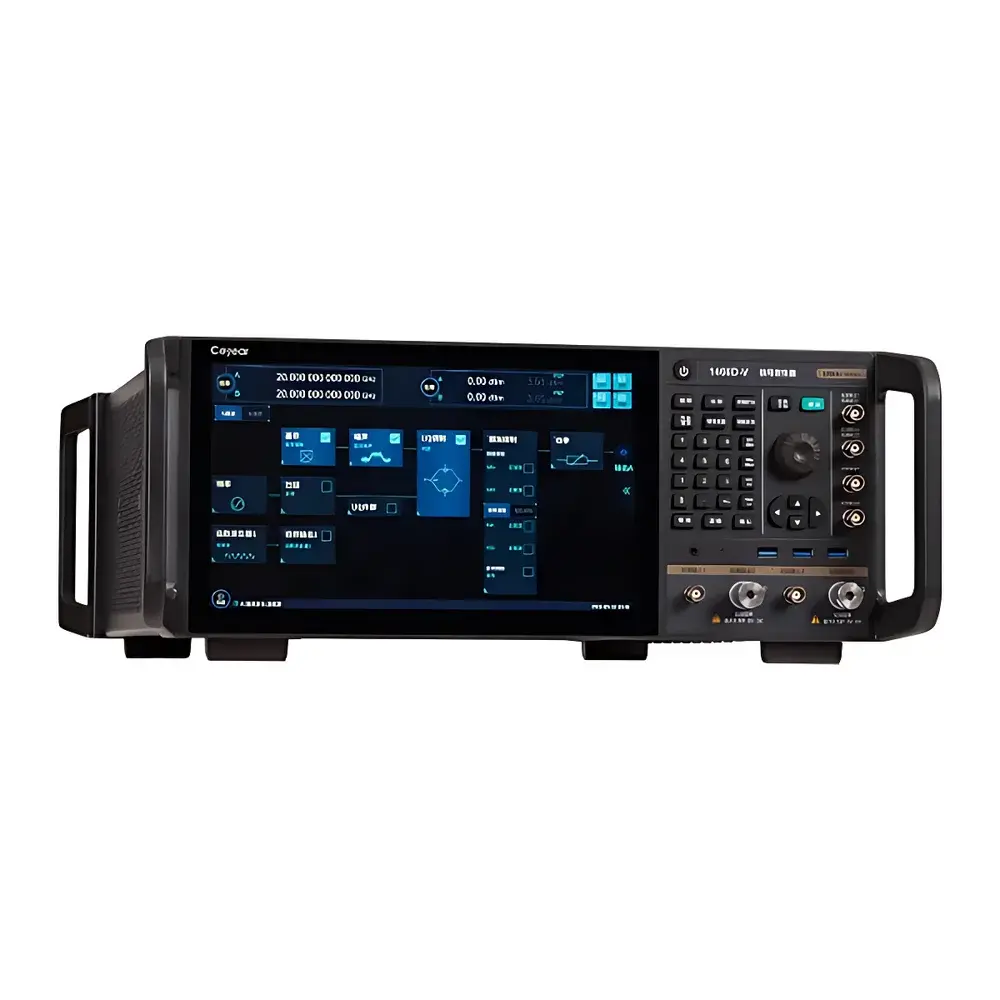
Auniontech VSG-67G High-Performance Vector Signal Generator
| Brand | Auniontech |
|---|---|
| Origin | Shanghai, China |
| Model | VSG-67G |
| Frequency Range | 6 kHz to 67 GHz (coaxial) |
| RF Modulation Bandwidth | up to 2 GHz (configurable: 500 MHz / 1 GHz / 2 GHz) |
| Phase Noise | –132 dBc/Hz (typ., 10 GHz carrier, 10 kHz offset) |
| Spurious | < –80 dBc (10 GHz carrier) |
| Wideband Noise Floor | –161 dBc/Hz (typ., 20 GHz carrier, 30 MHz offset) |
| Output Power Range | –150 dBm to +25 dBm (programmable) |
| EVM | < 0.8% (5G NR FR2, 28 GHz) |
| ACPR | < –55 dBc (5G NR, 2 GHz carrier, typ.), < –45 dBc (42.5 GHz carrier, typ.) |
| Fading Channels | up to 20 paths |
| Built-in Standards | 5G NR (FR1/FR2), LTE, WLAN 802.11a/b/g/n/ac/ax, Bluetooth, DVB-T, ISDB-T, and more |
Overview
The Auniontech VSG-67G is a high-performance vector signal generator engineered for demanding microwave and millimeter-wave test applications across research, development, and production environments. Based on direct digital synthesis (DDS) and advanced wideband upconversion architecture, it delivers coherent, low-phase-noise RF signals from 6 kHz to 67 GHz via precision coaxial output. Its design emphasizes spectral purity, modulation fidelity, and dynamic range—critical parameters for validating next-generation wireless systems, radar subsystems, and RF front-end components. The instrument supports both internal baseband generation and external I/Q input, enabling seamless integration into automated test systems and hardware-in-the-loop (HIL) validation platforms. Unlike legacy signal sources, the VSG-67G implements real-time digital predistortion and adaptive calibration algorithms to maintain vector accuracy across its full frequency and power range—making it suitable for standards-compliant conformance testing under 3GPP, IEEE 802.11, and ITU-R frameworks.
Key Features
- Ultra-wide frequency coverage: 6 kHz–67 GHz in a single coaxial path, eliminating the need for multiple instruments or external mixers.
- Programmable RF modulation bandwidth: factory-configurable options of 500 MHz, 1 GHz, or 2 GHz; extends to 5 GHz when driven by external baseband sources with ≥2 GS/s sample rate.
- Exceptional spectral integrity: phase noise as low as –132 dBc/Hz at 10 GHz (10 kHz offset), spurious content < –80 dBc, and wideband noise floor of –161 dBc/Hz (20 GHz, 30 MHz offset).
- High-fidelity vector modulation: error vector magnitude (EVM) < 0.8% for 5G NR FR2 (28 GHz, 400 MHz bandwidth, 64-QAM), validated per 3GPP TS 38.141-1.
- Dual independent RF outputs per chassis, supporting amplitude-, phase-, and time-aligned multi-channel stimulus for MIMO, beamforming, and spatial diversity testing.
- Hardware-accelerated fading simulation: up to 20 independently configurable fading paths with Doppler spectrum shaping, supporting 3GPP TR 38.901-defined TDL, CDL, and EPA/ETU models.
- Comprehensive built-in waveform library: over 600 standardized test models—including 5G NR FRCs, LTE RMCs, WLAN OFDM symbols, and pulsed radar waveforms—with editable parameters such as roll-off, cyclic prefix, and subcarrier spacing.
Sample Compatibility & Compliance
The VSG-67G is designed for compatibility with industry-standard test workflows and regulatory requirements. Its firmware implements traceable calibration routines aligned with ISO/IEC 17025 metrological principles, and all output settings—including frequency, power, modulation state, and timestamped parameter changes—are logged with audit-trail capability compliant with FDA 21 CFR Part 11 and GLP/GMP documentation protocols. The instrument supports SCPI 1999 and IVI-COM driver interfaces, ensuring interoperability with Keysight PathWave, NI TestStand, and Python-based automation frameworks. It meets EN 61326-1 (EMC) and EN 61010-1 (safety) for laboratory use, and its RF emissions are certified to CISPR 11 Class B limits. For wireless device certification, the generator satisfies the signal quality prerequisites outlined in ETSI EN 300 328, EN 301 893, and FCC Part 2, Subpart J.
Software & Data Management
Control and waveform generation are managed through Auniontech’s SignalStudio Pro software suite—a Windows-based application supporting both GUI-driven configuration and script-based batch operation. The software includes integrated baseband editors for custom QAM, OFDM, and chirp sequences, with real-time spectral preview, constellation diagram rendering, and EVM/ACPR measurement overlays. All waveform files are stored in IEEE 1596-compliant .wvz format, enabling cross-platform portability and version-controlled revision history. For enterprise deployment, the VSG-67G supports RESTful API access over HTTPS, allowing integration into CI/CD pipelines and cloud-hosted test orchestration systems. Firmware updates are delivered via signed binary packages with SHA-256 verification, and configuration backups include cryptographic checksums to ensure data integrity during archival or transfer.
Applications
- 5G/6G Physical Layer Validation: Generation of FR1 and FR2 test models (including PDSCH/PUSCH with DM-RS, SSB bursts, and TDD frame structures) for transceiver characterization and OTA chamber testing.
- Radar System Development: Synthesis of linear FM, Barker-coded, and phase-coded pulses; dynamic multi-target echo simulation with programmable Doppler shift, range delay, and RCS scaling.
- RF Component Testing: Stimulus for amplifier linearity analysis (ACPR, ACLR, AM-AM/AM-PM), filter group delay measurement, and mixer conversion loss evaluation across mmWave bands.
- Wireless Coexistence Studies: Simultaneous emission of WLAN, Bluetooth LE, and NB-IoT signals with controlled interference timing and power ratios to assess receiver robustness.
- Quantum Control Signal Generation: Low-jitter, phase-stable CW and modulated tones for superconducting qubit control lines, meeting coherence time requirements in dilution refrigerator environments.
FAQ
Does the VSG-67G support phase-coherent multi-unit synchronization?
Yes—via dedicated 10 MHz and 1 PPS reference inputs/outputs, plus deterministic latency compensation for inter-chassis alignment within ±10 ps RMS jitter.
Can I import custom MATLAB or Python-generated waveforms?
Yes—the SignalStudio Pro software accepts CSV, HDF5, and MAT v7.3 files containing complex I/Q samples at user-defined sampling rates; automatic resampling and interpolation preserve spectral fidelity.
Is remote programming supported over LAN or USB?
Yes—SCPI commands are fully implemented over TCP/IP (port 5025), VXI-11, and USBTMC; IVI drivers for LabVIEW, C#, and Python (PyVISA) are included with the installation package.
What calibration documentation is provided?
Each unit ships with a NIST-traceable calibration certificate covering amplitude accuracy, frequency accuracy, phase noise, and EVM performance at key frequencies (1 GHz, 10 GHz, 28 GHz, 42.5 GHz, and 67 GHz).
How is firmware updated, and is rollback supported?
Firmware updates are performed via secure HTTPS download; the bootloader retains the previous version and allows verified rollback within 72 hours of installation.