
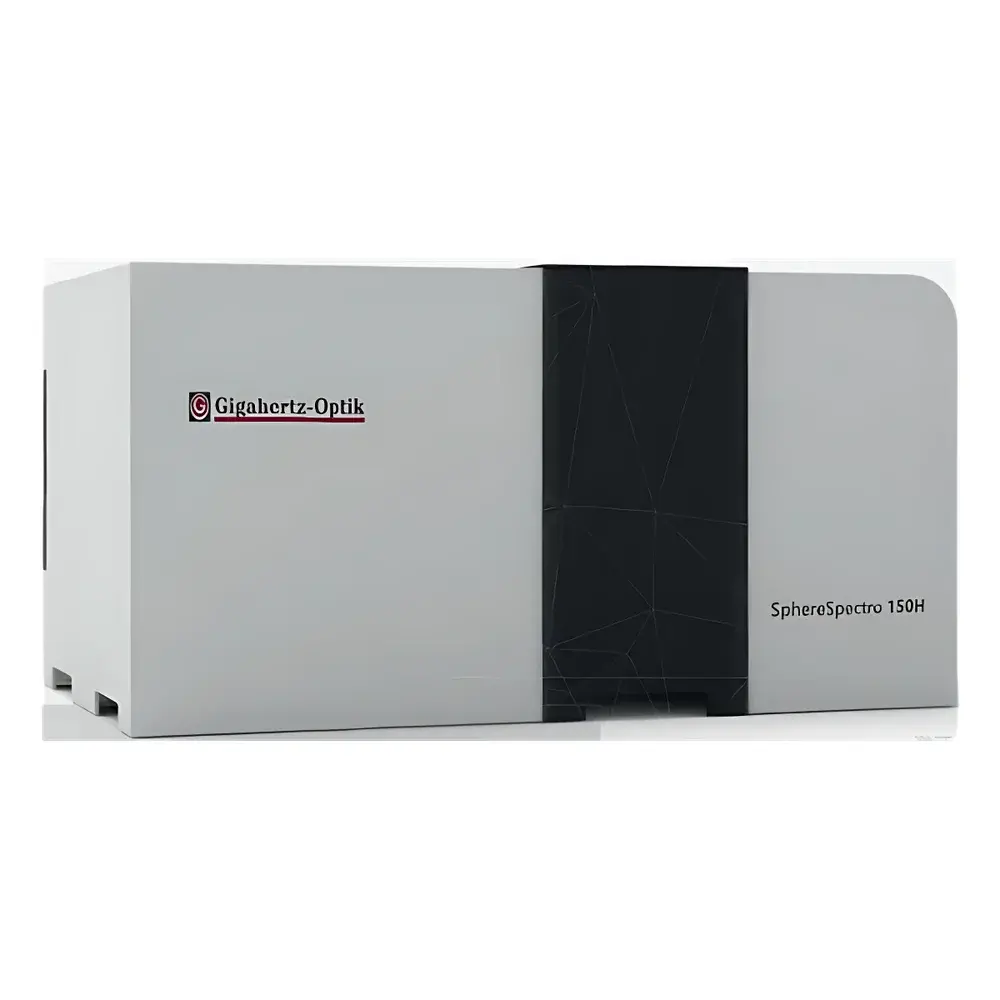
Gigahertz Optik SphereSpectro 150H UV-VIS-NIR Spectrophotometer
| Brand | Gigahertz Optik |
|---|---|
| Origin | Germany |
| Model | SphereSpectro 150H |
| Spectral Range (Version 3) | 240–2150 nm |
| Measurement Principle | Dual-parameter radiative transfer-based spectroscopy |
| Key Outputs | Spectral absorption coefficient (μₐ) and reduced scattering coefficient (μₛ′) |
| Typical Measurement Time | < 5 s (standard), ≤ 120 s (high-resolution) |
| Uncertainty Components | ±1% for μₐ/μₛ′ (thickness +1%), −5% (thickness −5%), ±0.01 to −0.06 refractive index deviation impact |
Overview
The Gigahertz Optik SphereSpectro 150H is a research-grade, dual-parameter UV-VIS-NIR spectrophotometer engineered for absolute, physics-based optical characterization of turbid and highly scattering media. Unlike conventional single-channel absorption or transmittance spectrometers, the SphereSpectro 150H implements a rigorously validated implementation of radiative transfer theory (RTT) to simultaneously quantify two fundamental optical properties: the spectral absorption coefficient (μₐ, in cm⁻¹) and the reduced scattering coefficient (μₛ′, in cm⁻¹). This capability is essential for quantitative analysis of biological tissues, pharmaceutical powders, cosmetic emulsions, food matrices, polymer composites, and other optically heterogeneous samples where photon pathlengths are statistically distributed and classical Beer–Lambert assumptions fail. The system operates across three configurable spectral bands—Version 1 (350–1050 nm), Version 2 (350–2150 nm), and Version 3 (240–2150 nm)—enabling seamless coverage from deep ultraviolet through near-infrared, with high-fidelity spectral calibration traceable to NIST-traceable reference standards.
Key Features
- Simultaneous determination of μₐ and μₛ′ via inverse modeling of spatially resolved diffuse reflectance and transmittance data
- Large-volume integrating sphere sample chamber accommodating solid slabs, liquid cuvettes, powders, and irregular geometries with multiple probe-mounting configurations
- Modular optical design supporting interchangeable light sources (deuterium, tungsten-halogen, and optional quartz-tungsten-halogen for UV extension) and cooled InGaAs/Si detectors
- Factory-calibrated wavelength accuracy ±0.2 nm (UV-VIS), ±1.0 nm (NIR); spectral resolution configurable down to 1 nm FWHM
- Robust mechanical architecture with temperature-stabilized optical bench and vibration-damped housing for laboratory and QA/QC environments
- Plug-and-play operation with integrated shutter control, automatic dark/reference correction, and real-time signal-to-noise optimization
Sample Compatibility & Compliance
The SphereSpectro 150H is optimized for non-destructive, contact-free or minimally invasive measurement of both transmission and diffuse reflectance from semi-transparent and opaque scattering materials. Compatible sample formats include: solid planar specimens (e.g., tissue phantoms, polymer films, ceramic coatings), liquid suspensions (e.g., milk, colloidal dispersions), powdered pharmaceuticals, and layered biological constructs. All hardware and firmware comply with CE marking requirements and electromagnetic compatibility (EMC) Directive 2014/30/EU. The instrument supports audit-ready operation under GLP and GMP frameworks: software enforces user authentication, electronic signatures, and full audit trails for all calibration events, measurement sessions, and parameter modifications—fully aligned with FDA 21 CFR Part 11 principles. Traceable calibration certificates (wavelength, irradiance, linearity) are supplied with each system and updated per ISO/IEC 17025-accredited procedures.
Software & Data Management
Control and analysis are performed using the proprietary SphereSoft 5.x platform—a Windows-based application developed specifically for RTT-based optical property inversion. The software provides intuitive workflow navigation, real-time spectral preview, batch processing for multi-sample studies, and export of fully annotated datasets in HDF5, CSV, and MATLAB-compatible formats. Core algorithms implement iterative Levenberg–Marquardt fitting against analytical solutions of the diffusion approximation to the radiative transfer equation, incorporating user-defined optical boundary conditions (e.g., refractive index mismatch, slab thickness, anisotropy factor g). Raw detector signals, corrected spectra, inverted μₐ/μₛ′ curves, confidence intervals, and residual error maps are all stored with metadata including timestamp, operator ID, calibration status, and environmental sensor readings (ambient temperature/humidity). Data integrity is enforced via SHA-256 hashing and write-once archival options.
Applications
- Biophotonics: Quantitative tissue optics, optical biopsy development, hemoglobin/oxyhemoglobin differentiation in vivo and ex vivo
- Pharmaceutical QA: Active pharmaceutical ingredient (API) concentration mapping in tablet matrices, excipient interaction studies, coating uniformity assessment
- Food Science: Fat/water content estimation in dairy products, ripeness evaluation in fruits, adulteration detection in oils
- Materials Science: Characterization of nanoparticle-loaded polymers, solar cell absorber layers, and translucent architectural glazing
- Cosmetic Formulation: SPF prediction modeling, pigment dispersion homogeneity, emulsion stability monitoring
- Chemometrics: Building robust PLS and PCA models linking optical properties to compositional or functional endpoints
FAQ
How does the SphereSpectro 150H differ from standard UV-VIS-NIR spectrophotometers?
It measures not only absorbance but also derives the reduced scattering coefficient (μₛ′) by solving the radiative transfer equation—enabling absolute optical property quantification in turbid media where conventional instruments yield ambiguous or non-quantitative results.
Is the system suitable for regulatory submissions (e.g., FDA, EMA)?
Yes—software features electronic signatures, audit trails, and calibration traceability meeting 21 CFR Part 11 and Annex 11 requirements; validation documentation packages are available upon request.
What sample preparation is required?
Minimal preparation: solid samples require known thickness and parallel surfaces; liquids require standard 1-cm pathlength cuvettes; powders may be compressed into pellets or measured in specialized holders.
Can the system be upgraded from VIS-only to UV-VIS-NIR configuration?
Yes—hardware modules (UV source, NIR detector, grating) are field-upgradeable; firmware and software licenses are updated remotely via secure portal.
What is the typical measurement uncertainty for μₐ and μₛ′?
Under nominal conditions (1-mm-thick PMMA phantom, n = 1.49), combined standard uncertainty is ≤ ±1.2% for μₐ and ≤ ±2.5% for μₛ′, as verified per ISO/IEC Guide 98-3 (GUM).




