
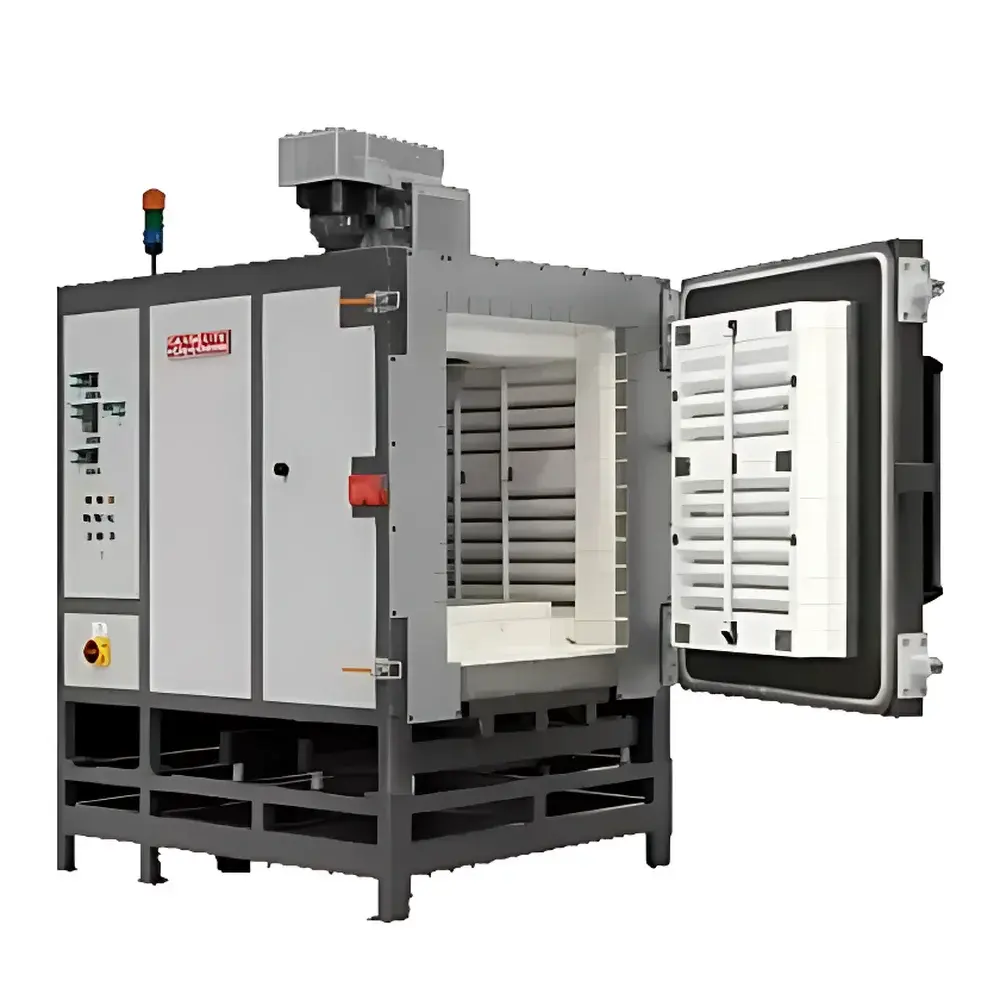
Carbolite Gero SBCF Static Car Bottom Furnace
| Brand | Carbolite Gero |
|---|---|
| Origin | Germany |
| Instrument Type | Box-Type Muffle Furnace |
| Model | SBCF |
| Rated Maximum Temperature | 1100 °C |
| Temperature Control Zones | 3-zone (with EPC3008P1 master controller and two EPC3016 slave units) |
| Compliance | AMS 2750F Class 2 / Class 3 capable |
| Heating Element | Spiral-wound resistance wire |
| Insulation | Low-thermal-mass ceramic fiber with high-density refractory lining at load zone |
| Hearth Material | Silicon carbide (SiC) tile-lined, wear-resistant |
| Chamber Geometry | Cubic |
| Door Configuration | Hinged single door (left- or right-hinged) |
| Optional Accessories | Recirculation blower for enhanced temperature uniformity |
| Safety | Dual-layer insulation, surface temperature <50 °C under full-load operation, independent overtemperature protection (OTL) circuit |
Overview
The Carbolite Gero SBCF Static Car Bottom Furnace is an industrial-grade, programmable box-type muffle furnace engineered for precision thermal processing in research laboratories, quality control environments, and aerospace component manufacturing. Designed around the fundamental principles of radiant heat transfer and controlled convection (when equipped with optional recirculation), the SBCF operates on a robust resistive heating architecture using high-stability spiral-wound resistance wire elements. Its 3-zone temperature control system—comprising one EPC3008P1 master controller and two EPC3016 slave controllers—enables independent thermal profiling across the furnace chamber height, depth, and width. This architecture directly supports compliance with stringent thermal process standards including AMS 2750F Class 2 and Class 3, making it suitable for heat treatment qualification, stress relief, sintering, ashing, and calcination where spatial temperature uniformity (±1 °C to ±3 °C across working volume, depending on configuration and load) and repeatability are critical.
Key Features
- Triple-zone programmable temperature control with EPC3008P1 master and EPC3016 slave controllers, enabling synchronized setpoint transmission and real-time thermal mapping capability
- AMS 2750F-compliant thermal architecture, including independent overtemperature limit (OTL) circuit with fail-safe cut-off and certified calibration traceability
- Cubic chamber geometry with three standard internal volume options (e.g., 45 L, 90 L, 150 L), optimized for uniform radiant heat distribution and minimal thermal gradients
- Dual-layer insulation system: low-thermal-mass ceramic fiber blanket combined with high-density refractory brick lining at the hearth zone, minimizing energy consumption and thermal lag
- Wear-resistant silicon carbide (SiC) hearth tiles—rated for continuous operation up to 1100 °C—provide mechanical durability against abrasive sample containers and repeated thermal cycling
- Static car-bottom configuration with heavy-duty steel rails and precision-ground trolley; enables vertical loading via overhead crane or hoist while maintaining furnace integrity and safety interlocks
- Surface temperature maintained below 50 °C during steady-state operation at maximum temperature, meeting EN 60519-2 and OSHA workplace safety requirements
Sample Compatibility & Compliance
The SBCF accommodates a broad range of sample forms—including crucibles (alumina, quartz, platinum), ceramic setters, metal trays, and custom fixtures—within its rigid SiC-lined cubic chamber. Its design conforms to ASTM E1142 (Standard Specification for Laboratory Furnaces), ISO 8501-4 (thermal treatment of metallic substrates), and USP (for thermal validation in pharmaceutical stability testing). When configured with recirculation blower and calibrated thermocouple mapping per AMS 2750F Section 3.3.2, the furnace achieves Class 2 or Class 3 thermal uniformity certification. All control systems comply with IEC 61508 SIL 2 functional safety requirements, and data logging meets FDA 21 CFR Part 11 audit trail and electronic signature readiness when integrated with validated software platforms.
Software & Data Management
The EPC3008P1 controller provides 16-segment programmable ramp-soak profiles, real-time graphical display, USB export of temperature/time logs, and RS485 Modbus RTU interface for integration into LabVantage, Siemens Desigo, or custom SCADA systems. Optional Carbolite Gero FurnaceLink™ software enables remote monitoring, automated report generation (PDF/CSV), alarm history archiving, and GLP/GMP-compliant electronic signatures. All temperature records include timestamped metadata (controller ID, thermocouple type, calibration due date), supporting ISO/IEC 17025 accreditation and internal audit preparedness.
Applications
- Aerospace component heat treatment (solution annealing, aging, stress relieving) per AMS 2750F and NADCAP AC7102
- Thermal analysis sample preparation (TGA/DTA/DSC pre-treatment, ash residue quantification)
- Ceramic and powder metallurgy sintering cycles requiring precise dwell control and low-oxygen ambient
- Calibration laboratory reference furnace applications (secondary standard comparison, thermocouple annealing)
- Pharmaceutical excipient drying and residual solvent removal under cGMP-aligned thermal protocols
- Research-scale pyrolysis and oxidation kinetics studies with reproducible thermal boundary conditions
FAQ
What temperature uniformity can be achieved in the SBCF chamber at 1100 °C?
Typical uniformity is ±2 °C across the working volume under no-load conditions; with optional recirculation blower and proper load distribution, ±1.5 °C uniformity is attainable and verifiable per AMS 2750F Section 3.3.2.
Is the SBCF compatible with inert or reducing atmospheres?
The standard model is air-atmosphere only; however, optional gas-tight construction with flanged inlet/outlet ports and purge control module enables operation under N₂, Ar, or forming gas (5% H₂/95% N₂) with appropriate safety interlocks.
Can the furnace be validated for GxP environments?
Yes—when supplied with IQ/OQ documentation package, calibrated Class 1 thermocouples, and FurnaceLink™ software with 21 CFR Part 11 mode enabled, the SBCF supports full GMP/GLP validation lifecycle management.
What maintenance intervals are recommended for the heating elements and insulation?
Heating elements require visual inspection every 200 operating hours; ceramic fiber insulation is rated for >10,000 hours at 1100 °C but should be assessed annually for compression or cracking during scheduled preventive maintenance.



