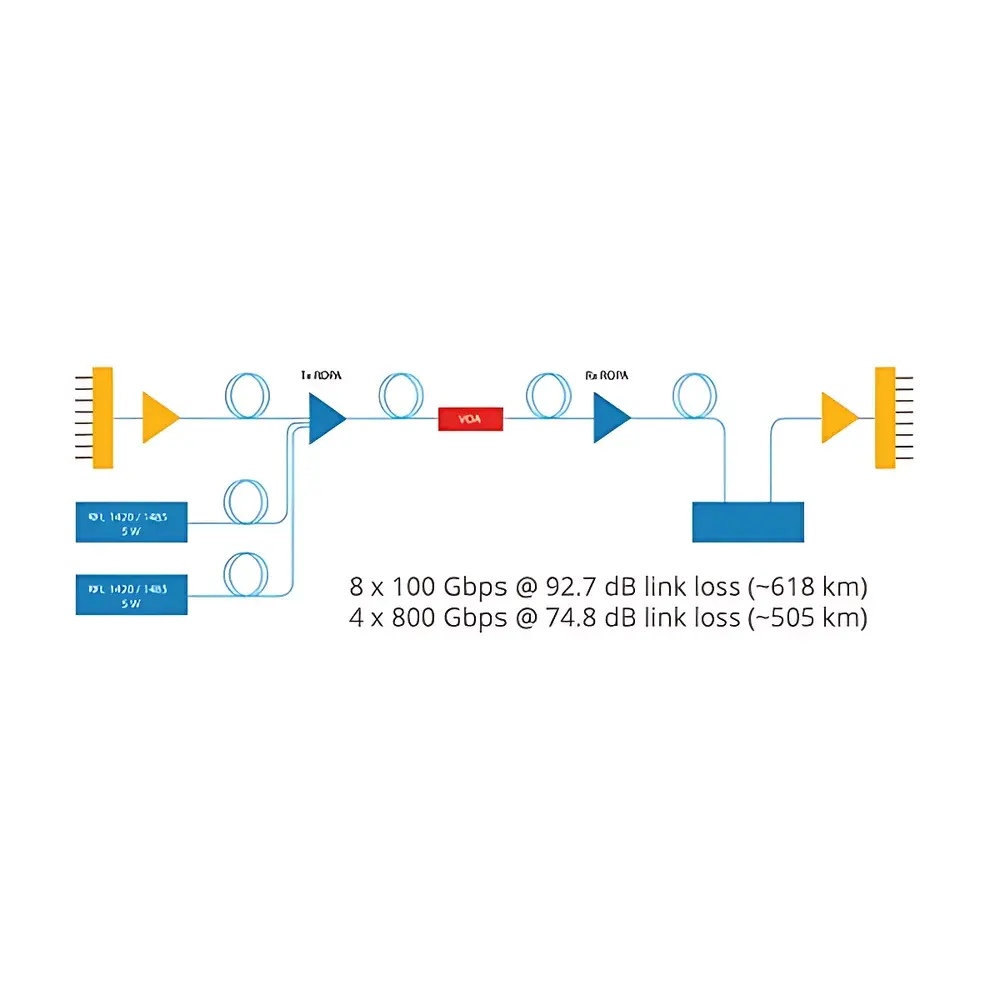
MPBC ROPA Passive Remote Optical Pump Amplifier
| Brand | MPBC |
|---|---|
| Origin | Canada |
| Model | ROPA Series |
| Type | Passive Remote Optical Pump Amplifier |
| Application | Unrepeatered Long-Haul Fiber Transmission |
| Compliance | ITU-T G.664, IEC 61280-2-9, Telcordia GR-1312-CORE |
| Operating Wavelength | C-band (1530–1565 nm) |
| Pump Wavelength | 1420–1480 nm |
| Gain Range | 15–30 dB (configurable via pump power and fiber length) |
| Noise Figure | <4.5 dB (typical, dependent on span design) |
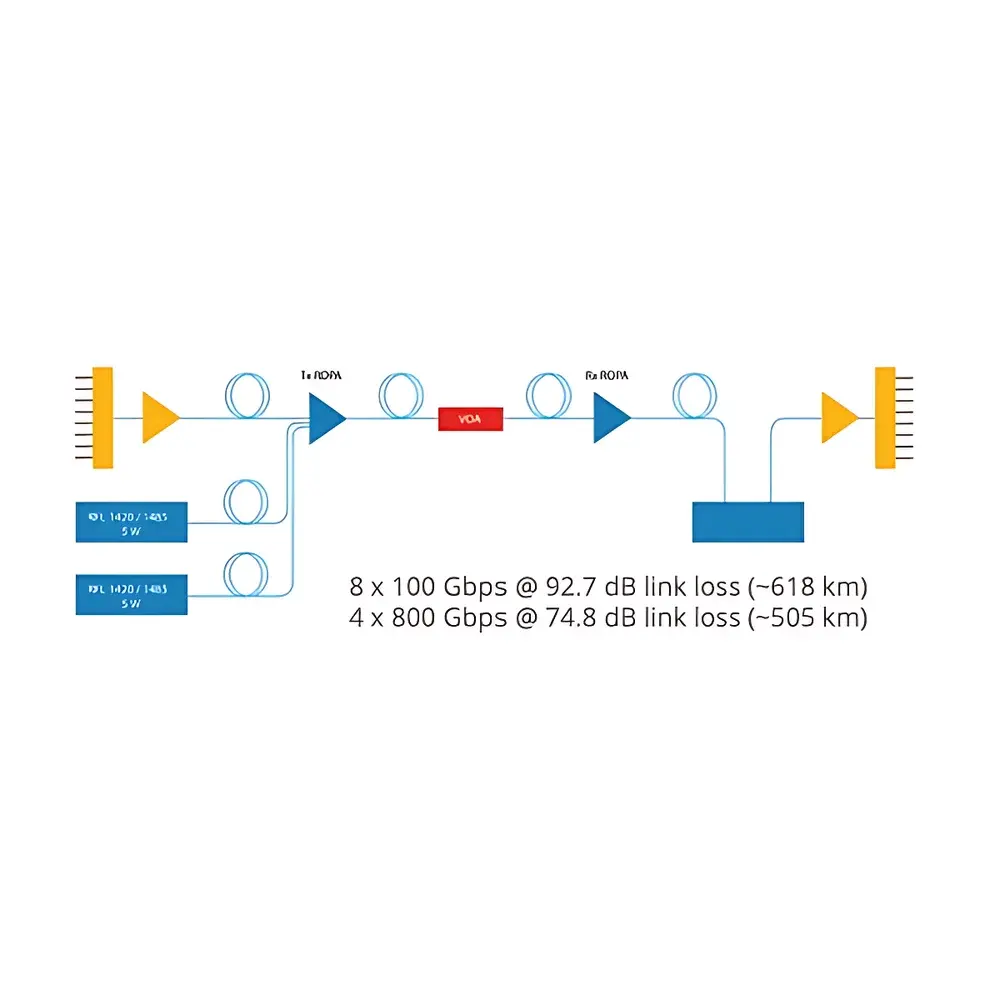
| Max Span Loss Compensation | 92.7 dB |
| Max Unrepeatered Distance | 618 km (with 8×100G DP-QPSK) |
| Form Factor | Compact module for splice closure integration |
| Environmental Rating | IP67, -40°C to +70°C operational |
Overview
The MPBC ROPA (Remote Optical Pump Amplifier) is a fully passive, distributed Raman amplification element engineered for ultra-long-haul unrepeatered optical transmission systems. Unlike conventional erbium-doped fiber amplifiers (EDFAs) or hybrid Raman/EDFA units, the ROPA operates without onboard electronics, power supplies, or active cooling—leveraging stimulated Raman scattering (SRS) in standard single-mode fiber (SSMF) or dispersion-shifted fiber (DSF), pumped remotely from terminal stations via dedicated pump wavelengths (1420–1480 nm). This architecture eliminates the need for powered repeaters, subsea power feeding equipment, or wet plant electronics—significantly reducing system complexity, failure points, and total cost of ownership. The ROPA is not a discrete component but a precisely engineered segment of transmission fiber integrated with optimized pump coupling and spectral management, enabling high-gain (>25 dB), low-noise-figure (<4.5 dB) signal amplification directly within the link path.
Key Features
- Fully passive operation: No local power, no active electronics, no thermal management required
- Remote pumping architecture: Pump light delivered from terminal sites over dedicated fibers or wavelength channels
- High gain efficiency: Achieves up to 30 dB net on-channel gain with configurable pump power and fiber length
- Low noise performance: Optimized for quantum-limited signal-to-noise ratio (OSNR) preservation in unrepeatered spans
- Field-deployable modular design: Engineered for integration into standard splice closures (e.g., 3M, AFL, Corning) with minimal footprint (≤2RU equivalent)
- Wide temperature tolerance: Qualified for operation from –40°C to +70°C, suitable for terrestrial, subsea, and OPGW environments
- Compatibility with legacy infrastructure: Works with G.652.D, G.655, and G.656 fiber types without modification
Sample Compatibility & Compliance
The MPBC ROPA is designed for deployment in both terrestrial and subsea unrepeatered links operating under ITU-T G.664 (optical safety), IEC 61280-2-9 (Raman amplifier test methods), and Telcordia GR-1312-CORE (reliability requirements for passive optical components). It supports industry-standard modulation formats including DP-QPSK, DP-16QAM, and probabilistic constellation shaping (PCS) at 100G, 200G, and 400G per channel. The device complies with GLP-aligned documentation practices for traceable installation and calibration records, and its passive nature inherently satisfies key aspects of IEC 62443-3-3 (security for industrial automation) and ISO/IEC 27001 controls related to hardware tamper resistance. All ROPA installations are validated against end-to-end OSNR budgets per ITU-T G.610 and G.698.2 (amplified DWDM systems).
Software & Data Management
While the ROPA itself contains no embedded firmware or software, MPBC provides a comprehensive engineering toolkit—including ROPA Link Designer v3.2—for system-level simulation, gain tilt optimization, and OSNR margin analysis. This Windows-based application integrates with industry-standard tools such as VPItransmissionMaker and OptiSystem, enabling joint modeling of pump power allocation, fiber nonlinearities (SPM, XPM), and polarization-mode dispersion (PMD) accumulation. All design outputs generate audit-ready reports compliant with FDA 21 CFR Part 11 (electronic records/signatures) when used in regulated telecom infrastructure projects. Field commissioning data—including pump power levels, backscattered Raman spectra (via OTDR), and pre-/post-amplification BER measurements—is logged in standardized CSV and XML formats compatible with network management systems (NMS) such as Ericsson ENMS or Cisco Crosswork.
Applications
- Subsea unrepeatered networks: Enables >600 km spans in branch cable systems (e.g., Chilean Pacific Coast network, 3,500 km total), eliminating wet plant repeaters and reducing latency by >12 µs/km versus active alternatives
- Arctic terrestrial backbone: Deployed in the Mackenzie Valley Fiber Link (1,154 km), where ambient temperatures fall below –40°C; ROPA modules operate continuously without heater-induced power draw or fan failure risk
- OPGW-integrated smart grids: Integrated into overhead ground wire cables for utility communications, providing passive amplification across 120–200 km spans without requiring pole-mounted power sources
- Offshore oil & gas telemetry: Supports real-time seismic monitoring and SCADA backhaul from remote platforms using 8×100G DWDM over 92.7 dB loss spans—validated in collaboration with Tampnet AS in North Sea deployments
FAQ
How does the ROPA differ from a conventional EDFA?
The ROPA uses distributed Raman amplification in the transmission fiber itself, pumped remotely from terminals—whereas EDFAs require localized power, cooling, and active gain control circuitry.
Can ROPA be retrofitted into existing fiber routes?
Yes—ROPA modules are spliced directly into the line fiber within standard closures; no trenching or right-of-way modification is needed beyond access to splice points.
What pump laser specifications are required at the terminal?
MPBC specifies narrow-linewidth (<100 kHz), polarization-maintaining pump lasers at 1427 nm, 1455 nm, or 1480 nm, with output power scalable from 500 mW to 2.5 W depending on span loss and target gain.
Is ROPA suitable for coherent detection systems?
Yes—ROPA maintains phase coherence and polarization stability essential for DP-QPSK and higher-order QAM; gain flatness is tunable within ±0.5 dB across the C-band using multi-wavelength pump combiners.
Does MPBC provide installation support and system validation?
MPBC offers turnkey engineering services including site survey, link budgeting, OTDR-assisted commissioning, and 24-month performance warranty with quarterly OSNR trend reporting.
Related Products