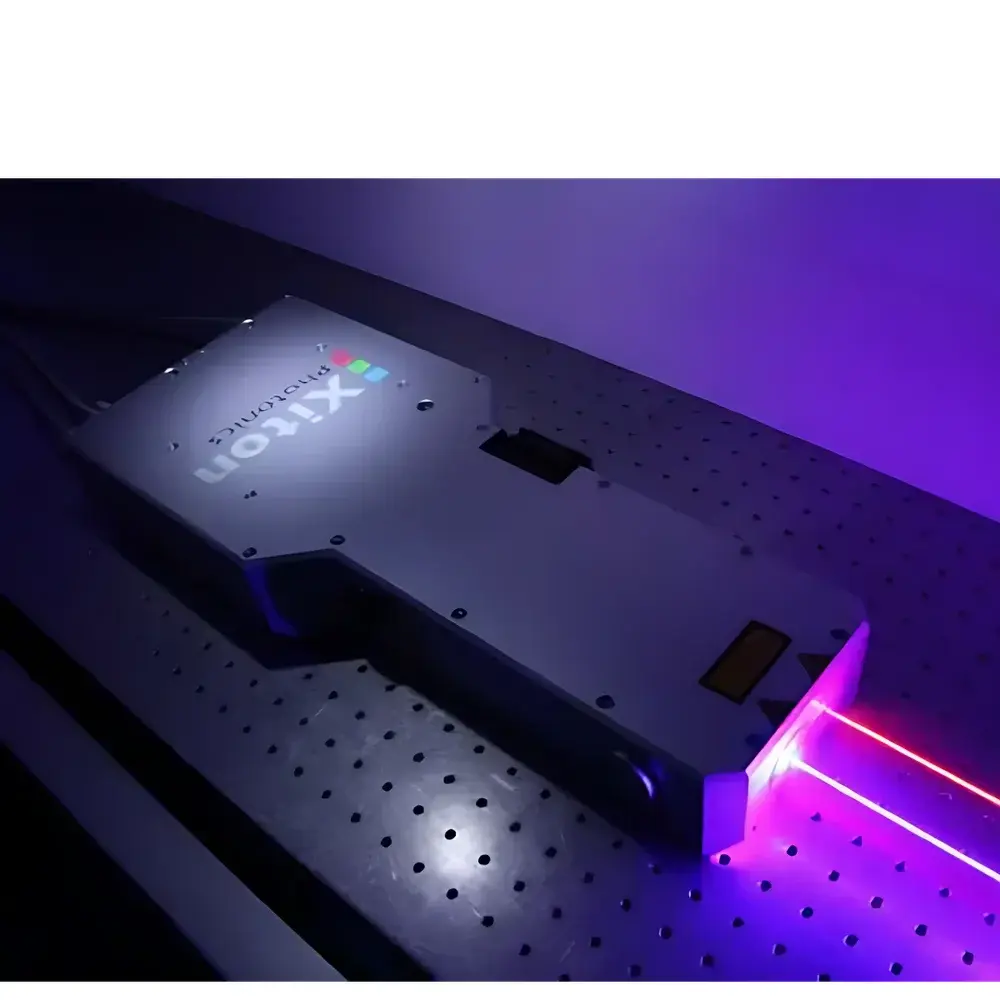
Auniontech IDOL Series Diode-Pumped Nanosecond Solid-State Laser (1342 nm / 671 nm / 447 nm)
| Brand | Auniontech |
|---|---|
| Wavelengths | 1342 nm / 671 nm / 447 nm |
| Average Power | 4.5 W (1342 nm), 2 W (671 nm), 1.5 W (447 nm) |
| Pulse Width | 10–26 ns (model-dependent) |
| Pulse Energy | 300 µJ (1342 nm), 130 µJ (671 nm), 100 µJ (447 nm) |
| Repetition Rate | 1–50 kHz (1342 nm), 1–30 kHz (671 nm & 447 nm) |
| Beam Quality (M²) | <1.2 (1342 nm & 671 nm), <1.3 (447 nm) |
| Origin | Shanghai, China |
| Manufacturer Type | Authorized Distributor |
Overview
The Auniontech IDOL Series is a family of diode-pumped, actively Q-switched solid-state lasers engineered for precision nanosecond pulse delivery at three harmonically related wavelengths: fundamental 1342 nm, second harmonic 671 nm, and third harmonic 447 nm. Unlike broadly tunable or ultrafast laser sources, the IDOL platform leverages Nd:YVO₄ crystal architecture with intracavity frequency conversion to deliver stable, high-brightness pulses optimized for wavelength-specific material interaction. Its core design prioritizes temporal stability, spatial beam quality (M² < 1.3), and thermal robustness—critical for integration into metrology-grade interferometric systems and industrial micromachining platforms. While not a laser interferometer itself, the IDOL Series serves as a certified coherent light source compliant with ISO 10110-3 (laser beam characterization) and suitable for use in heterodyne or homodyne interferometric configurations where wavelength stability, low amplitude noise (<1.5% RMS), and pulse-to-pulse timing jitter (<500 ps) are essential.
Key Features
- Three-wavelength output from a single platform: 1342 nm (fundamental), 671 nm (SHG), and 447 nm (THG), enabling multi-modal process optimization without hardware reconfiguration.
- Nanosecond pulse control: Adjustable repetition rate (1–50 kHz), consistent pulse width (10–26 ns, depending on model and operating point), and high pulse energy stability (±2% over 8 hours).
- Diffraction-limited beam profile: M² < 1.2 at 1342 nm and 671 nm; <1.3 at 447 nm—ensuring high focusability and minimal divergence in interferometric alignment paths.
- Integrated thermal management: Conduction-cooled design with real-time temperature monitoring and closed-loop stabilization, supporting continuous operation under ambient variations (15–30 °C).
- Industrial-grade interface: RS-232 and USB 2.0 digital control, TTL-compatible external trigger input (rising-edge sensitive), and analog modulation port for pulse energy scaling.
- Compliance-ready architecture: Designed to meet IEC 60825-1:2014 Class 4 laser safety requirements; includes interlock circuitry, emission indicator LED, and key-controlled enable switch.
Sample Compatibility & Compliance
The IDOL Series exhibits strong spectral selectivity for materials with distinct absorption edges in the visible-to-NIR range. At 1342 nm, silicon demonstrates high transmission with localized nonlinear absorption—ideal for stealth dicing and selective ablation in semiconductor wafer processing. The 671 nm output couples efficiently with photoresist layers and thin-film transistor (TFT) electrodes in OLED and LCD panel repair, while 447 nm enables high-resolution photothermal modification of metal oxides and polymer-based conductive traces. All models conform to RoHS 2011/65/EU directives and support traceable calibration via NIST-traceable power meters (e.g., Ophir PD300-MS). For regulated environments, the system supports optional audit trail logging compatible with GLP/GMP documentation workflows.
Software & Data Management
Auniontech provides the IDOL Control Suite—a Windows-based application supporting full parameter scripting (repetition rate, pulse energy setpoint, burst mode configuration), real-time oscilloscope-style pulse monitoring, and CSV export of operational logs (timestamp, setpoint, measured average power, internal temperature). The SDK (C/C++, Python, LabVIEW) enables integration into custom metrology software stacks, including those compliant with IEEE 1588-2019 (PTP) for synchronized interferometric acquisition. No proprietary cloud services or mandatory telemetry are implemented; all data remains local unless explicitly exported by the user. Firmware updates follow secure signed-package protocols and require manual initiation—aligning with FDA 21 CFR Part 11 principles for electronic records integrity.
Applications
- Laser interferometry: As a stabilized source in displacement measurement systems requiring long coherence length (>10 m at 1342 nm) and low phase noise for sub-nanometer resolution.
- Silicon wafer processing: Invisible scribing (stealth dicing) of Si wafers with minimal thermal damage zone (<2 µm) and high edge straightness (±0.5 µm over 100 mm).
- Flat-panel display repair: Pixel-level laser trimming of ITO lines, gate electrode correction, and micro-defect ablation in AMOLED backplanes using 671 nm’s optimal absorption in indium tin oxide.
- Micro-optics fabrication: Direct-write structuring of fused silica and BK7 substrates via multiphoton absorption at 447 nm, achieving feature sizes down to 800 nm with high aspect ratio.
- Time-resolved reflectometry: Pump-probe setups leveraging synchronized dual-wavelength operation (e.g., 1342 nm pump + 671 nm probe) for carrier dynamics analysis in photovoltaic materials.
FAQ
Is the IDOL Series qualified for use in ISO/IEC 17025-accredited calibration laboratories?
Yes—when operated with traceably calibrated power sensors and environmental monitoring (temperature, humidity), the IDOL Series meets the stability and repeatability criteria outlined in ISO/IEC 17025:2017 Clause 7.7 for reference light sources used in interferometric calibration.
Can the 1342 nm and 671 nm outputs be used simultaneously?
No—wavelength selection is mechanical and mutually exclusive via internal dichroic mirror translation; simultaneous dual-wavelength emission is not supported.
What beam delivery options are available for interferometric integration?
Standard output is free-space collimated beam (Ø2.5 mm, divergence 75% and polarization extinction ratio >20 dB.
Does the system support external cavity length locking for interferometer stabilization?
While the IDOL does not include built-in Pound-Drever-Hall electronics, its low-frequency intensity noise (<0.3% RMS below 100 kHz) and narrow linewidth (<5 MHz) make it compatible with third-party locking modules for active cavity stabilization.
Is service and spare parts support available outside mainland China?
Yes—Auniontech maintains authorized service partners in Germany, Japan, and the United States, with standard lead time of 12–16 weeks for critical spares such as Q-switch drivers and harmonic crystals.