
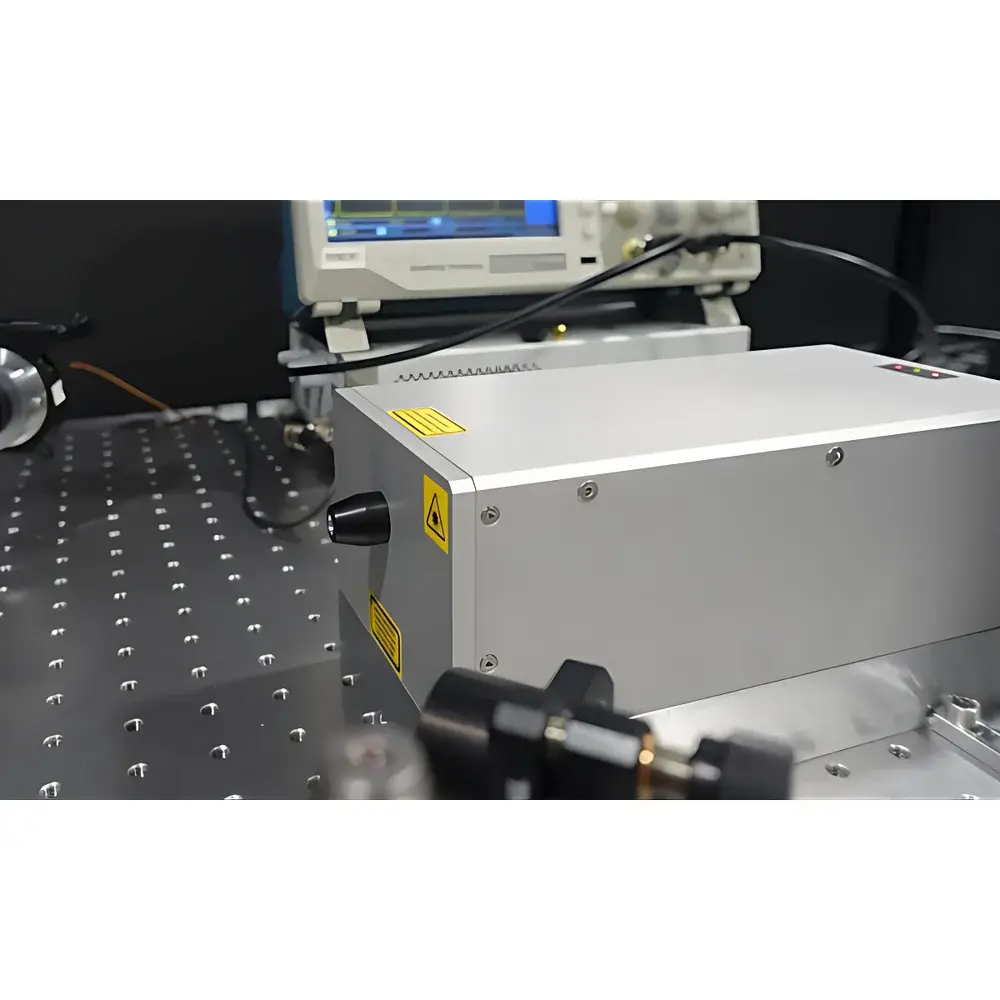
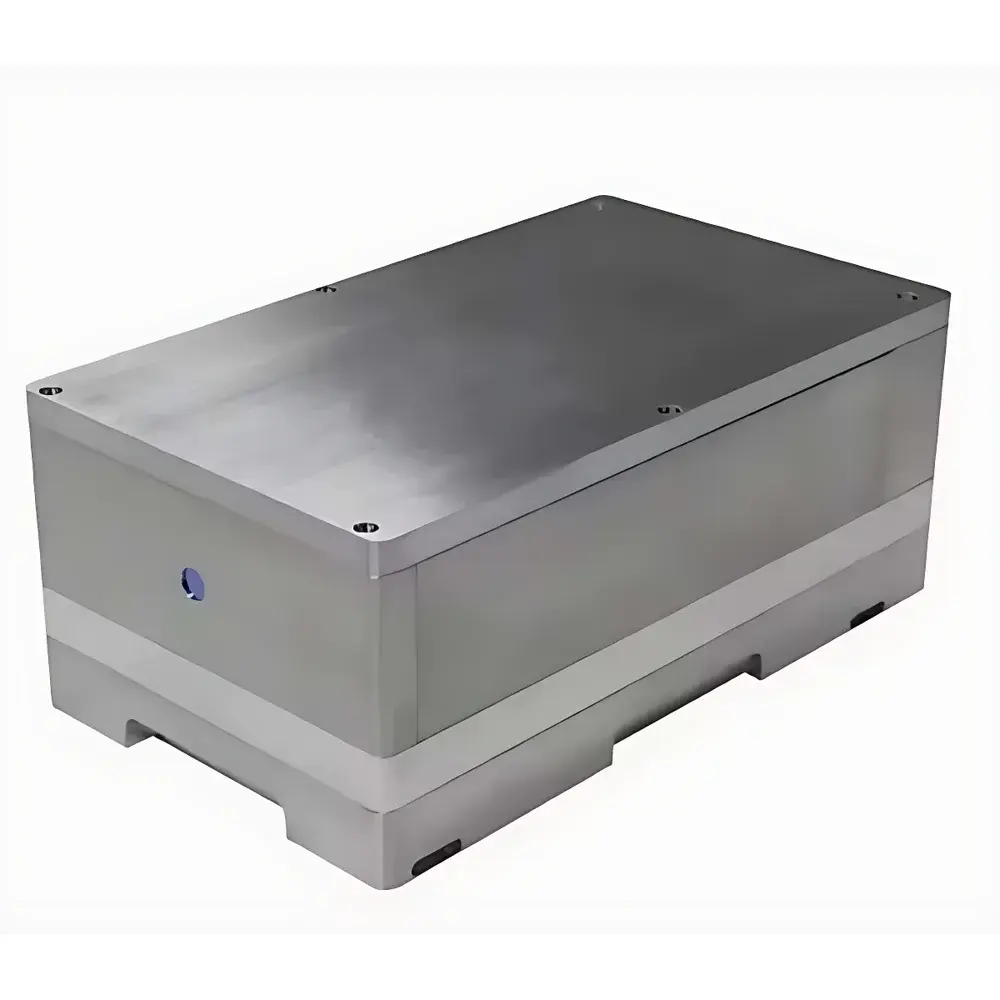
Auniontech 320/349 nm Narrow-Linewidth Continuous-Wave Ultraviolet Laser System
| Brand | Auniontech |
|---|---|
| Wavelength | 320 nm / 349 nm |
| Output Power | ≤ 200 mW |
| Linewidth | < 0.5 MHz |
| Coherence Length | > 100 m |
| Spatial Mode | TEM₀₀ |
| Spectral Stability | ±0.2 pm (8 h) |
| Power Stability | < 2.0 % (8 h) |
| RMS Intensity Noise | < 0.1 % (10 Hz – 10 MHz) |
| Beam Divergence | 1.0 mrad |
| Beam Diameter | 0.6–1.2 mm |
| Beam Pointing Stability | < 5 µrad/°C |
Overview
The Auniontech 320/349 nm Narrow-Linewidth Continuous-Wave Ultraviolet Laser System is a gas-based, single-frequency UV source engineered for high-precision photonic applications requiring exceptional spectral purity, long coherence length, and thermal-mechanical stability. Operating on a stabilized atomic or molecular transition—optimized for deep-UV emission—the system delivers diffraction-limited TEM₀₀ output with sub-0.5 MHz linewidth and coherence lengths exceeding 100 meters. Unlike conventional HeCd (325 nm) or Ar⁺ (351 nm) ion lasers, this laser eliminates plasma instability, high-voltage hazards, and bulky water-cooling infrastructure while maintaining superior power stability (<2.0% over 8 hours) and ultra-low intensity noise (60% versus legacy ion-laser platforms—without compromising beam pointing stability (<5 µrad/°C) or spectral fidelity.
Key Features
- Single longitudinal mode (SLM) operation with linewidth < 0.5 MHz, enabling high-resolution interferometric and holographic applications
- TEM₀₀ spatial profile with M² < 1.1 and beam divergence of 1.0 mrad for efficient coupling into single-mode fibers and waveguides
- High spectral stability: ±0.2 pm drift over 8-hour continuous operation, suitable for long-duration spectroscopic measurements
- Low-intensity noise floor (<0.1% RMS, 10 Hz–10 MHz), critical for quantum optics, cavity-enhanced absorption, and photoacoustic detection
- Integrated thermal regulation and electronic feedback control ensure robust performance across ambient temperature fluctuations
- Compact monolithic design integrating laser head, driver, and thermal management—no external chiller or high-voltage rack required
Sample Compatibility & Compliance
The laser is compatible with standard UV-grade optical components (e.g., fused silica lenses, MgF₂ coatings, CaF₂ prisms) and supports direct coupling into silica-based single-mode fibers (e.g., SM630, SMF-28e+) via adjustable kinematic mounts. It meets IEC 60825-1:2014 Class 3B laser safety requirements when operated with appropriate interlocks and beam enclosures. The system architecture supports GLP-compliant operation through optional analog/digital monitoring outputs (power, temperature, status flags) and conforms to electromagnetic compatibility standards per EN 61326-1 for laboratory instrumentation. While not intrinsically certified for GMP environments, its stable output and traceable calibration protocols align with ASTM E2912 (Standard Practice for Laser-Based Dimensional Metrology) and ISO/IEC 17025 documentation practices for metrological traceability.
Software & Data Management
The laser includes RS-232 and USB 2.0 interfaces for remote parameter control (output power, modulation mode, safety lockout) using vendor-provided SDKs for Python, LabVIEW, and MATLAB. Real-time telemetry—including diode current, heatsink temperature, and photodiode-monitored output power—is logged at user-defined intervals (10 ms–1 s resolution) and exportable in CSV or HDF5 format. Optional firmware upgrades support time-stamped audit trails compliant with FDA 21 CFR Part 11 requirements when deployed with validated third-party data acquisition software. No cloud connectivity or proprietary cloud services are embedded; all data remains locally stored unless explicitly routed via customer-controlled network infrastructure.
Applications
- Photo-thermal refractive (PTR) glass inscription for volumetric Bragg grating fabrication, leveraging high-power 320 nm irradiation to induce localized index changes with micron-scale spatial resolution
- UV Raman spectroscopy of biological macromolecules and semiconductor defects, where narrow linewidth enables unambiguous peak deconvolution below 0.1 cm⁻¹ spectral uncertainty
- In-line wafer inspection systems requiring stable 349 nm illumination for defect scattering contrast enhancement in deep-UV lithography mask metrology
- Atomic physics experiments involving calcium (Ca) or strontium (Sr) ion trapping, where 349 nm serves as a repumping transition with minimal off-resonant scattering
- Holographic data storage in photopolymer media sensitive to 320 nm exposure, benefiting from extended coherence length for high-fidelity interference fringe formation
- Calibration of UV spectroradiometers and monochromators against NIST-traceable line sources, supported by factory-measured spectral purity certification
FAQ
Is this laser qualified for use in cleanroom environments?
Yes—its sealed gas discharge architecture, absence of oil-based vacuum pumps, and low outgassing housing materials meet ISO Class 5 particulate requirements when installed with standard HEPA-filtered exhaust ducting.
Can the 320 nm and 349 nm versions be frequency-stabilized to an external cavity reference?
Both wavelengths support optional piezoelectric transducer (PZT)-based cavity length tuning and can be locked to ultra-stable Fabry–Pérot interferometers (FSR = 1 GHz) using standard Pound–Drever–Hall electronics.
What is the expected lifetime of the gas discharge tube under continuous operation?
Rated mean time between failures (MTBF) exceeds 10,000 hours at nominal output power, based on accelerated life testing per MIL-HDBK-217F.
Does the system include beam-shaping optics or require external collimation?
The output is pre-collimated to 1.0 mrad divergence with a 0.6–1.2 mm beam diameter; no additional collimation is needed for most free-space applications, though focusing optics must be UV-optimized.
Are calibration certificates provided with each unit?
Each laser ships with a factory calibration report including measured linewidth (via delayed self-heterodyne interferometry), absolute wavelength (using a wavemeter traceable to NIST SRM-2034), and power stability data over 8 hours.





