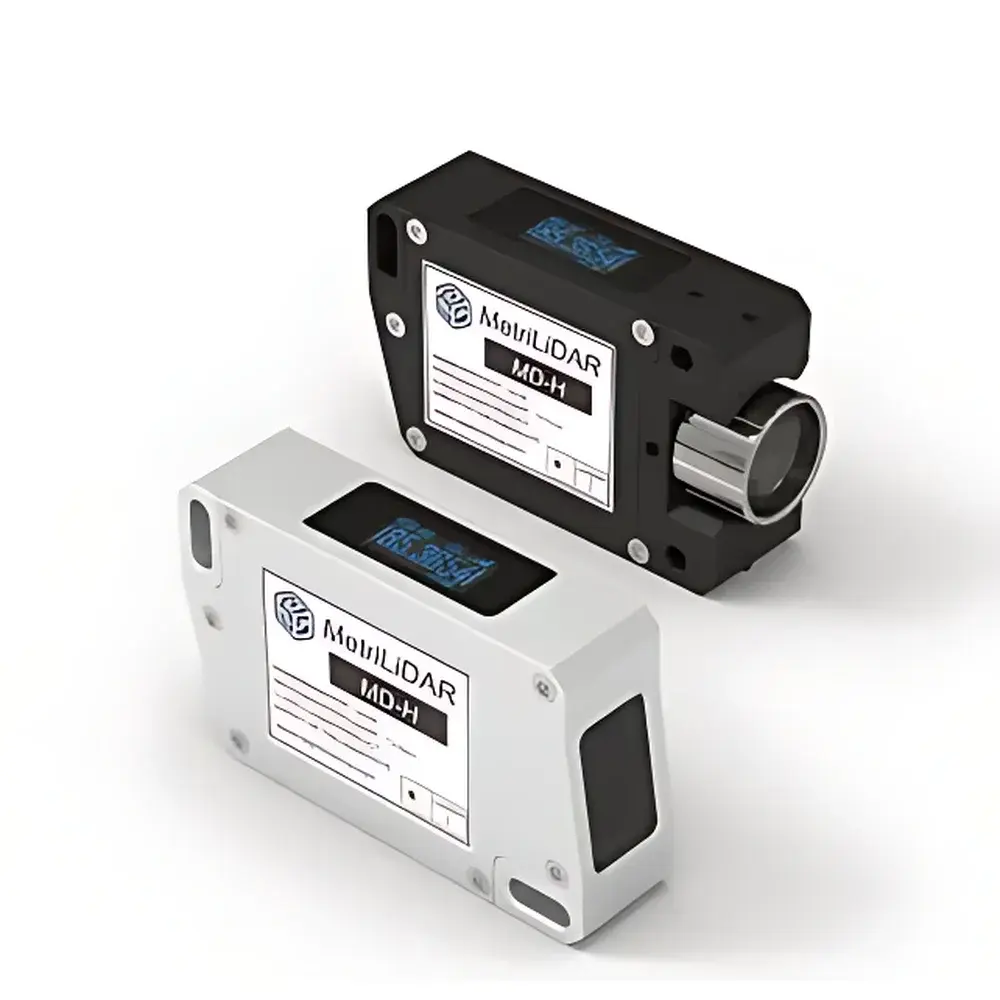
Auniontech MD Series FMCW Laser Distance Sensor
| Brand | Auniontech |
|---|---|
| Model | MD |
| Measurement Principle | Frequency-Modulated Continuous-Wave (FMCW) Coherent Interferometry |
| Accuracy Class | Micrometer-Level Absolute Distance Measurement |
| Optical Architecture | Monolithic Silicon Photonic Integrated Chip with On-Chip Reference and Signal Interferometric Pathways |
| Beam Delivery | Coaxial Transceiver Design (Transmit and Receive Along Identical Optical Axis) |
| Target Compatibility | Universal — Opaque, Colored, Metallic, Non-Metallic, Semi-Transparent, and Transparent Surfaces |
| Environmental Immunity | Insensitive to Ambient Light, Surface Reflectivity, and Spectral Absorption Characteristics |
| Compliance Context | Designed for integration into ISO/IEC 17025-accredited metrology workstations and GLP/GMP-aligned industrial inspection systems |
Overview
The Auniontech MD Series FMCW Laser Distance Sensor is an absolute distance measurement instrument engineered for high-precision, non-contact displacement and position monitoring in demanding industrial metrology and automated quality control environments. Unlike time-of-flight (ToF) or triangulation-based sensors, the MD sensor operates on the principle of frequency-modulated continuous-wave (FMCW) coherent interferometry. In this architecture, a semiconductor laser emits a linearly chirped optical signal; the reflected beam from the target is mixed with a phase-stable reference beam—both derived from the same integrated photonic chip. The resulting beat frequency is directly proportional to the round-trip optical path difference, enabling unambiguous, micrometer-level resolution over extended working distances (typically up to several meters, dependent on optical power and surface reflectance). Critically, the sensor’s monolithic silicon photonic integration embeds both the interferometric signal path and the reference path on a single chip, eliminating thermal drift-induced phase errors common in bulk-optic interferometers. Its coaxial transceiver configuration ensures zero blind zones—even in deep cavities, narrow bores, or recessed features—where conventional off-axis triangulation systems fail due to geometric occlusion.
Key Features
- FMCW-based absolute distance measurement with inherent immunity to target surface properties—including color, gloss, roughness, transparency, and partial translucency.
- Monolithic silicon photonic integrated circuit (PIC) housing both the interferometric detector and on-chip reference waveguide, ensuring long-term phase stability and thermal robustness.
- Coaxial optical architecture: emission and reception share a single collimated beam path, eliminating shadowing effects and enabling reliable measurement in confined geometries (e.g., threaded holes, turbine blade roots, microfluidic channels).
- Active ambient light rejection: the sensor responds exclusively to its own frequency-coded optical signal, making it operationally stable under strong daylight, fluorescent lighting, or pulsed industrial illumination.
- High dynamic range detection: capable of resolving sub-micron displacements while maintaining linearity across multi-meter measurement ranges—without recalibration or gain switching.
- Ruggedized optical module design incorporating hermetically sealed semiconductor laser diode and high-quantum-efficiency photodetector within a unified optomechanical housing.
Sample Compatibility & Compliance
The MD sensor demonstrates universal target compatibility without requiring surface preparation, retroreflective tape, or wavelength-specific coatings. It delivers consistent performance on black anodized aluminum, polished stainless steel, frosted glass, PET film, silicone elastomers, and even water surfaces—validating its utility in semiconductor wafer handling, medical device assembly, and precision injection molding. From a regulatory standpoint, the sensor’s deterministic, traceable output and absence of moving parts support compliance with ISO 10360 (coordinate measuring machine acceptance testing), ISO 5725 (accuracy and precision of measurement methods), and ASTM E2548 (standard guide for laser-based dimensional measurements). When embedded in closed-loop motion control or inline inspection platforms, its real-time analog/digital outputs are compatible with systems validated under FDA 21 CFR Part 11 (electronic records and signatures) and EU Annex 11 (computerized systems in GMP environments), provided appropriate audit trail and data integrity protocols are implemented at the system level.
Software & Data Management
The MD sensor interfaces via RS-422, Ethernet (TCP/IP), or optional EtherCAT for deterministic real-time synchronization in motion-critical applications. Aboard the sensor is an embedded firmware engine supporting configurable averaging, outlier suppression, and temperature-compensated linearization tables. A vendor-neutral SDK (C/C++, Python, LabVIEW) enables seamless integration into custom metrology software stacks. Raw phase and beat frequency data can be streamed for post-acquisition spectral analysis—supporting advanced diagnostics such as vibration mode identification or thermal expansion coefficient derivation. All configuration parameters, calibration coefficients, and measurement logs are stored with timestamped metadata, facilitating GLP-compliant data archiving and 21 CFR Part 11–aligned electronic record generation when deployed with qualified host software.
Applications
- Precision machining: real-time tool wear compensation and in-process verification of bore diameter, thread pitch, and surface flatness.
- Automotive powertrain QA: non-contact measurement of valve lift profiles, gear tooth backlash, and bearing race runout.
- Semiconductor packaging: height mapping of die attach pads and coplanarity assessment of leadframe substrates.
- Medical device manufacturing: dimensional validation of stent strut thickness, catheter lumen concentricity, and microfluidic channel depth.
- Research-grade metrology: primary length standard transfer, gravitational wave test mass positioning feedback, and nanoscale thermal expansion studies.
FAQ
Does the MD sensor require reflective targets or special surface treatment?
No. It measures absolute distance on raw, untreated surfaces—including matte black plastics, transparent glass, and liquid interfaces—without retroreflectors or coatings.
How does the MD sensor handle multi-path interference in complex industrial environments?
Its FMCW architecture inherently suppresses multipath artifacts through frequency-domain discrimination; only the dominant beat tone corresponding to the shortest optical path is resolved, rejecting ghost echoes from adjacent structures.
Is factory recalibration required after mechanical shock or thermal cycling?
The monolithic PIC design and coaxial alignment eliminate mechanical sensitivity; no field recalibration is needed unless the optical window becomes contaminated or physically damaged.
Can the MD sensor be synchronized with motion stages or vision systems?
Yes—via hardware trigger inputs, PTP (IEEE 1588) time stamping over Ethernet, or distributed clock synchronization in EtherCAT networks.
What traceability documentation is provided with each unit?
Each MD sensor ships with a manufacturer’s calibration certificate referencing NIST-traceable interferometric standards, including uncertainty budgets per ISO/IEC 17025 requirements.