
SICK Ranger3 Series Separated 3D Vision System for Rail Transit Inspection
| Brand | SICK |
|---|---|
| Origin | Germany |
| Product Type | Imported Optical Imaging Equipment |
| Model | Ranger3 Series Separated 3D Camera |
| Key Specifications | None |
Overview
The SICK Ranger3 Series Separated 3D Vision System is an industrial-grade optical imaging solution engineered for high-precision, real-time 3D profiling in demanding rail transit infrastructure and rolling stock inspection environments. Built upon structured light triangulation with synchronized laser projection and high-dynamic-range CMOS sensing, the Ranger3 platform delivers robust depth map acquisition under variable illumination, motion, and surface reflectivity conditions. Unlike conventional 2D vision systems, it captures full XYZ coordinate data at frame rates scalable to operational train speeds—enabling non-contact, automated metrology of critical components without interrupting maintenance workflows or line operations. Its modular architecture supports distributed deployment across fixed gantries, mobile robots, and onboard inspection vehicles, making it a foundational sensor for condition-based maintenance (CBM), predictive analytics, and digital twin integration in modern railway asset management.
Key Features
- Modular separated design: Independent projector and camera units enable flexible mechanical integration in constrained spaces—ideal for undercarriage, tunnel ceiling, or contact wire mounting.
- High-speed synchronization: Hardware-triggered acquisition with sub-millisecond latency ensures geometric fidelity even at train speeds exceeding 120 km/h.
- Adaptive illumination control: Dynamic laser power modulation and multi-exposure HDR capture mitigate interference from ambient sunlight, headlight glare, and highly reflective or low-reflectance surfaces (e.g., oxidized steel, rubber seals, carbon composites).
- Multi-camera calibration framework: Supports precise spatial registration of up to 22 synchronized Ranger3 units via SICK’s proprietary calibration suite, enabling seamless 360° volumetric reconstruction of rails, tunnels, and wheelsets.
- Ruggedized industrial housing: IP65-rated enclosure with thermal management for continuous operation in outdoor environments ranging from −25 °C to +60 °C.
- Real-time point cloud streaming: Native support for GigE Vision and GenICam protocols ensures seamless integration with ROS 2, HALCON, OpenCV, and custom inspection software stacks.
Sample Compatibility & Compliance
The Ranger3 system is validated for consistent performance across diverse rail-specific targets: ferrous and non-ferrous metallic surfaces (rails, wheel treads, pantograph carbon strips), composite brake pads, elastomeric suspension components, concrete tunnel linings, and ceramic insulators. It complies with IEC 62443-4-2 for secure device development lifecycle and meets electromagnetic compatibility requirements per EN 50121-3-2 (Railway Applications – Electromagnetic Compatibility). All firmware and configuration tools adhere to ISO/IEC 17025 traceability principles for measurement uncertainty documentation. For regulated maintenance programs, the system supports audit-ready logging aligned with EN 15380 (Railway Applications – Maintenance Management) and facilitates GLP-compliant data retention through configurable metadata tagging (time stamp, GPS position, vehicle ID, operator ID).
Software & Data Management
SICK provides the Visionary-T software suite for offline calibration, ROI definition, and defect classification model training using annotated point cloud datasets. The Ranger3 integrates natively with SICK’s InspectorP software for rule-based dimensional verification (e.g., flange thickness, gauge width, contact wire height) against configurable tolerances per UIC 518, EN 15273, or GB/T 32588 standards. Raw point clouds are exportable in standard formats (PLY, XYZ, LAS) for third-party analysis in PolyWorks, CloudCompare, or MATLAB. For enterprise deployment, the system supports TLS 1.2-secured REST APIs and OPC UA server integration, enabling bidirectional communication with MES (Manufacturing Execution Systems) and CMMS (Computerized Maintenance Management Systems). Audit trails—including parameter changes, user logins, and measurement result exports—are recorded in accordance with FDA 21 CFR Part 11 requirements when configured with digital signature modules.
Applications
- Train body and roof profiling: Full-envelope scanning at speeds from 10–120 km/h; detects misalignment, deformation, missing fasteners, and pantograph clearance violations.
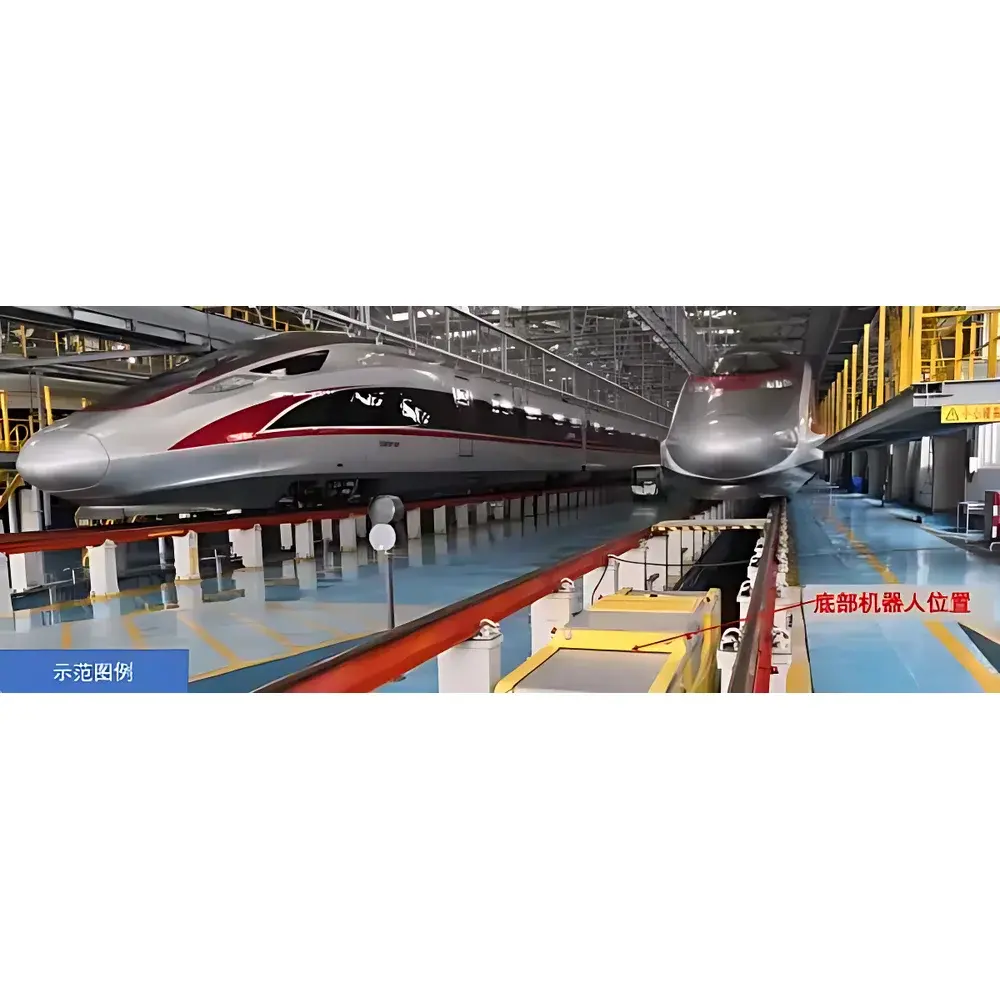
- Undercarriage inspection: Mounted on robotic arms or fixed cradles to scan bogies, brake calipers, couplers, and suspension linkages—operating in sub-1.5 m clearance zones.
- Autonomous inspection robot vision: Provides real-time 3D localization and obstacle mapping for rail-mounted robots navigating complex trackside geometry, including ballast, sleepers, and signal infrastructure.
- Overhead catenary system (OCS) monitoring: Measures contact wire height, stagger, and wear profile across spans up to 60 m; compensates for solar-induced thermal expansion drift.
- Rail profile metrology: Quantifies rail head wear, gauge variation, twist, and vertical alignment on active lines with ±0.1 mm repeatability over 2.5 m baselines.
- Wheelset dimensional verification: Captures tread contour, flange thickness, QR value, and internal distance during rolling passage—calibrated for dynamic runout compensation.
- Tunnel lining integrity assessment: Generates dense 360° panoramic point clouds for crack width estimation, spalling detection, and convergence analysis using georeferenced stitching.
- Mill exit inspection: High-throughput 3D profiling of hot-rolled rail sections at line speeds up to 4 m/s; detects surface defects ≥0.3 × 0.3 × 1 mm³ via multi-angle occlusion analysis.
FAQ
What distinguishes the Ranger3 from integrated 3D cameras in rail applications?
The separated architecture allows independent optimization of laser projection angle and camera viewpoint—critical for minimizing shadowing on complex undercarriage geometries and achieving uniform depth resolution across large working distances.
How is ambient light rejection achieved outdoors?
Through synchronized pulsed laser illumination combined with temporal filtering and adaptive exposure control—not passive optical filtering—ensuring stable performance under direct sunlight and nighttime headlight exposure.
Can Ranger3 data be used for automated defect classification?
Yes; point cloud features (curvature, normal deviation, planarity residuals) serve as inputs to supervised ML models trained in InspectorP or exported to Python-based frameworks like PyTorch Geometric.
Is factory calibration sufficient for long-term field stability?
No; SICK recommends quarterly verification using certified reference artifacts (e.g., NIST-traceable step gauges, sphere arrays), with optional on-site recalibration services available under extended support contracts.
Does the system support integration with existing SCADA or PMS platforms?
Yes; via OPC UA PubSub over TSN or MQTT with JSON payload schema—enabling direct ingestion into Siemens Desigo, GE Digital Predix, or custom rail asset performance management dashboards.





