
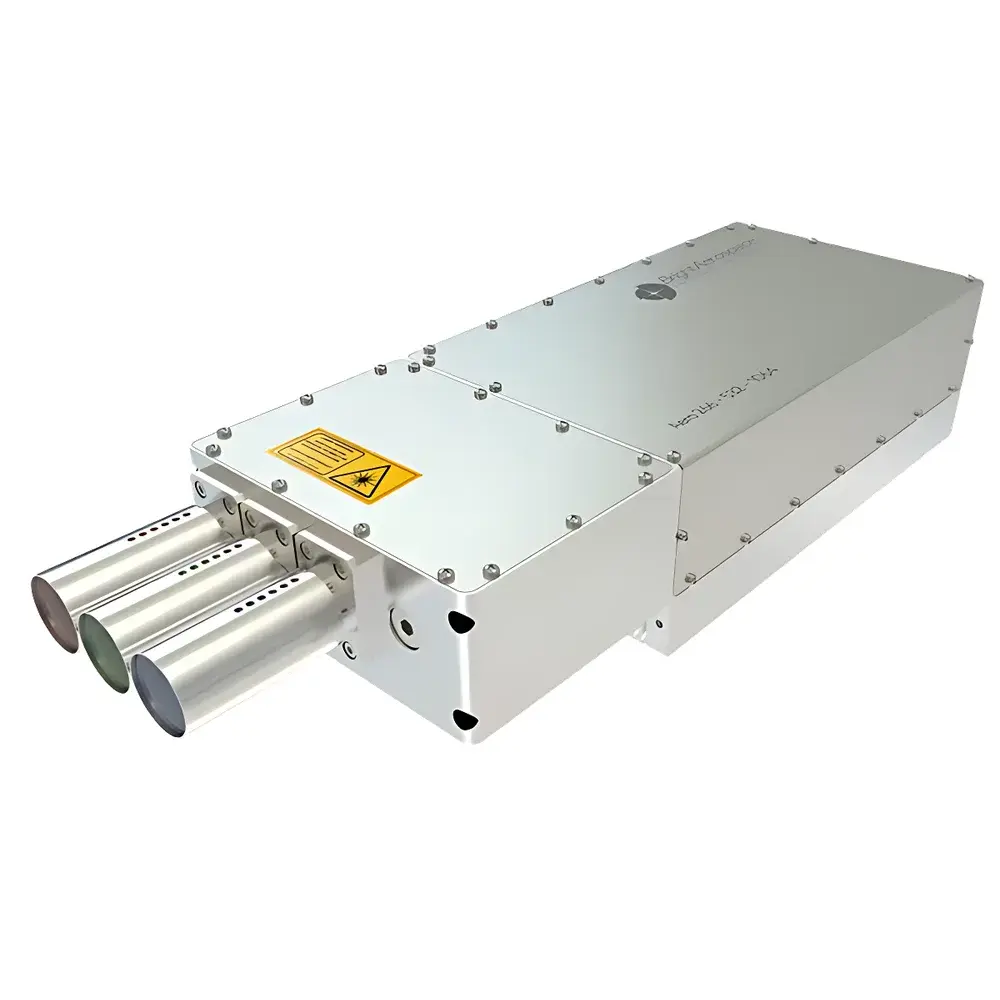
Bright Solutions AERO Series High-Energy (200 mJ) DPSS Nanosecond Laser
| Brand | Bright Solutions |
|---|---|
| Model | AERO Series |
| Pulse Energy | up to 200 mJ @ 1064 nm, up to 100 mJ @ 532 nm |
| Pulse Width | 10–30 ns |
| Wavelength Options | 1064 nm, 532 nm, 355 nm, 266 nm |
| Repetition Rate | Single-shot to 500 Hz |
| Laser Type | Diode-Pumped Solid-State (DPSS) Q-switched Nanosecond Laser |
| Beam Shaping | Customizable |
| Compliance | Space-qualified configurations available (tested per ECSS-E-ST-10-03C and MIL-STD-810G) |
Overview
The Bright Solutions AERO Series is a high-energy, diode-pumped solid-state (DPSS) nanosecond laser system engineered for demanding scientific, industrial, and aerospace applications requiring robust pulse-to-pulse stability, precise temporal control, and high peak power. Based on master oscillator–power amplifier (MOPA) architecture with intracavity harmonic generation, the AERO platform delivers up to 200 mJ per pulse at 1064 nm with pulse durations tunable between 10 ns and 30 ns—optimized for nonlinear optical conversion and plasma generation. Its thermally stable Nd:YAG gain medium, combined with high-efficiency fiber-coupled diode pumping and active cavity alignment, ensures long-term output reproducibility under variable ambient conditions. Designed from inception for integration into turnkey instrumentation—including airborne LIDAR platforms, spaceborne LIBS spectrometers, and ultrafast pump-probe setups—the AERO series meets stringent requirements for shock resistance, vacuum compatibility, and radiation tolerance in mission-critical environments.
Key Features
- High single-pulse energy: 200 mJ @ 1064 nm; 100 mJ @ 532 nm; 50 mJ @ 355 nm; 25 mJ @ 266 nm (typical, dependent on harmonic configuration)
- Adjustable pulse width: 10–30 ns (FWHM), digitally selectable via internal timing controller
- Repetition rate flexibility: Single-shot mode through burst-mode operation up to 500 Hz with <±0.1% jitter
- Multi-wavelength capability: Fundamental (1064 nm) and harmonics (532 nm, 355 nm, 266 nm) generated within a single monolithic resonator housing
- Beam quality: M² < 1.3 (TEM₀₀), with optional beam homogenization or top-hat profile delivery via diffractive optical elements (DOEs)
- Robust mechanical architecture: Aluminum alloy chassis with passive thermal management; qualified for operation in -10 °C to +45 °C ambient range
- Space-readiness option: Available with radiation-hardened electronics, outgassing-compliant materials (per ECSS-Q-ST-70-02C), and vibration-tested mounting interfaces (per ECSS-E-ST-10-03C)
Sample Compatibility & Compliance
The AERO laser is compatible with a wide range of target materials—from dielectric thin films and semiconductor wafers to metallic alloys and biological tissues—enabling non-contact ablation, LIBS excitation, and time-resolved fluorescence triggering without sample preparation. Its pulse parameters meet key requirements for ISO 11554 (laser beam parameter measurements), ASTM E2912 (LIBS calibration standards), and USP (laser-based analytical instrumentation). For regulated environments, firmware supports audit-trail logging and user-access controls aligned with FDA 21 CFR Part 11 and EU Annex 11 principles. All standard units comply with IEC 60825-1:2014 (laser safety) and CE/UKCA marking requirements. Optional configurations include Class 1 enclosure integration and interlock-ready OEM interfaces.
Software & Data Management
Control is provided via Bright Solutions’ AERO Control Suite—a cross-platform application (Windows/Linux/macOS) supporting real-time monitoring of pulse energy, repetition rate, temperature, and diode current. The suite enables script-driven sequencing (Python API included), synchronization via TTL/RS-422 triggers, and timestamped data export in HDF5 or CSV formats. Integrated diagnostics log thermal drift trends, flashlamp/diode lifetime estimates, and cavity alignment status—critical for GLP/GMP documentation. Remote operation is supported over Ethernet (TCP/IP) or USB-C, with TLS-secured firmware updates and role-based access control for multi-user laboratories.
Applications
- LIDAR & Remote Sensing: High-energy pulses enable atmospheric backscatter profiling at kilometer-scale ranges; dual-wavelength operation supports differential absorption LIDAR (DIAL) for trace gas detection.
- Laser-Induced Breakdown Spectroscopy (LIBS): Stable 200 mJ pulses generate reproducible microplasmas on conductive and insulating substrates; ideal for planetary rovers (e.g., Mars 2020 Perseverance heritage), scrap metal sorting, and nuclear fuel assay.
- Aerospace Instrumentation: Qualified variants support onboard calibration of hyperspectral imagers and star tracker alignment systems in low-Earth orbit missions.
- FPD & Microelectronics Repair: Precision ablation of ITO layers, OLED pixel isolation, and via drilling in flexible PCBs using 355 nm/266 nm harmonics.
- Nonlinear Optics Research: Pump source for OPOs, OPCPAs, and THz generation; high peak power enables efficient second- and third-harmonic mixing in BBO/LBO crystals.
- Time-Resolved Spectroscopy: Synchronized pump-probe experiments with sub-nanosecond jitter across UV–NIR spectral bands.
FAQ
What is the typical pulse-to-pulse energy stability over 8 hours?
Energy stability is ≤ ±1.5% RMS (1σ) at 200 Hz operation with active thermal regulation enabled.
Can the AERO laser be integrated into an existing vacuum chamber?
Yes—vacuum-compatible versions (10⁻⁶ mbar) are available with CF-63 flanges, non-outgassing optics mounts, and feedthrough-rated power/control connectors.
Is remote firmware update supported?
Yes—secure over-the-air (OTA) updates via encrypted HTTPS connection with cryptographic signature verification.
Does the system include compliance documentation for export control (e.g., EAR99 or ITAR)?
Standard units are classified EAR99; ITAR-controlled configurations require prior authorization and are supplied only to approved end-users under DSP-5 license.
What cooling method is used?
Conductive cooling with forced-air heat exchangers; liquid-cooled variants (water/glycol) are available for high-duty-cycle operation (>300 Hz continuous).




