
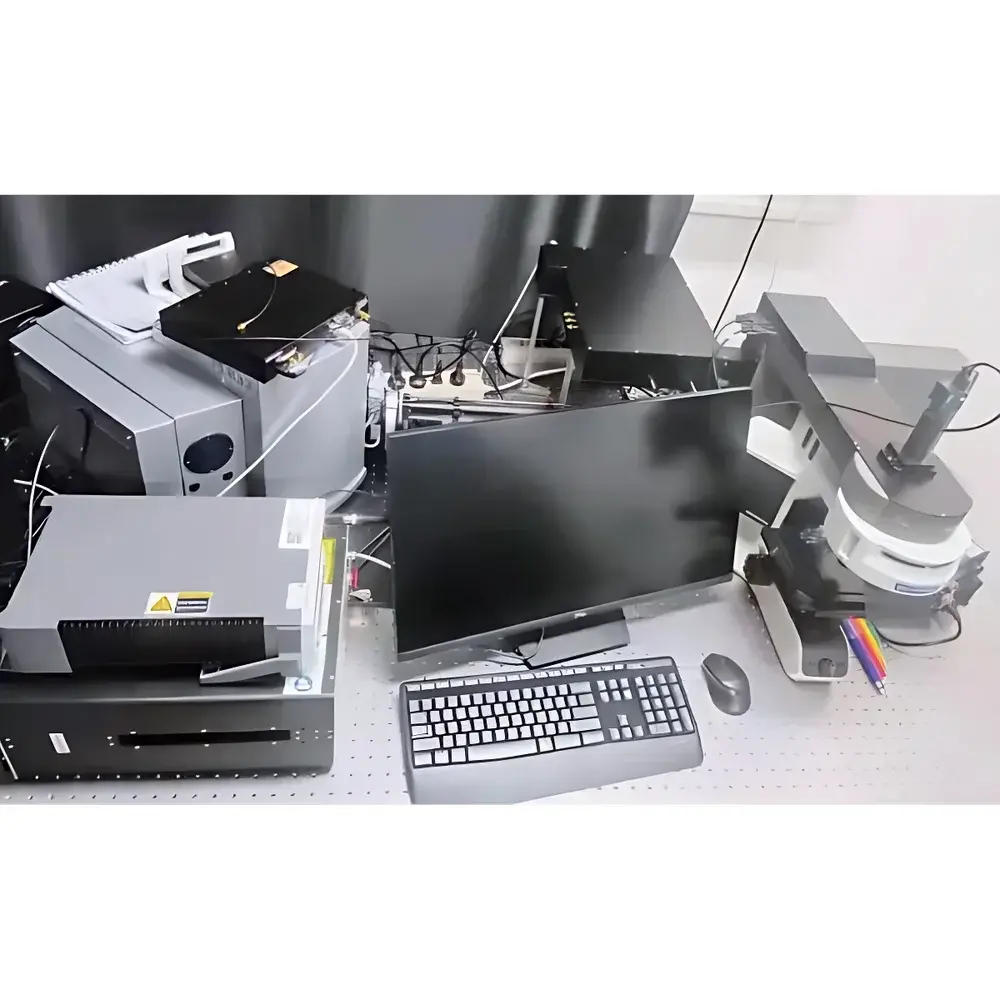
Nanobase AUT-XperRam LW Confocal Low-Wavenumber Raman Imaging System
| Brand | Nanobase |
|---|---|
| Origin | South Korea |
| Instrument Type | Confocal Micro-Raman Spectrometer |
| Excitation Wavelengths (Standard) | 532 nm, 633 nm, 785 nm |
| Laser Linewidth | ≤1 MHz |
| SMSR | ≥30 dB |
| Wavelength Stability | ≥1 pm |
| Power Stability (8 h) | ±1% |
| Spectrometer Focal Length | 833 mm |
| Grating Options | 1800 lp/mm @ 400 nm, 1200 lp/mm @ 650 nm, 300 lp/mm @ 500 nm |
| Spectral Resolution (Reference) | 0.033 nm / 29.25 cm⁻¹ (with 1800 lp/mm grating, 25 µm pixel) |
| Minimum Detectable Raman Shift | 125 cm⁻¹ |
| Optical Filter Options | Edge filter (<100–3750 cm⁻¹), Optional ultra-low-frequency filter (<250 cm⁻¹) with bandpass + OD3 dual-stage rejection |
| Detector | Back-illuminated deep-depletion CCD, 2000 × 256 pixels, 15 µm × 15 µm pixel size |
| Scanning Method | Galvo-based laser scanning (non-contact, sample-static mapping) |
| Mapping Precision | ≤20 nm lateral positioning accuracy |
| Objective Options | 10×, 20×, 40× (default), 50×, 100×, Long WD 20×/40× |
| Software | NanoSpectrum Suite (supports .txt, .csv, .spm export), NanoControl mobile app for remote monitoring |
| Compliance | Designed for GLP/GMP-aligned workflows |
Overview
The Nanobase AUT-XperRam LW Confocal Low-Wavenumber Raman Imaging System is a research-grade confocal micro-Raman platform engineered for high-fidelity spectral acquisition in the low-wavenumber regime (down to 125 cm⁻¹). It employs a permanently aligned volume phase holographic (VPH) transmission grating — a design that delivers >90% diffraction efficiency across the visible–NIR range — minimizing photon loss and maximizing signal throughput. Unlike reflective grating systems, this transmission architecture reduces stray light and optical aberrations, directly contributing to superior signal-to-noise ratio (SNR) and spectral fidelity. The system integrates a single-longitudinal-mode (SLM) DPSS laser source with sub-MHz linewidth and picometer-level wavelength stability, coupled to an 833 mm focal length automated spectrometer. Its galvo-driven laser scanning mechanism enables non-mechanical, sample-static 2D Raman mapping — eliminating stage-induced drift, vibration artifacts, and positional uncertainty associated with piezo or motorized stage scanning. This architecture is particularly advantageous for fragile, large, or heavy samples common in materials science, semiconductor metrology, and pharmaceutical solid-state analysis.
Key Features
- Permanently aligned VPH transmission grating: No realignment required for ≥12 months; supports rapid spectral reconfiguration via incident angle tuning
- Ultra-low-frequency capability: Standard edge filter configuration (<100–3750 cm⁻¹); optional <250 cm⁻¹ detection with dual-stage OD3 + bandpass filtering
- Galvo-based laser scanning: Enables high-speed, high-precision (≤20 nm lateral accuracy), sample-static mapping over areas up to 400 µm × 400 µm (20× objective) or 200 µm × 200 µm (40× objective)
- Back-illuminated deep-depletion CCD detector: 2000 × 256 pixels, 15 µm pitch, optimized for quantum efficiency in 500–1000 nm range
- Modular excitation: Three standard lasers (532 nm, 633 nm, 785 nm); all SLM-class with ≥30 dB side-mode suppression ratio and ±1% power stability over 8 hours
- Flexible microscope integration: Compatible with upright or inverted platforms; objective options include long-working-distance variants for encapsulated or thick-sample analysis
Sample Compatibility & Compliance
The AUT-XperRam LW accommodates diverse sample geometries — from polished wafers and thin-film heterostructures to bulk crystals, polymer composites, and pharmaceutical tablets — without requiring physical translation during mapping. Its static-sample methodology satisfies stringent requirements for reproducible spatial registration in longitudinal studies or multi-modal correlative workflows (e.g., combined with AFM or SEM). The system adheres to foundational spectroscopic measurement principles defined in ASTM E1840 and ISO 8655-7 for spectrometer calibration traceability. When configured with NanoSpectrum software’s audit-trail mode and role-based user authentication, it supports documentation practices aligned with GLP and GMP environments, including electronic signatures and immutable metadata logging compliant with FDA 21 CFR Part 11 Annex 11 expectations.
Software & Data Management
NanoSpectrum software provides full instrument control, spectral processing, and hyperspectral data visualization. It supports batch acquisition, automated background subtraction, cosmic-ray removal, peak fitting (Voigt/Gaussian models), and multivariate analysis (PCA, cluster mapping). Spectral data exports to standardized formats (.txt, .csv) ensure compatibility with third-party chemometric tools (e.g., MATLAB, Python SciPy, Unscrambler). Mapping datasets are saved in .spm (Spectra Processing Map) format — a vendor-neutral binary structure preserving spatial coordinates, intensity values, and acquisition metadata. The optional NanoControl mobile application allows remote monitoring of live acquisitions and real-time status alerts. For regulated laboratories, optional validation packages include IQ/OQ documentation templates and software verification protocols.
Applications
This system is routinely deployed in investigations requiring precise low-frequency vibrational fingerprinting: lattice modes in transition metal dichalcogenides (e.g., MoS₂, WS₂), interlayer breathing modes in van der Waals heterostructures, phonon confinement effects in semiconductor quantum dots, crystalline polymorph discrimination in active pharmaceutical ingredients (APIs), longitudinal acoustic phonons in conjugated polymers, and defect-sensitive modes in metal oxides (e.g., TiO₂ anatase/rutile phase quantification). Its high SNR and sub-20 nm mapping precision make it suitable for correlating nanoscale structural heterogeneity with local mechanical or electronic properties — especially where conventional Raman systems suffer from fluorescence interference or insufficient low-wavenumber sensitivity.
FAQ
What distinguishes the AUT-XperRam LW from conventional confocal Raman systems?
It replaces mechanical stage scanning with galvo-based laser scanning — enabling sample-static mapping, eliminating thermal drift and mechanical hysteresis, and supporting larger/heavier specimens.
Can the system perform true low-wavenumber measurements below 200 cm⁻¹?
Yes — using the optional dual-stage filter kit (bandpass + OD3), it achieves reliable detection down to 125 cm⁻¹ with minimal Rayleigh leakage and high rejection ratio (>OD6 at laser line).
Is the VPH grating user-replaceable or field-tunable?
The grating is permanently aligned but angularly tunable via motorized rotation mount; users can optimize blaze condition for specific excitation wavelengths without optical recalibration.
How is spectral calibration maintained over time?
The system includes automated internal neon-argon lamp calibration before each session; reference spectra are stored and traceable to NIST-traceable emission lines.
Does NanoSpectrum support automated particle identification using spectral libraries?
Yes — optional Raman library module enables match-against-database search with customizable similarity thresholds and false-positive suppression algorithms.





