
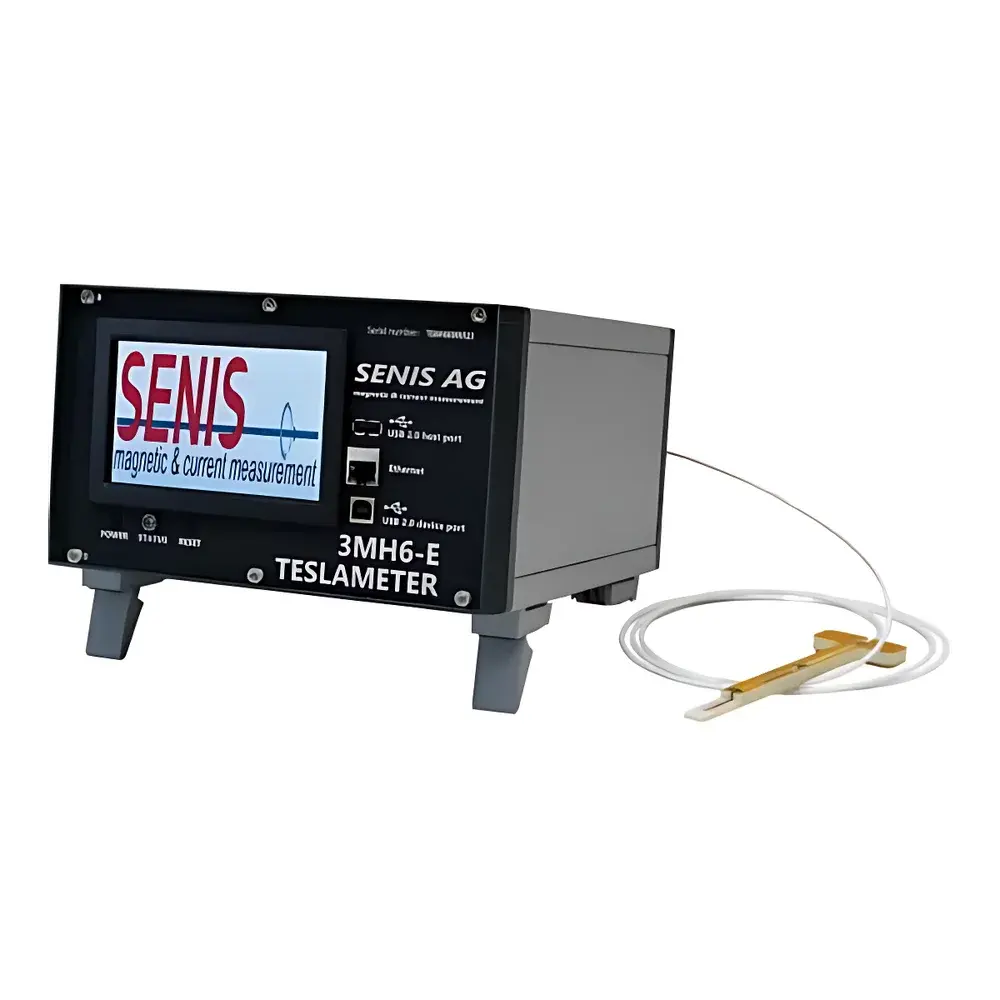
Senis 3MH6-E High-Precision Triaxial Hall Effect Tesla Meter with Interchangeable Probes
| Brand | auniontech |
|---|---|
| Origin | Shanghai, China |
| Manufacturer Type | Authorized Distributor |
| Product Category | Domestic |
| Model | Senis 3MH6-E |
| Price | Upon Request |
| Magnetic Range Options | ±100 mT, ±500 mT, ±2 T, ±20 T (Calibrated up to ±9 T) |
| DC Accuracy | ±0.01% of Full Scale (100 ppm) |
| Resolution | 2 ppm (24-bit ADC) |
| Bandwidth | DC – 2.5 kHz (–3 dB) |
| Sampling Rate | Up to 7.5 kS/s |
| Temperature Stability | 20 ppm/°C of Reading |
| Probe Interchangeability | Yes (EEPROM-stored calibration data per probe) |
| Output Units | Tesla (T) and Gauss (G) selectable |
| Interface | USB Device Port (Virtual COM) |
| Data Logging Interval | 0.5 s – 60 s (up to 300 days storage) |
| Trigger Modes | Internal/External, Single-shot/Manual/Continuous |
| Built-in Temperature Sensor | Yes |
| Operating System Support | Windows 10/7 (PC software), Android (embedded GUI) |
Overview
The Senis 3MH6-E is a high-precision, triaxial Hall effect tesla meter engineered for laboratory-grade magnetic field characterization in research, metrology, and industrial quality control environments. It operates on the principle of the Hall effect—measuring the transverse voltage generated across a semiconductor (Hall sensor) when subjected to orthogonal magnetic flux density—and delivers vectorial measurement of all three orthogonal components (Bx, By, Bz) simultaneously. Unlike single-axis instruments requiring mechanical reorientation, the 3MH6-E integrates a C-type 3-axis Hall probe with co-located temperature sensing, enabling real-time thermal drift compensation and eliminating positional uncertainty during spatial mapping. Its architecture separates sensor functionality into two modular units: the Hall probe module (H) with flexible cable lengths and the electronics module (E), supporting rapid field replacement without recalibration. Each probe is individually calibrated at the factory, with full correction coefficients stored in an onboard EEPROM—ensuring interchangeability across all four selectable ranges (±100 mT, ±500 mT, ±2 T, ±20 T) while maintaining ≤100 ppm DC accuracy and ≤2 ppm magnetic resolution.
Key Features
- Triaxial vector measurement of Bx, By, and Bz with integrated temperature monitoring for real-time thermal compensation
- Modular design with fully interchangeable Hall probes—each probe retains its unique calibration dataset in embedded EEPROM
- DC magnetic resolution better than 1 µT (in-plane) and 2 µT (perpendicular) at ±2 T range, supported by 24-bit analog-to-digital conversion
- Wide dynamic bandwidth: DC to 2.5 kHz (–3 dB), suitable for both static field mapping and time-varying field analysis (e.g., pulsed magnets, motor harmonics)
- Flexible triggering: internal clock, external TTL input (single-shot, manual, or continuous mode), with programmable interval from 100 ms to 5 minutes
- Auto-ranging, auto-zero, hold, min/max capture, and user-selectable units (T or G)
- Embedded Android-based GUI for standalone operation; PC software for Windows 10/7 enables remote acquisition, visualization, and scripting integration
Sample Compatibility & Compliance
The 3MH6-E supports non-contact, non-destructive magnetic field measurements on a broad class of materials—including permanent magnets, electromagnets, magnetic shielding alloys, superconducting devices, and MEMS actuators—without perturbing the field under test. Its low-noise front-end and thermally stable signal chain meet requirements for ISO/IEC 17025-accredited calibration labs performing magnetic field verification against reference standards traceable to national metrology institutes (e.g., PTB, NIST). While not inherently certified for regulatory compliance, the instrument’s deterministic behavior, audit-ready data logging (with timestamped metadata), and deterministic trigger synchronization support implementation in GLP/GMP environments where field uniformity validation is required—for example, in MRI fringe field assessment, magnetic separator qualification, or magnetized component screening per ASTM A977/A977M.
Software & Data Management
Data acquisition is implemented via a virtual COM port over USB, exposing raw sensor outputs (Bx, By, Bz, temperature) as ASCII-formatted packets at user-defined sampling rates (up to 7.5 kS/s). The included Windows application provides real-time plotting, statistical analysis (mean, std dev, min/max), and CSV export with header metadata (range, probe ID, timestamp, unit). For automated integration, comprehensive API documentation is provided for C/C++, C#, Python, LabVIEW, and Delphi—enabling direct incorporation into custom test sequences, HALT/HASS protocols, or closed-loop feedback systems. All logged data includes probe serial number, calibration date, range setting, and ambient temperature—facilitating full traceability in accordance with FDA 21 CFR Part 11 principles when deployed with appropriate system-level controls.
Applications
- Characterization of NdFeB, SmCo, and ferrite permanent magnets—including Br, HcJ, and BH curve point verification
- Mapping stray fields around MRI systems, particle accelerators, and fusion confinement devices
- Quality assurance of magnetic assemblies in automotive sensors (e.g., ABS, EPS), aerospace actuators, and electric motor stators
- Validation of magnetic shielding effectiveness (e.g., Mu-metal enclosures) using differential field gradient analysis
- Research in spintronics, magneto-optical trapping, and quantum sensing platforms requiring sub-µT stability
- Calibration transfer between primary and secondary magnetic standards in metrology laboratories
FAQ
Can I replace the Hall probe without losing calibration accuracy?
Yes. Each probe contains an EEPROM storing its full multi-point calibration matrix. When swapped, the electronics module automatically loads the corresponding coefficients—maintaining ≤100 ppm DC accuracy across all four ranges.
What is the maximum sampling rate for continuous acquisition?
Up to 7.5 kS/s (7,500 samples per second), limited only by USB throughput and host buffer capacity.
Is the device compliant with FDA 21 CFR Part 11 for regulated environments?
The hardware and firmware support audit-trail-capable operation (timestamped logs, user attribution via software layer), but formal Part 11 compliance requires site-specific validation of the complete software stack and access controls.
Does the instrument support AC field measurements up to its specified bandwidth?
Yes. The analog front-end preserves phase coherence up to 2.5 kHz (–3 dB), enabling RMS, peak, and harmonic analysis of time-varying fields.
How is temperature compensation implemented?
A co-located Pt1000 RTD measures probe junction temperature in real time; sensitivity drift coefficients (20 ppm/°C) are applied dynamically to raw Hall voltages prior to vector summation.



