
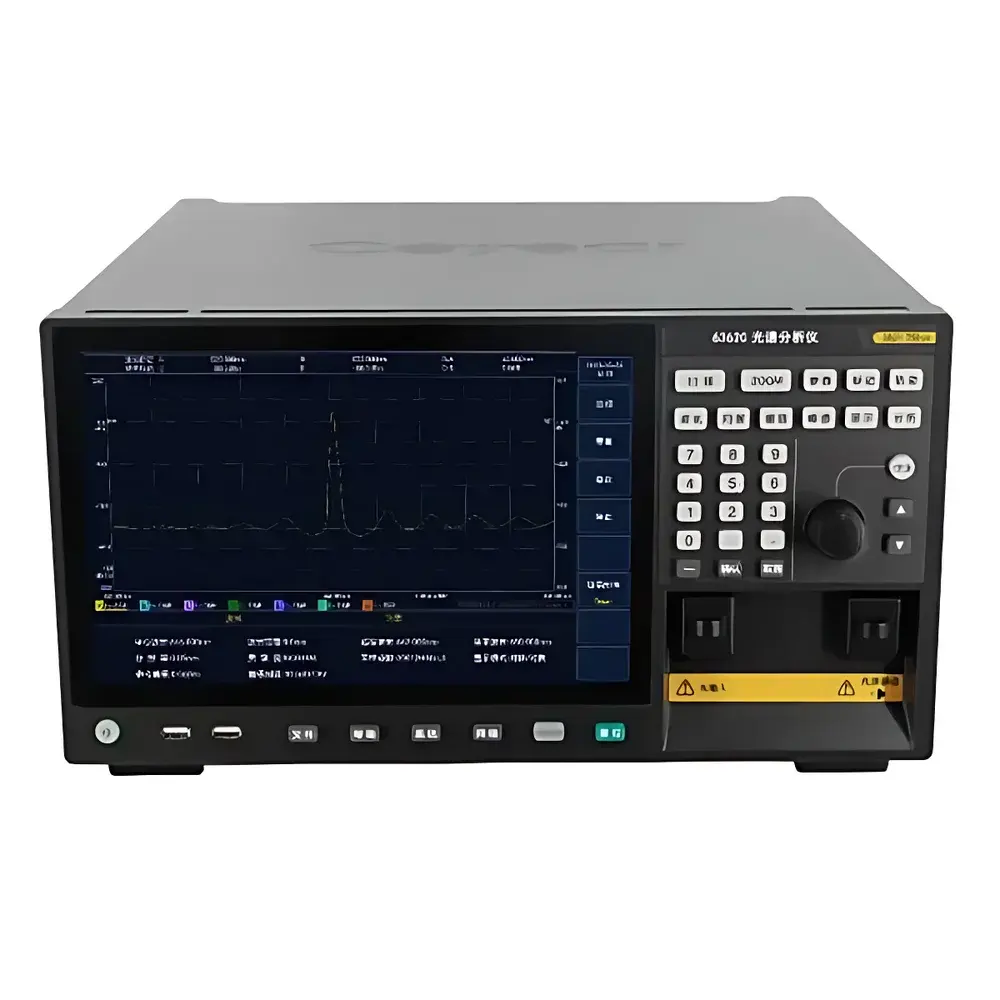
Auniontech 6362C High-Resolution Visible-Near-Infrared Spectral Analyzer
| Brand | Auniontech |
|---|---|
| Model | 6362C |
| Spectral Range | 350–1200 nm |
| Optical Resolution | 10 pm (0.01 nm at 400–470 nm) |
| Wavelength Accuracy | ±0.05 nm @ 633 nm |
| Dynamic Range | 60 dB (peak ±0.5 nm, res. 0.02 nm) |
| Sensitivity | –80 dBm @ 500–1000 nm |
| Input Connectors | FC/PC |
| Fiber Compatibility | SMF, MMF (50/125 µm, 62.5/125 µm), Large-Core Fibers (<800 µm) |
| Touchscreen Interface | 12.1″ capacitive display |
Overview
The Auniontech 6362C High-Resolution Visible-Near-Infrared Spectral Analyzer is an engineered optical measurement instrument designed for precision spectral characterization across the 350–1200 nm wavelength band. Based on high-finesse diffraction grating optics and thermally stabilized detector architecture, it delivers sub-picometer-level resolution—specifically 10 pm (0.01 nm) in the 400–470 nm range—with calibrated wavelength accuracy of ±0.05 nm at 633 nm using He-Ne laser reference. Its core measurement principle relies on monochromator-based scanning spectroscopy with real-time photodiode array detection, enabling high-fidelity acquisition of spectral shape, peak position, linewidth, and relative intensity distribution. This makes the 6362C particularly suited for R&D and production environments where traceable, repeatable spectral metrology is required—including laser diode qualification, passive component insertion loss profiling, LED chromaticity validation, and thin-film optical density mapping.
Key Features
- Continuous spectral coverage from 350 nm to 1200 nm, supporting both UV-Vis and short-wave NIR applications
- Configurable optical resolution down to 10 pm (0.01 nm) in the blue-violet region; standard resolution settings include 0.02–10 nm across full range
- Wavelength calibration traceable to NIST-traceable He-Ne laser (633 nm), with extended accuracy verification across 400–1100 nm (±0.2 nm)
- Dynamic range of 60 dB measured at peak ±0.5 nm under 0.02 nm resolution—enabling simultaneous detection of dominant and weak spectral features
- High sensitivity of –80 dBm (typical, 500–1000 nm) achieved via multi-stage gain control and signal averaging (up to 10x)
- Optical input compatibility with single-mode fiber (SMF, MFD 5 µm @ 850 nm), graded-index multimode fiber (50/125 µm, 62.5/125 µm), and large-core fibers up to 800 µm diameter
- Integrated alignment light source for rapid optical axis optimization—eliminating dependency on external wavelength standards during setup
- 12.1-inch capacitive touchscreen interface with embedded firmware supporting real-time spectrum rendering, marker-based analysis, and export-ready data formatting
Sample Compatibility & Compliance
The 6362C supports direct coupling to free-space beams (via optional collimator adapters) and fiber-pigtailed devices using standard FC/PC connectors. It complies with IEC 61326-1:2013 for electromagnetic compatibility in laboratory environments and meets safety requirements per IEC 61010-1:2010 for measurement equipment. While not certified to FDA 21 CFR Part 11 or ISO/IEC 17025 out-of-the-box, its data logging architecture—featuring timestamped spectra, user-defined metadata fields, and audit trail-enabled configuration history—supports integration into GLP/GMP workflows when deployed with validated software extensions. All spectral measurements adhere to ASTM E308-22 for colorimetric computation and ISO 13697:2021 for optical filter spectral transmittance testing protocols.
Software & Data Management
The instrument ships with Auniontech’s SpectraView Pro v4.x software suite, which provides native support for spectral math operations (e.g., normalization, derivative calculation, peak deconvolution), CIE color space conversion (XYZ, xyY, u’v’), and pass/fail limit testing against user-defined spectral templates. Raw data is exported in ASCII CSV and HDF5 formats, ensuring interoperability with MATLAB, Python (NumPy/Pandas), and LabVIEW environments. The embedded system logs all acquisition parameters—including resolution setting, averaging count, sensitivity mode, and calibration timestamp—into each dataset header. Optional API modules enable remote control via TCP/IP or USB-VCOM, facilitating automated test sequences in production line environments compliant with Industry 4.0 data acquisition frameworks.
Applications
- Laser diode development: DFB, VCSEL, and FP laser characterization—including SMSR, side-mode suppression, and temperature-dependent wavelength drift
- Passive optical component testing: WDM filter roll-off steepness, isolator polarization-dependent loss (PDL), and FBG reflection bandwidth analysis
- LED and OLED manufacturing: Dominant wavelength, color rendering index (CRI), and spectral radiant flux quantification per CIE S 025/E:2015
- Materials science: Thin-film interference modeling, absorption coefficient extraction, and semiconductor bandgap determination
- Biophotonics: Hemoglobin/oxyhemoglobin spectral separation in tissue-simulating phantoms, fluorescence excitation profiling
- System-level validation: EDFA gain flatness, SCS spectral noise floor assessment, and ultrafast laser pulse spectrum reconstruction
FAQ
What wavelength calibration standards are supported?
The 6362C includes factory calibration using a NIST-traceable He-Ne laser at 633 nm. Users may perform in-house recalibration using optional external references such as Hg/Ar lamps or tunable laser sources.
Can the instrument measure absolute power?
Yes—power measurement is traceable to internal photodiode responsivity curves, with accuracy of ±1.0 dB at 850 nm under defined conditions (–20 dBm input, ≥0.2 nm resolution, MID/HIGH sensitivity modes).
Is fiber optic connector interchangeability supported?
Standard configuration uses FC/PC interfaces; SC, LC, or SMA adapters are available as optional accessories with recalibration documentation.
How is thermal drift managed during long acquisitions?
The optical bench incorporates passive thermal stabilization and real-time wavelength feedback correction using the built-in alignment source, reducing drift to <±0.5 pm over 2-hour continuous operation.
Does the system support automated pass/fail reporting for QC environments?
Yes—SpectraView Pro includes configurable limit templates, batch processing, and PDF/CSV report generation with embedded pass/fail flags and operator signatures.



