
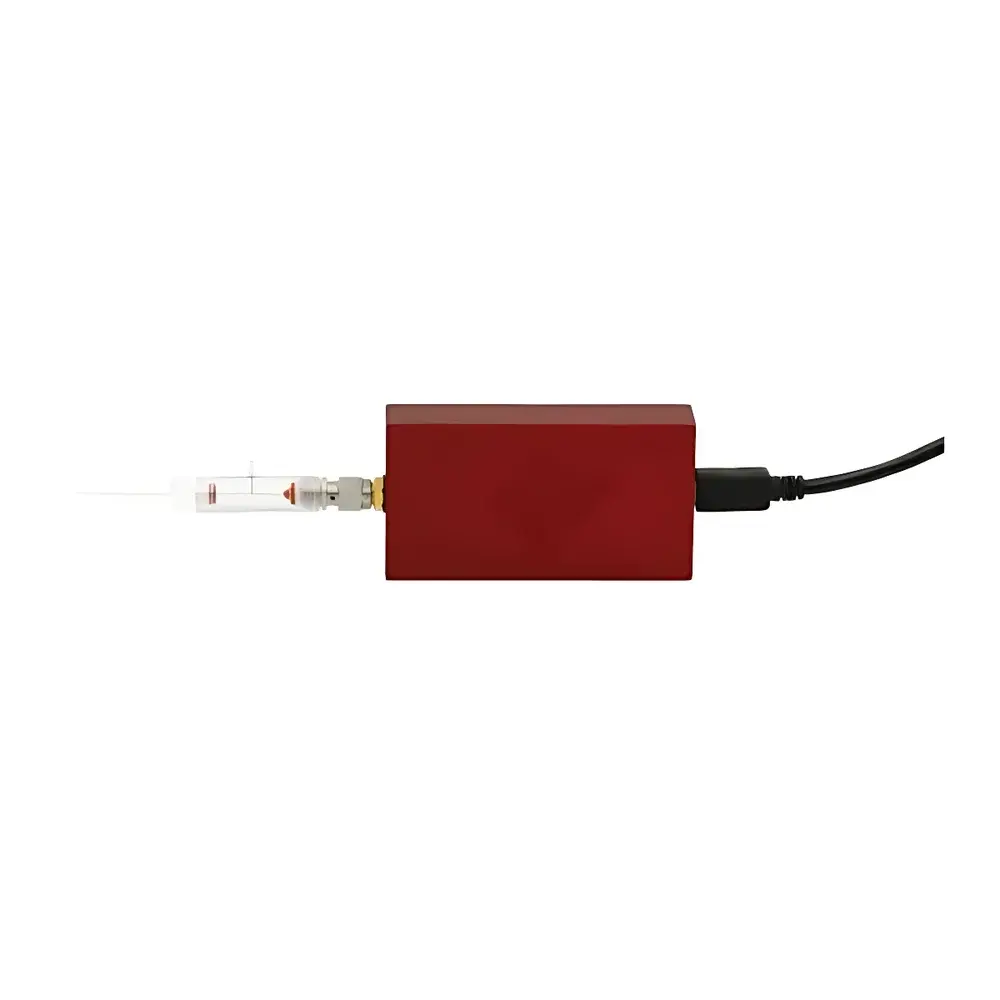
El.En. ePatch VC-CC Microfluidic Patch-Clamp Amplifier
| Brand | El.En. |
|---|---|
| Origin | Italy |
| Model | ePatch VC-CC |
| Measurement Principle | Voltage-Clamp / Current-Clamp / Zero-Current-Clamp Electrophysiology |
| Input Noise (VC, rms) | 300 fA @ 625 Hz |
| Current Ranges | ±200 pA (2.25 GΩ), ±2 nA (225 MΩ), ±20 nA (22.5 MΩ), ±200 nA (2.25 MΩ) |
| Voltage Pulse Range | ±500 mV |
| Max Sampling Rate | 200 kS/s |
| C-fast Compensation | 0–11 pF |
| C-slow Compensation | 0–250 pF / 0–2500 µs |
| Series Resistance Compensation | 0–25 MΩ |
| Bridge Balance | 0–40 MΩ |
| Pipette Neutralization | 0–31 pF |
| Dimensions | 42 × 18 × 78 mm |
| Weight | 200 g |
| Power | USB 5 V (no external PSU required) |
| Data Format | ABF v2.x compliant |
Overview
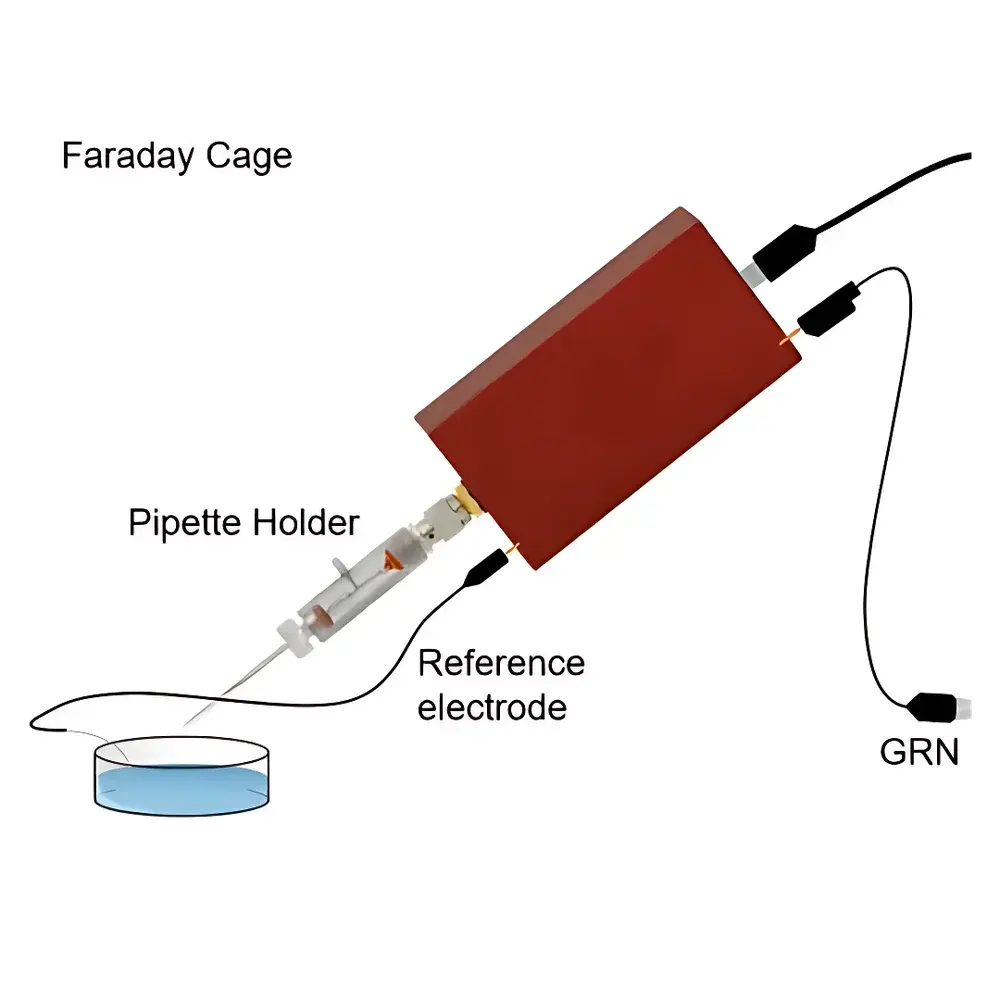
The El.En. ePatch VC-CC is a compact, high-fidelity microfluidic patch-clamp amplifier engineered for rigorous electrophysiological investigation of live cells and acute tissue slices. Unlike conventional benchtop amplifiers, the ePatch integrates a low-noise headstage, precision voltage/current stimulus generator, and 200 kS/s analog-to-digital converter into a single monolithic unit measuring only 42 × 18 × 78 mm and weighing 200 g. Its USB-powered architecture eliminates reliance on external power supplies, isolated grounding systems, or bulky signal conditioning hardware—enabling rapid deployment in confined spaces such as vibration-isolated microscope stages, laminar flow hoods, or mobile lab environments. The device operates on standard USB 2.0 power (5 V DC) and communicates via high-speed USB 2.0, ensuring deterministic latency and real-time data streaming without driver-level bottlenecks. Designed around the core principles of Coulombic charge detection and feedback-controlled transimpedance amplification, the ePatch supports both voltage-clamp and current-clamp configurations with true zero-current mode—a critical capability for accurate resting membrane potential measurement under minimal perturbation.
Key Features
- Integrated headstage with 300 fA RMS input noise at 625 Hz—optimized for high-resolution single-channel and miniature synaptic current recording
- Four programmable current ranges (±200 pA to ±200 nA) with selectable transimpedance gains (2.25 GΩ to 2.25 MΩ), enabling dynamic adaptation to seal resistance and channel conductance
- Voltage-clamp pulse generator with ±500 mV range and sub-microsecond timing resolution, supporting complex step-and-ramp protocols
- Comprehensive capacitance and series resistance compensation: C-fast (0–11 pF), C-slow (0–250 pF / 0–2500 µs), R-series (0–25 MΩ), bridge balance (0–40 MΩ), and pipette neutralization (0–31 pF)
- True zero-current clamp mode for unbiased resting potential acquisition—eliminating bias-induced drift during long-duration recordings
- Real-time digital filtering with adjustable cutoff frequencies from 625 Hz to 100 kHz, implemented in FPGA-based hardware for zero-phase distortion
- ABF v2.x native data output compatible with Clampex, pCLAMP, Axograph, and open-source analysis pipelines (e.g., Neo, Elephant, SciPy)
Sample Compatibility & Compliance
The ePatch is validated for use across primary neuronal cultures (e.g., cortical or hippocampal neurons), acutely prepared brain slices (200–400 µm thickness), and heterologous expression systems (HEK293, CHO, Xenopus oocytes). Its ultra-low-noise front-end and adaptive compensation algorithms support gigaseal formation (>1 GΩ) and stable whole-cell configuration over durations exceeding 30 minutes. The system complies with essential electrophysiology standards including IEEE 1073.2.0 (medical device interoperability), IEC 61000-4-3 (EMC immunity), and meets the electrical safety requirements of IEC 61010-1 for laboratory equipment. While not FDA-cleared for clinical diagnostics, its architecture supports GLP/GMP-aligned workflows when paired with audit-trail-enabled software (e.g., custom LabVIEW or Python-based acquisition suites with timestamped metadata logging).
Software & Data Management
The ePatch is controlled via a cross-platform native application supporting Windows, macOS, and Linux. The interface provides synchronized visualization of voltage and current traces at full sampling rate (200 kS/s), with configurable dual-axis scaling, real-time FFT spectral monitoring, and overlay-triggered averaging. A built-in protocol editor allows definition of multi-step voltage ramps, current injections, and hybrid clamp sequences—including conditional branching based on membrane potential thresholds. Membrane parameter estimation (Rm, Cm, τm) is performed in real time using least-squares fitting of exponential responses to hyperpolarizing pulses. All acquired data are saved in standardized ABF v2.x format with embedded metadata (stimulus parameters, compensation values, temperature, user annotations), ensuring full traceability and compatibility with third-party analysis tools. Optional API access (C/C++, Python bindings) enables integration into automated patching platforms and closed-loop stimulation paradigms.
Applications
- Whole-cell voltage-clamp recordings of ligand-gated (e.g., AMPA, GABAA) and voltage-gated (e.g., Nav, Kv) ion channels in primary neurons
- Single-channel analysis in excised inside-out or outside-out patches, leveraging sub-picoampere noise floor and 100 kHz bandwidth
- Current-clamp interrogation of action potential firing dynamics, afterhyperpolarization kinetics, and input resistance in acute brain slices
- Resting membrane potential mapping in developmentally immature neurons using true zero-current mode
- High-throughput pharmacological screening of ion channel modulators in heterologous expression systems
- Combined optogenetic-electrophysiological experiments (e.g., ChR2 stimulation + simultaneous current-clamp recording)
FAQ
Does the ePatch require an external power supply or ground isolation unit?
No. It draws regulated 5 V DC directly from a standard USB 2.0 port and includes internal galvanic isolation to suppress ground loops.
Can the ePatch be used for both whole-cell and single-channel recordings?
Yes. Its 300 fA input noise at 625 Hz and selectable high-gain transimpedance modes (up to 2.25 GΩ) support robust single-channel resolution in low-capacitance configurations.
Is ABF file export compatible with Clampfit and other commercial analysis packages?
Yes. All recordings are saved in ABF v2.x format with complete header metadata, ensuring seamless import into Clampfit, Axograph, NeuroMatic, and open-source toolchains.
How is series resistance compensated during whole-cell recordings?
The ePatch implements real-time analog R-series compensation with a 0–25 MΩ range and automatic feedback calibration prior to break-in, minimizing voltage error and improving temporal fidelity.
What is the maximum achievable sampling rate, and is oversampling supported?
The native ADC operates at 200 kS/s with hardware decimation filters; users may configure effective sampling rates from 1 kS/s to 200 kS/s with corresponding anti-aliasing filter cutoffs.
Related Products





