
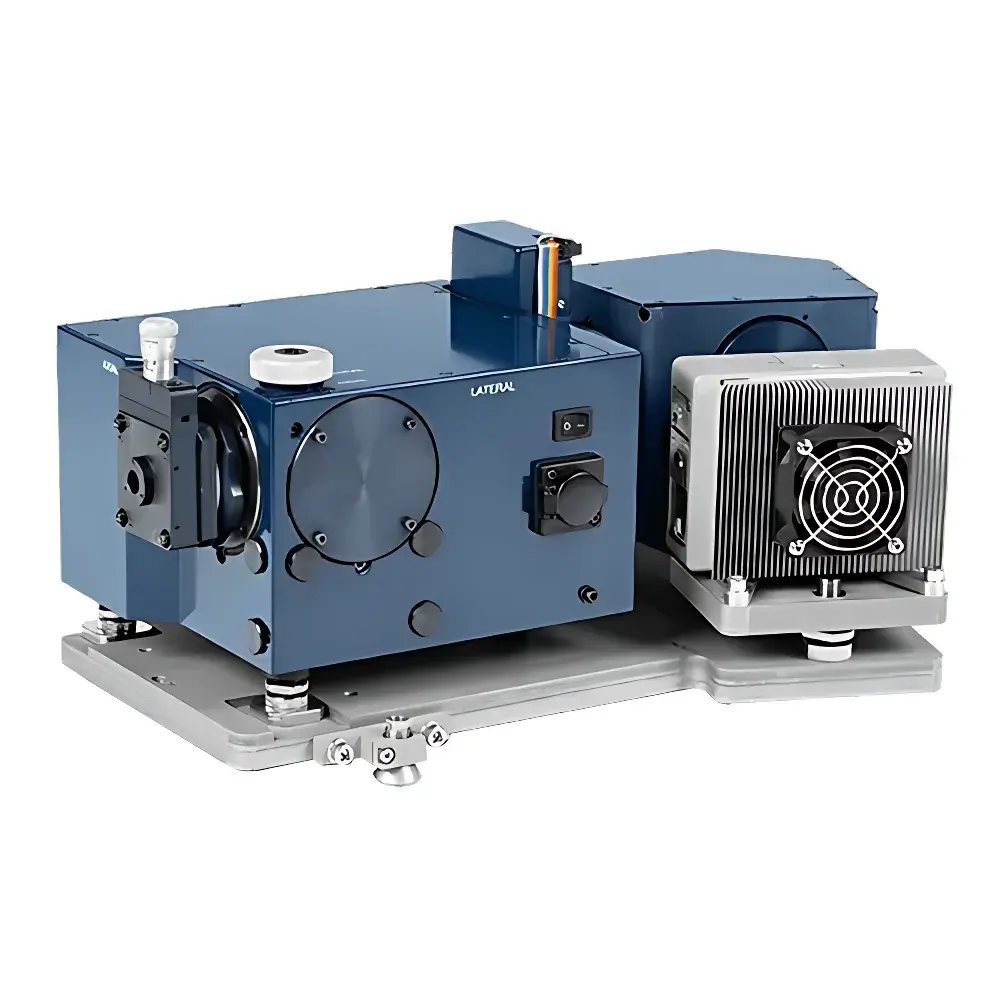
Auniontech XWS-65 Tunable Broadband Light Source
| Brand | Auniontech |
|---|---|
| Model | XWS-65 |
| Spectral Range | 190–2500 nm |
| Spectral Bandwidth | Continuously Adjustable (Down to 0.5 nm) |
| Output Power | Up to 3 mW at 6 nm bandwidth |
| Spectral Power Density | Up to 60 µW/(nm·mm²) |
| Wavelength Reproducibility | 0.02–0.1 nm |
| Source Type | Laser-Pumped Plasma Broadband Source |
| Lifetime | >10,000 hours |
| Monochromator Options | Compact M150 (f = 142 mm, f/3.6) or High-Resolution M266 (f = 284 mm, f/3.8) |
| Input Slit Size | 500 µm |
| Output Options | Free-space via exit slit, fiber-coupled, or collimated beam with optional achromatic doublet lenses |
| Interface | USB |
Overview
The Auniontech XWS-65 Tunable Broadband Light Source is an engineered solution for applications demanding high spectral coverage, exceptional stability, and precise wavelength control across the deep ultraviolet to near-infrared spectrum (190–2500 nm). Unlike conventional arc lamps—such as xenon or mercury discharge sources—the XWS-65 employs a laser-pumped plasma architecture, generating broadband continuum emission through localized, high-energy plasma excitation. This physical mechanism delivers significantly improved spatial homogeneity, temporal stability (intensity drift <0.3% over 8 h), and radiometric reproducibility compared to thermal or gas-discharge alternatives. The system integrates seamlessly with either the compact M150 or high-resolution M266 monochromator, enabling flexible trade-offs between throughput, resolution, and cost without compromising optical alignment integrity. Its modular design supports direct free-space output, SMA-905 fiber coupling (with optional FC/PC or custom connectors), and collimated beam delivery using interchangeable achromatic doublet objectives—making it suitable for both benchtop research and embedded OEM instrumentation.
Key Features
- Laser-pumped plasma broadband source (XWS-65) delivering superior brightness (>10× UV-VIS irradiance vs. standard Xe lamps) and long operational lifetime (>10,000 h at rated power)
- Continuous spectral tuning from 190 nm to 2500 nm with resolution down to 0.5 nm (dependent on grating selection and slit width)
- High spectral power density: up to 60 µW/(nm·mm²) at the exit plane, optimized for low-light detection systems and integrating sphere-based measurements
- Wavelength reproducibility of 0.02–0.1 nm (verified via NIST-traceable reference lines), critical for repeatable spectroscopic calibration and inter-laboratory comparison
- Automated monochromator control via USB interface; firmware supports command-line scripting (SCPI-compatible) and integration with LabVIEW, Python, and MATLAB environments
- Integrated stray-light compensation optics in both M150 and M266 monochromators, reducing second-order contributions by >40 dB across the full range
- Thermally stabilized housing with active cooling to maintain spectral centroid stability within ±0.05 nm over ambient fluctuations of ±5 °C
Sample Compatibility & Compliance
The XWS-65 is compatible with standard optical components including quartz, fused silica, CaF₂, and MgF₂ transmissive elements—enabling use down to 190 nm without vacuum purging. For UV-C operation (<220 nm), nitrogen purging or evacuated beam paths are recommended to mitigate ozone absorption. The system conforms to IEC 61000-6-3 (EMC emission limits) and IEC 61010-1 (safety requirements for laboratory equipment). All firmware and control software support audit trail logging and user-access-level management, aligning with GLP and ISO/IEC 17025 documentation requirements. While not FDA 21 CFR Part 11 certified out-of-the-box, the architecture permits validation-ready configuration for regulated photobiological safety testing (IEC 62471) and photovoltaic spectral response calibration (IEC 60904-9 Ed. 3).
Software & Data Management
The native XWS Control Suite provides real-time wavelength scanning, power monitoring, and automated grating/slit sequencing. Export formats include CSV, HDF5, and SIF (Spectral Instrument File), ensuring compatibility with Origin, Igor Pro, and commercial spectrometer analysis platforms. Raw intensity data includes timestamped metadata (wavelength, slit width, grating ID, lamp hours, ambient temperature). Remote operation is supported via TCP/IP socket interface for integration into automated test benches. All software binaries are digitally signed, and firmware updates follow secure boot verification protocols. Audit logs record every parameter change, user login, and hardware event—retained for ≥90 days unless externally archived.
Applications
- Spectroscopy & Fluorescence Excitation: High-stability excitation source for steady-state and time-resolved fluorescence, Raman pump-probe setups, and absorbance/transmittance mapping
- Photovoltaic Characterization: Spectral responsivity measurement per IEC 60904-8 and quantum efficiency calibration traceable to NREL standards
- Optical Metrology: Reference source for monochromator calibration, spectral radiance validation, and goniophotometer characterization
- Photochemistry & Photobiology: Dose-controlled irradiation experiments with defined action spectra (e.g., DNA damage studies, photocatalysis kinetics)
- Microscopy Illumination: Tunable epi-illumination for multispectral reflectance imaging, dark-field contrast enhancement, and optogenetic stimulation
- OEM Integration: Compact footprint (240 × 180 × 120 mm) and low EMI profile enable embedding in analytical instruments, environmental sensors, and industrial inspection systems
FAQ
What is the minimum achievable bandwidth, and how is it determined?
The minimum spectral bandwidth is governed by the combination of monochromator focal length, grating groove density, and input/output slit width. With the M266 and 1200 g/mm grating, a 500 µm slit yields ~0.5 nm FWHM at 500 nm. Narrower slits improve resolution but reduce throughput proportionally.
Can the XWS-65 be used below 200 nm without purging?
Operation below 200 nm requires nitrogen purging or vacuum environment to minimize O₂ and H₂O absorption; standard quartz optics transmit down to ~190 nm under dry N₂ flow.
Is fiber coupling included as standard, or is it an optional accessory?
Fiber coupling is optional and configured at order time. Standard SMA-905 termination is provided; custom connectors (FC/APC, ST, or liquid light guide interfaces) are available upon request.
How is wavelength calibration performed, and what traceability does it offer?
Factory calibration uses Hg/Ne/Ar spectral lines with uncertainties referenced to NIST SRM 2035. End-users may perform recalibration using supplied mercury-argon pen lamp or external calibrated line sources.
Does the system support synchronization with external detectors or pulsed lasers?
Yes—TTL sync output (rising edge at scan start) and external trigger input (for gated acquisition) are provided via BNC connectors, with jitter <100 ns.





