
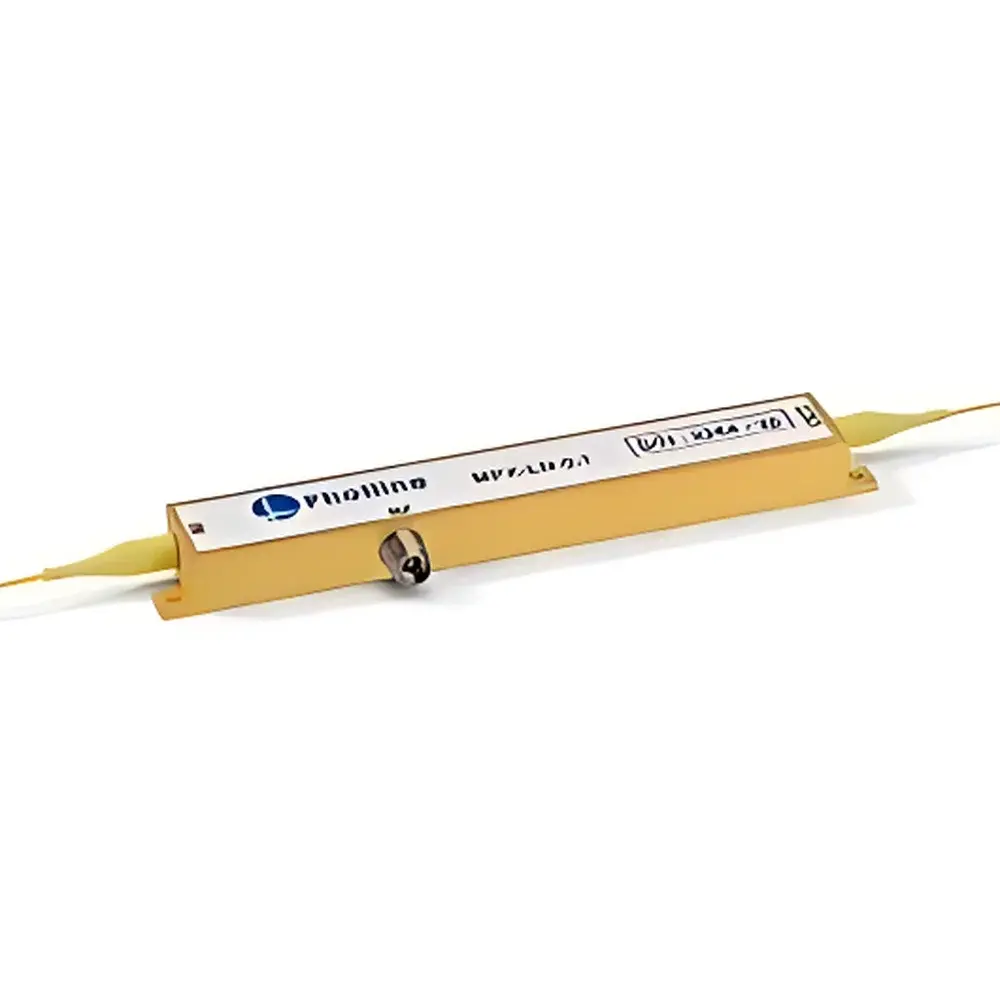
Photline LiNbO3 EO Phase Modulator Series
| Origin | France |
|---|---|
| Manufacturer Type | Authorized Distributor |
| Origin Category | Imported |
| Model | LiNbO3_EO_Phase_Modulator |
| Pricing | Available Upon Request |
Overview
The Photline LiNbO3 EO Phase Modulator Series is a family of high-performance, waveguide-based electro-optic phase modulators engineered for precision optical phase control across multiple telecom and scientific wavelength bands. Leveraging the strong Pockels effect in single-crystal lithium niobate (LiNbO₃), these devices convert applied radio-frequency (RF) or DC voltage into controlled, linear optical phase shifts via the electro-optic coefficient r₃₃. The modulators employ either X-cut or Z-cut crystal configurations—optimized for thermal stability, low half-wave voltage (Vπ), and polarization-maintaining operation—and are fabricated using proton exchange (PE) or titanium indiffusion (Ti:LiNbO₃) waveguide processes to ensure high optical damage threshold, low propagation loss, and robust mechanical integrity. Designed for integration into fiber-pigtailed systems, each modulator features polarization-maintaining (PM) or standard single-mode fiber input/output, hermetically sealed packaging, and RF-compatible electrode interfaces compliant with industry-standard SMA or K connectors.
Key Features
- Multi-band wavelength coverage: 780–890 nm (800 nm band), 980–1150 nm (1060 nm band), 1260–1650 nm (C+L band), and 1900–2200 nm (2 µm band)
- Electro-optic bandwidth options from DC–150 MHz up to 32 GHz (typ.), supporting both analog and digital phase modulation protocols
- Low Vπ values ranging from 2.5 V (800 nm, low-frequency variant) to 150 V (2 µm, low-frequency variant), enabling efficient drive electronics integration
- Insertion loss as low as 2.5 dB (typ.) for high-speed variants; ≤4.0 dB (typ.) across all series
- High optical power handling: up to 100 mW (PE-waveguide variants at 800/1060 nm); >500 mW available upon request for custom designs
- Thermally stable X-cut architecture for low drift in interferometric and sensing applications
- Fiber-pigtailed configuration with FC/APC or PM-fiber pigtails; optional integrated bias controllers and RF impedance matching networks
Sample Compatibility & Compliance
All Photline LiNbO₃ phase modulators are designed and tested in accordance with ISO 9001-certified manufacturing protocols. Device-level performance complies with IEC 61280-2-9 (optical modulator testing), Telcordia GR-468-CORE (reliability for optoelectronic devices), and RoHS 2011/65/EU directives. For laboratory and industrial deployment requiring traceable calibration and audit readiness, photonic subsystems—including modulator + driver combinations—support optional GLP-compliant documentation packages. While not inherently FDA 21 CFR Part 11–compliant (as a hardware-only component), the modulators integrate seamlessly with validated software-controlled test platforms used in regulated environments such as quantum optics R&D and aerospace-grade fiber sensor qualification.
Software & Data Management
As a passive electro-optic component, the LiNbO₃ phase modulator does not incorporate embedded firmware or onboard data logging. However, it is fully interoperable with industry-standard instrumentation ecosystems: Keysight PXIe-based RF signal generators, Zurich Instruments HF2LI lock-in amplifiers, and Python- or LabVIEW-controlled arbitrary waveform generators (AWGs) for precise phase trajectory synthesis. Photline provides comprehensive datasheets, S-parameter files (up to 40 GHz), and MATLAB/Python modeling scripts for transfer function prediction, chirp characterization, and dispersion-compensated phase modulation design. Optional evaluation kits include calibrated RF drivers with adjustable gain, bias tees, and real-time Vπ monitoring outputs—enabling closed-loop calibration traceable to NIST-traceable voltage standards.
Applications
- Coherent optical communications: QPSK, 8-QAM, and higher-order phase-shift keying (PSK) modulation in metro and long-haul DWDM systems
- Interferometric fiber-optic sensors: Distributed acoustic sensing (DAS), fiber Bragg grating (FBG) interrogation, and Michelson/Mach-Zehnder based strain/temperature monitoring
- Ultrafast optics: Optical frequency comb generation, spectral broadening via nonlinear phase accumulation, and pulse shaping in CPA and OPCPA laser systems
- Quantum photonics: Phase encoding in time-bin and polarization-based quantum key distribution (QKD) protocols; active stabilization of Mach-Zehnder interferometers in boson sampling experiments
- Laser linewidth narrowing and active feedback control: Pound-Drever-Hall locking, cavity ring-down spectroscopy, and ultra-stable laser frequency referencing
- Mid-IR photonics: Low-noise phase modulation at 2 µm for gas sensing (e.g., CO₂, CH₄) and medical laser delivery systems
FAQ
What is the typical half-wave voltage (Vπ) for the 1550 nm MPX-LN-0.1 modulator?
The MPX-LN-0.1 exhibits a typical Vπ of 3 V at 1550 nm under DC or low-frequency conditions.
Do these modulators require temperature stabilization for stable operation?
X-cut devices (e.g., MPX-LN series) demonstrate intrinsic thermal stability with drift 20 °C ambient variation.
Can the 2 µm MPX2000-LN-0.1 be used with polarization-maintaining fiber?
Yes—it is supplied with PM1550-compatible fiber at 2 µm (custom Panda or Bow-tie PM fiber available) and maintains extinction ratio >20 dB over its operating bandwidth.
Is RF impedance matching included in the standard package?
All high-bandwidth models (>1 GHz) feature 50 Ω matched RF electrodes; low-frequency variants use high-impedance electrodes optimized for voltage-driven operation.
Are S-parameters and eye diagrams available for system-level simulation?
Yes—Photline provides Touchstone (.s2p) files up to 40 GHz and measured eye diagrams for 28 Gbaud NRZ/QPSK signals upon request with NDA.




