
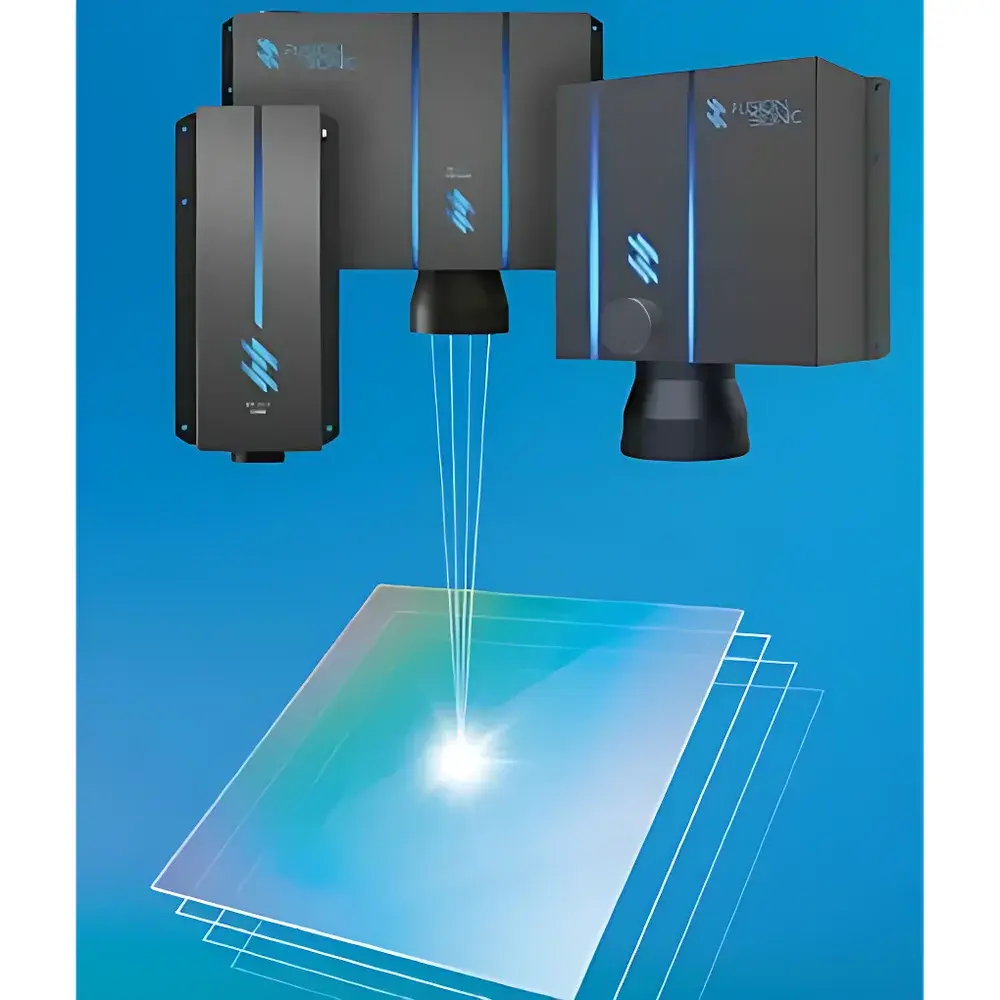
Auniontech DLIP-200 Direct Laser Interference Patterning System
| Brand | Auniontech |
|---|---|
| Origin | Shanghai, China |
| Model | DLIP-200 |
| Core Components | Solid-State Ultrafast Laser-Compatible Interferometric Beam Combining Optics |
| Laser Compatibility | Compatible with ps–fs pulsed lasers (≥1 ps pulse width) |
| Configuration | Fixed-beam and scanning variants available |
| Compliance | Designed for ISO 14644-1 Class 8 cleanroom-optional operation |
| Application Domain | Micro/nano surface structuring for functional surfaces |
Overview
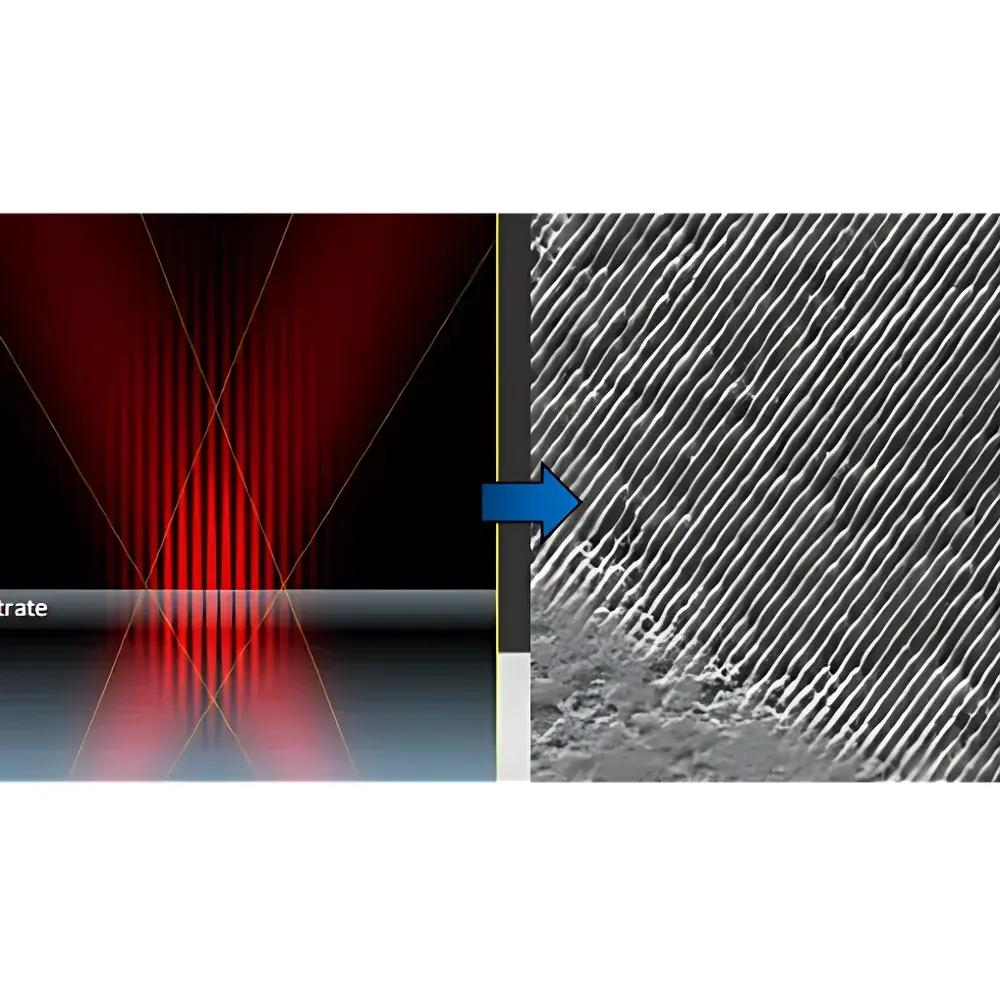
The Auniontech DLIP-200 Direct Laser Interference Patterning System is an engineered optical instrument for non-contact, large-area fabrication of periodic micro- and nano-scale surface topographies via coherent beam interference. Unlike conventional photolithography or laser scanning ablation, DLIP leverages the physical principle of multi-beam optical interference—where two or more collimated, phase-coherent ultrashort laser beams intersect at controlled angles within the focal plane—to generate stable, sub-wavelength intensity modulations on material surfaces. These interference fringes induce spatially periodic energy deposition, enabling deterministic ablation, melting, or surface modification without masks, resists, or vacuum environments. The system operates with solid-state ultrafast lasers (pulse widths ≥1 ps), supporting high-repetition-rate processing while maintaining thermal confinement and minimizing heat-affected zones. It is purpose-built for industrial R&D laboratories requiring rapid prototyping and scalable production of functionalized surfaces—particularly where repeatable pitch control (ranging from ~200 nm to >10 µm), high aspect-ratio feature fidelity, and substrate versatility are critical.
Key Features
- Non-contact, maskless patterning—eliminates tool wear, alignment overhead, and chemical processing steps
- Multi-beam interferometric architecture: supports dual-beam (linear grating), triple-beam (hexagonal lattice), and quadruple-beam (square/rectangular array) configurations
- Real-time angular tuning of beam intersection via motorized kinematic mounts—enables in situ spatial period adjustment without hardware reconfiguration
- Compatible with commercial Ti:sapphire, Yb-fiber, and Nd:YAG ultrafast laser systems (1030 nm, 515 nm, 343 nm harmonics supported)
- Throughput up to 3 m²/min on planar substrates under optimized fluence and repetition rate conditions
- Integrated beam homogenization and wavefront correction optics—ensures uniform fringe contrast (>0.95 visibility) across ≥50 mm × 50 mm fields
- Compact, modular optical layout with standardized kinematic interfaces (e.g., SM1-threaded mounts, 30 mm cage system compatibility)
Sample Compatibility & Compliance
The DLIP-200 accommodates a broad spectrum of rigid and semi-rigid substrates—including aluminum alloys (e.g., AA2024, AA7075), titanium Grade 5, stainless steel 316L, silicon wafers, fused silica, polyimide films, and biomedical-grade polymers (e.g., PEEK, PU). Surface roughness requirements are ≤Ra 100 nm for optimal fringe definition; pre-polishing is recommended for metallic substrates. The system complies with IEC 60825-1:2014 for Class 4 laser product safety and integrates interlocked enclosures meeting EN 60204-1. While not requiring ISO Class 5–7 cleanrooms, it supports optional HEPA-filtered air purge for oxide-sensitive processes. All pattern geometries adhere to ASTM E2905–22 guidelines for reporting periodic surface structure metrology in functional coating validation.
Software & Data Management
Control is executed via Auniontech’s DLIP-Studio v3.2—a Windows-based application supporting script-driven parameter sequencing (Python API included), real-time beam alignment diagnostics, and interferogram stability monitoring. The software logs full experimental metadata—including laser pulse energy (J/pulse), repetition rate (Hz), beam angle (±0.01° resolution), scan velocity (mm/s), and environmental temperature/humidity—into timestamped SQLite databases compliant with FDA 21 CFR Part 11 audit trail requirements. Export formats include CSV, HDF5, and ISO-standardized STEP AP242 for CAD-integrated metrology workflows. Optional integration with third-party profilometers (e.g., Bruker ContourGT, Zygo NewView) enables automated feedback-loop optimization of ablation depth vs. fluence.
Applications
- Aerospace anti-icing surfaces: DLIP-patterned wing skins reduce ice adhesion strength by >85% and lower active de-icing power demand by 60–80%, validated per SAE ARP6327 test protocols
- Bioimplant osseointegration enhancement: Ti-6Al-4V surfaces structured with 1.2 µm hexagonal pits demonstrate 3.2× increase in osteoblast cell attachment density (in vitro, ISO 10993-5)
- Anti-reflective textures on solar cover glass: Sub-250 nm line gratings achieve <0.5% average reflectance across 350–1100 nm (ASTM E903)
- Microfluidic channel wall functionalization: Anisotropic groove arrays (pitch = 4.8 µm) enable directional capillary flow control without surfactants
- Antibacterial Cu–Ni alloy surfaces: 300 nm dot arrays inhibit >99.7% S. aureus biofilm formation after 24 h (ISO 22196)
FAQ
What laser specifications are required to operate the DLIP-200?
A pulse energy ≥20 µJ at 1030 nm (or ≥10 µJ at 515 nm), repetition rate 1–1000 kHz, and M² <1.3 are recommended. Full compatibility matrices for Coherent Monaco, Light Conversion PHAROS, and Trumpf TruMicro Series lasers are provided in the technical manual.
Can the system pattern curved or non-planar surfaces?
Yes—when integrated with a 3-axis galvo-scanner or CNC stage, the DLIP-200 supports conformal patterning on cylindrical surfaces (radius ≥25 mm) and shallow spherical domes (R ≥50 mm), with pitch deviation <±1.5% over 10 mm arcs.
Is process validation support available for GMP-regulated industries?
Auniontech provides IQ/OQ documentation packages, traceable calibration certificates for angular encoders and energy sensors, and assistance in developing PAT (Process Analytical Technology) frameworks aligned with ICH Q8(R2) and USP .
What maintenance is required for long-term operational stability?
Annual recalibration of beam alignment optics and interferometer path-length matching is advised. No consumables are used; optical coatings are rated for >10⁹ laser pulses at 1030 nm / 100 fs.





