
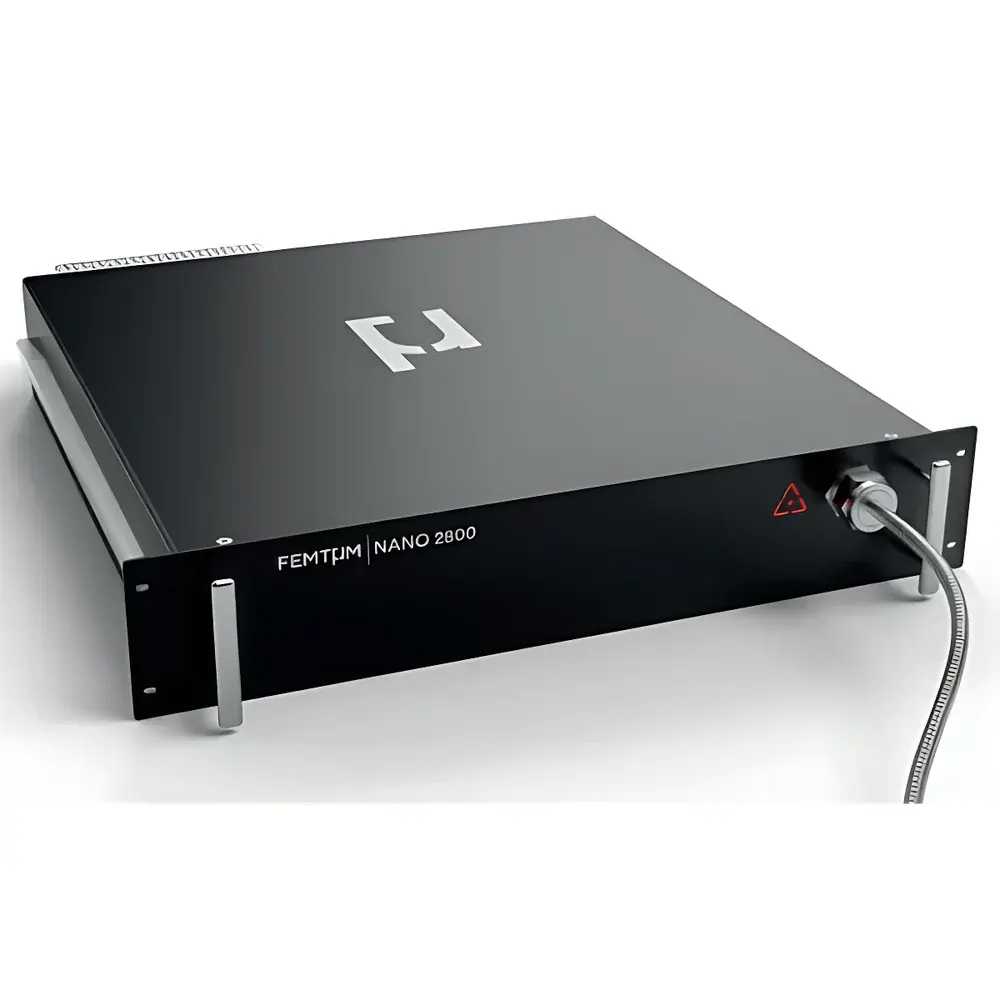
Femtum Nano2800 2800 nm Nanosecond Pulsed Fiber Laser
| Brand | Femtum |
|---|---|
| Wavelength | 2780–2830 nm (fixed or tunable) |
| Output | Free-space or fiber-coupled |
| Average Power | Up to 3 W |
| Pulse Energy | Up to 100 µJ |
| Repetition Rate | 5–30 kHz |
| Pulse Width | <200 ns |
| Beam Quality | M² < 1.3 |
| Cooling | Air-cooled |
| Dimensions | 19 × 5.5 × 20.5 in |
| Power Supply | 100/240 V AC, 50/60 Hz |
Overview
The Femtum Nano2800 is an industrial-grade, nanosecond-pulsed fiber laser engineered for precision mid-infrared material interaction at 2800 nm (2.8 µm). Operating on thulium-doped fiber gain media with master oscillator power amplifier (MOPA) architecture, it delivers high peak power pulses via stimulated emission in the 2.7–2.8 µm spectral window—coinciding with strong vibrational absorption bands of C–H, O–H, and N–H bonds in polymers, biological tissues, and thin-film dielectrics. This wavelength enables efficient, non-thermal ablation and selective photothermal processing without collateral damage, distinguishing it from near-IR lasers used in conventional micromachining. The system is designed for integration into automated platforms requiring stable, turnkey operation under laboratory or factory-floor conditions.
Key Features
- Compact, air-cooled OEM module with integrated driver electronics and thermal management
- Turnkey operation: fully aligned, factory-calibrated, and software-controlled via USB/Ethernet interface
- High repetition rate (5–30 kHz) with pulse-to-pulse stability < ±1.5% RMS over 8 hours
- Nanosecond pulse generation (<200 ns FWHM) with near-Gaussian temporal profile for controlled energy deposition
- Fiber-delivered or free-space collimated output options; compatible with standard FC/APC or SMA-905 connectors
- Fixed-wavelength variants centered at 2780 nm, 2800 nm, or 2830 nm; custom tuning within 2710–2830 nm available upon request
- Narrow linewidth option (<0.5 nm FWHM) for applications requiring spectral selectivity, such as pump-probe spectroscopy or nonlinear frequency conversion
Sample Compatibility & Compliance
The Nano2800 is optimized for processing non-metallic materials where water and organic functional groups dominate optical absorption. It is routinely deployed in ISO 13485-certified medical device manufacturing for polymer stent patterning and bioresorbable scaffold texturing. In academic research, it complies with laser safety standards per IEC 60825-1:2014 (Class 4), and its control firmware supports audit-ready logging per FDA 21 CFR Part 11 when integrated with compliant host software. All units undergo full environmental stress screening—including thermal cycling (−5 °C to +40 °C) and vibration testing (5–500 Hz, 0.04 g²/Hz)—to ensure robustness in GLP/GMP-aligned environments.
Software & Data Management
Femtum Control Suite (v3.2+) provides deterministic pulse parameter configuration—including independent adjustment of repetition rate, pulse width, and burst mode sequencing—via intuitive GUI or Python/C++ SDK. Real-time monitoring includes internal photodiode feedback for pulse energy stabilization and interlock status reporting. Export formats include CSV and HDF5 for traceable data archiving. When deployed in regulated settings, optional timestamped event logs (including laser enable/disable, error codes, and calibration timestamps) are generated with cryptographic hashing to support ALCOA+ data integrity principles.
Applications
- Film micropatterning: High-resolution ablation of PET, PI, and PDMS substrates for flexible electronics and microfluidic channel fabrication
- Polymer surface functionalization: Controlled micro-roughening of PEEK and PEKK for enhanced osseointegration in orthopedic implants
- Bio-tissue ablation: Precise, minimally invasive removal of corneal epithelium and dental enamel with sub-10 µm lateral thermal diffusion zones
- Semiconductor metrology: Pump source for mid-IR supercontinuum generation in ZBLAN fibers (2–4 µm) for FTIR-based defect mapping
- Nonlinear optics: Optical parametric amplification seeding and difference-frequency generation in orientation-patterned GaAs (OP-GaAs)
FAQ
What is the typical pulse-to-pulse energy stability?
Standard deviation remains below ±1.2% RMS over 10⁴ pulses at 20 kHz repetition rate, measured with calibrated thermopile sensor traceable to NIST standards.
Is fiber coupling included by default?
Yes—standard configurations include PM1550-compatible polarization-maintaining fiber output with FC/APC connector; free-space collimated output is available as alternative.
Can the laser be synchronized to external TTL triggers?
Yes, with jitter < 5 ns (RMS) relative to rising edge; trigger input accepts 3.3–5 V CMOS/TTL signals with programmable delay (0–100 ms, 10 ns resolution).
Does the system support OEM integration into motion-controlled stages?
Fully supported via Ethernet TCP/IP command set (SCPI-compliant) and digital I/O lines for hardware handshaking with Galvo scanners or CNC controllers.
What maintenance is required during routine operation?
No consumables or periodic alignment needed; recommended annual verification of output power calibration and interlock functionality per manufacturer’s service protocol.



