
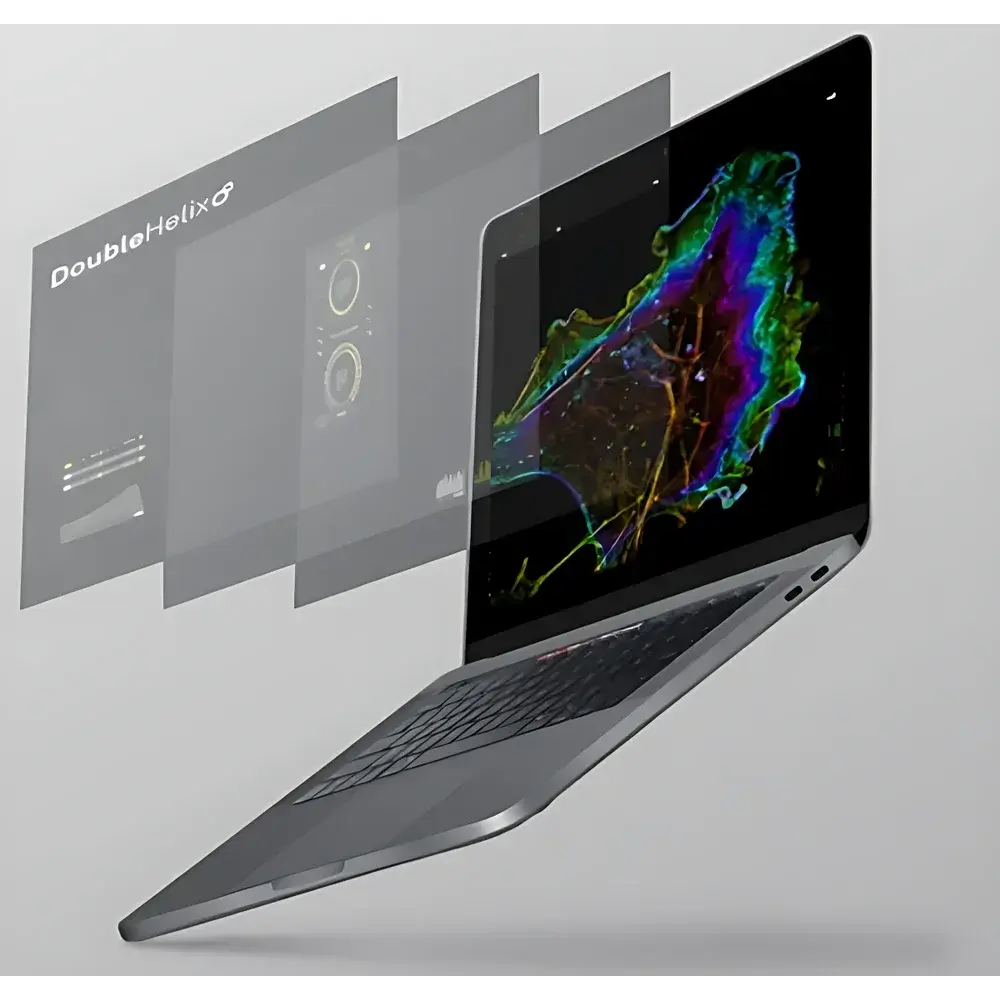
Auniontech SPINDLE 3D Microscopy Software Suite – 3DTRAX™
| Brand | Auniontech |
|---|---|
| Model | SPINDLE |
| Origin | USA |
| Product Type | Imported Scientific Software Module |
| Compatible Hardware | Standard Inverted/Epi-Fluorescence Microscopes |
| Core Technology | Dual-Helix Point Spread Function (DH-PSF) & Engineered Phase Mask (e-PSF) Based 3D Localization |
| Spatial Resolution (Axial) | <20 nm |
| Temporal Resolution | Up to 100 Hz (system-dependent) |
| Supported Modalities | SMLM (STORM, PALM, DNA-PAINT), 4D Single-Particle Tracking, Extended Depth-of-Field (EDF) Imaging, Multichannel Simultaneous Acquisition (SPINDLE2 variant) |
| Software Architecture | Windows 10/11 x64, GPU-Accelerated Reconstruction, HDF5 Native Data Format |
| Compliance | Supports Audit Trail Logging, User Access Control, and Exportable Metadata per GLP/GMP Documentation Requirements |
Overview
The Auniontech SPINDLE 3D Microscopy Software Suite – 3DTRAX™ is a purpose-built computational platform engineered for quantitative, high-fidelity 3D and 4D fluorescence microscopy. It implements advanced optical encoding strategies—including dual-helix point spread function (DH-PSF) engineering and e-PSF phase mask libraries—to convert standard widefield or TIRF microscope hardware into precision 3D localization instruments. Unlike conventional deconvolution or z-stack reconstruction tools, 3DTRAX™ operates at the single-molecule level, extracting axial (z) position information directly from photon distribution asymmetry in each detected emitter. This enables nanoscale volumetric mapping without mechanical stage scanning, delivering sub-20 nm axial localization precision across extended depth ranges (up to 2–4 µm depending on immersion medium and wavelength). The software is designed for integration with commercial inverted microscopes equipped with sCMOS or EMCCD cameras and compatible laser excitation sources, supporting both fixed-cell super-resolution imaging and live-cell dynamic tracking workflows.
Key Features
- Native support for DH-PSF and e-PSF optical encoding modalities—calibrated against NIST-traceable PSF standards
- GPU-accelerated 3D localization engine enabling real-time rendering of >10⁴ molecules/sec (dependent on GPU memory bandwidth and camera frame rate)
- Automated drift correction using fiducial bead tracking or cross-correlation-based non-rigid registration
- Modular architecture: users select validated modules (e.g., SMLM Reconstruction, 4D Particle Tracker, EDF Renderer, SPINDLE2 Multichannel Splitter) based on experimental configuration
- Parameter optimization wizard with physics-informed presets for STORM, PALM, and DNA-PAINT acquisition protocols
- HDF5-native data storage with embedded metadata (acquisition time, laser power, filter set, objective NA, immersion index) compliant with FAIR data principles
Sample Compatibility & Compliance
3DTRAX™ supports fixed and live biological specimens imaged under standard aqueous or glycerol-based mounting media. It accommodates sparse labeling densities required for SMLM (<0.1 emitters/µm²) as well as denser configurations via iterative fitting and overlapping emitter decomposition algorithms. The software conforms to laboratory regulatory expectations: user authentication logs, configurable audit trails, electronic signature support, and exportable PDF reports meet documentation requirements for GLP-compliant studies. While not FDA-cleared as a medical device, its data handling framework aligns with 21 CFR Part 11 Annex 11 guidance for analytical instrument software used in regulated environments. All calibration routines reference ISO 20957 (microscopy performance testing) and ASTM E3085 (super-resolution imaging validation).
Software & Data Management
3DTRAX™ employs a client-server architecture where acquisition control, reconstruction, and analysis are decoupled for scalability. Raw TIFF or ND2 sequences are ingested and converted to compressed HDF5 containers with lossless compression (LZF) and chunked multidimensional indexing. Visualization leverages OpenGL-accelerated volume rendering with adjustable transfer functions, isosurface extraction, and colocalization heatmaps. Quantitative outputs include XYZ coordinates with Cramér-Rao lower bound (CRLB) uncertainty estimates, trajectory files in MDTraj-compatible format, and segmented object masks for morphometric analysis. Batch processing pipelines can be scripted in Python (via provided API) or scheduled through Windows Task Scheduler. Export options include CSV, MATLAB .mat, Imaris IMS, and OME-TIFF with OMERO-compatible metadata tags.
Applications
- 3D SMLM: Full-volume reconstruction of nuclear pore complexes, cytoskeletal networks, or synaptic protein clusters with isotropic resolution ≤20 nm axially and ≤10 nm laterally
- 4D Single-Particle Tracking: Sub-diffraction tracking of quantum dot–labeled receptors or mRNA granules across extended axial volumes (≥3 µm), enabling accurate diffusion coefficient mapping and confinement zone analysis
- Extended Depth-of-Field Imaging: Single-shot volumetric capture of whole mitochondria or Golgi stacks without z-scanning—ideal for phototoxicity-sensitive live-cell experiments
- Multimodal Correlative Imaging: SPINDLE2 module synchronizes dual-channel detection on one camera sensor, enabling simultaneous structural (e.g., tubulin) and functional (e.g., Ca²⁺ indicator) readouts with pixel-registered 3D alignment
FAQ
Is 3DTRAX™ compatible with my existing microscope?
Yes—provided your system includes a scientific-grade camera (sCMOS/EMCCD), motorized filter wheel, and stable laser illumination (405/488/561/640 nm typical), 3DTRAX™ interfaces via Micro-Manager, MetaMorph, or direct SDK integration.
Does it require proprietary hardware?
No. While optimized for Auniontech’s Optics Spindle® series phase masks and DH-PSF objectives, the software accepts custom PSF models and supports third-party encoded optics with calibrated PSF measurement.
Can I perform batch analysis across multiple datasets?
Yes. The Pipeline Manager allows creation of reproducible workflows—including drift correction, localization, filtering, and colocalization—with version-controlled parameter sets and dependency tracking.
How is data integrity ensured during long acquisitions?
All intermediate buffers are checksummed; write operations use atomic file commits; unexpected termination triggers automatic recovery from last valid checkpoint with full metadata continuity.
Is technical support available for method development?
Auniontech provides application scientist consultation for assay optimization, including PSF calibration, labeling density assessment, and uncertainty budgeting per ISO/IEC 17025 guidelines.




