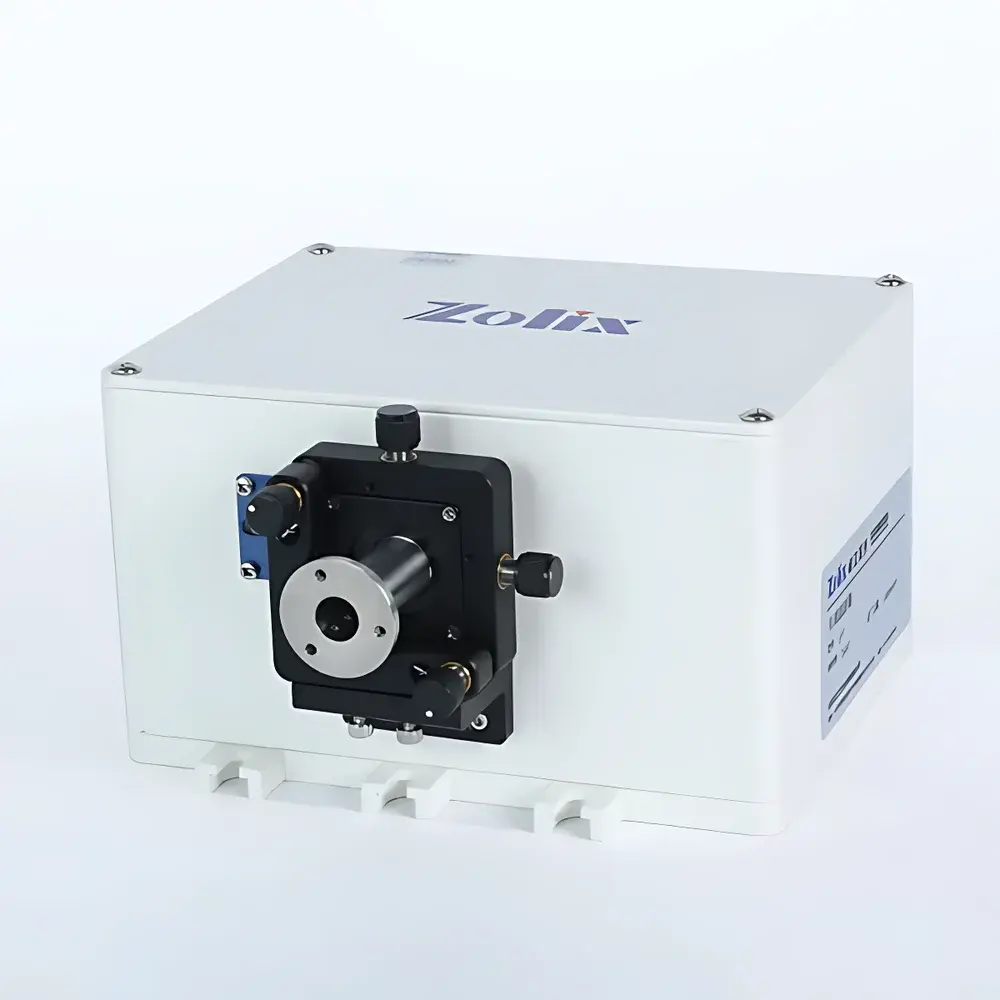
Auniontech VBG-Based Reflective Ultra-Narrowband Filter (FWHM down to 20 pm)
| Brand | Auniontech |
|---|---|
| Origin | Shanghai, China |
| Model | VBG-REF-UNB Series |
| FWHM | down to 20 pm |
| Central Wavelength Range | 400–3000 nm |
| Diffraction Efficiency | up to 95% |
| Laser Damage Threshold | >5 J/cm² @ 1064 nm, 10 ns (optional) |
| Substrate Material | Photo-Thermo-Refractive (PTR) Glass |
| Fabrication Method | Holographic Volume Bragg Grating (VBG) |
| Standard Aperture | 5 mm × 5 mm, up to 30 mm × 30 mm |
Overview
The Auniontech VBG-Based Reflective Ultra-Narrowband Filter is a high-precision optical interference device engineered for applications demanding exceptional spectral selectivity. Unlike conventional thin-film or interference filters—whose typical full-width-at-half-maximum (FWHM) ranges from sub-nanometer to several nanometers—this filter leverages volume Bragg grating (VBG) technology fabricated in photo-thermo-refractive (PTR) glass via holographic exposure. This architecture enables intrinsic spectral resolution down to 20 pm (0.02 nm), corresponding to a free spectral range (FSR) of ~0.1–0.3 nm depending on wavelength and grating period. The reflective configuration ensures minimal insertion loss in the stopband while delivering near-zero group delay dispersion (GDD) across the passband—a critical advantage for ultrafast laser pulse shaping and coherent detection systems. It operates on the principle of Bragg diffraction within a three-dimensional periodic refractive index modulation, offering angular and polarization sensitivity consistent with first-order VBG theory.
Key Features
- Ultra-narrow spectral bandwidth: FWHM configurable down to 20 pm (0.02 nm) at design wavelength
- High diffraction efficiency: up to 95% in reflection mode, optimized for p-polarized incidence at Bragg angle
- Exceptional laser damage resistance: >5 J/cm² at 1064 nm, 10 ns pulse width (certified per ISO 21254-1)
- Broad operational wavelength coverage: customizable central wavelengths from 400 nm to 3000 nm—including key laser lines such as 405, 532, 630, 780, 795, 800, 810, 813, 863, 895, 1030, 1064, 1341, 1522, and 2200 nm
- Robust thermal and mechanical stability: PTR glass substrate exhibits <10⁻⁶/K coefficient of thermal expansion and negligible aging under ambient lab conditions
- Scalable aperture dimensions: standard 5 mm × 5 mm; custom sizes available up to 30 mm × 30 mm with maintained wavefront distortion <λ/10 PV
Sample Compatibility & Compliance
This VBG filter is compatible with collimated, low-divergence beams (typical divergence <0.5 mrad recommended for peak efficiency). Optimal performance requires precise angular alignment—typically ±0.02° tolerance around the Bragg angle—and incident beam diameter ≤80% of clear aperture to avoid vignetting-induced spectral broadening. The device complies with ISO 10110-7 (surface quality), ISO 9022-3 (environmental testing), and RoHS 2015/863/EU. While not certified to FDA 21 CFR Part 11, its deterministic optical response and traceable calibration protocol support integration into GLP/GMP-compliant optical subsystems when paired with documented alignment procedures and environmental monitoring.
Software & Data Management
As a passive optical component, the filter does not incorporate embedded firmware or digital interfaces. However, Auniontech provides comprehensive technical documentation including measured spectral transmission/reflection curves (±0.5 pm wavelength accuracy), angular tuning maps, and polarization-dependent loss (PDL) characterization reports. These datasets are delivered in standardized ASCII format compatible with MATLAB, Python (NumPy), and LabVIEW for integration into automated alignment routines or spectral modeling workflows. For OEM integration, mechanical mounting templates (STEP/IGES) and thermal expansion coefficients are supplied to enable accurate optomechanical simulation in Zemax OpticStudio or CODE V.
Applications
- Quantum optics: frequency filtering of single-photon sources, cavity-enhanced spontaneous parametric down-conversion (SPDC), and atomic vapor cell spectroscopy (e.g., Rb/D2-line filtering at 780 nm or Cs/D1-line at 895 nm)
- Ultrafast laser systems: pulse compression stabilization, spectral narrowing of amplified Ti:sapphire or Yb-fiber outputs, and coherent control experiments requiring <100 MHz linewidth rejection
- Terahertz time-domain spectroscopy (THz-TDS): pump-probe spectral gating with sub-picosecond temporal resolution
- Narrow-linewidth laser stabilization: reference cavity locking for external-cavity diode lasers (ECDLs) and fiber lasers operating in L-band or mid-IR
- High-resolution Raman spectroscopy: suppression of Rayleigh scatter while preserving Stokes/anti-Stokes signal integrity
- Free-space optical communications: channel selection in dense wavelength-division multiplexing (DWDM) testbeds operating beyond C+L bands
FAQ
What is the maximum acceptable beam divergence for optimal diffraction efficiency?
Beam divergence should be ≤0.5 mrad (FWHM) to maintain >90% of peak diffraction efficiency. Higher divergence induces spectral broadening and reduced peak reflectance.
Can this filter be used at non-Bragg angles?
Yes—angular tuning shifts the central wavelength linearly (~0.01 nm/arcsec near 1064 nm), but efficiency drops rapidly outside ±0.1° of nominal Bragg angle due to phase-matching degradation.
Is polarization sensitivity compensated in standard configurations?
Standard units are optimized for p-polarized light at the design angle. s-polarized incidence reduces peak efficiency by ~15–25%; polarization-insensitive designs require dual-grating stacking and are available on request.
How does temperature affect the center wavelength stability?
Thermal shift is typically +8–12 pm/°C near 1064 nm. For sub-pm stability, active temperature control (<±0.05°C) or athermal mounting is recommended.
Are custom coating or AR-layer options available on substrates?
Yes—single- or dual-side antireflection coatings (R<0.25% per surface, 400–2000 nm broadband) can be applied without compromising VBG performance; quoting requires specification of incident medium and AOI.