
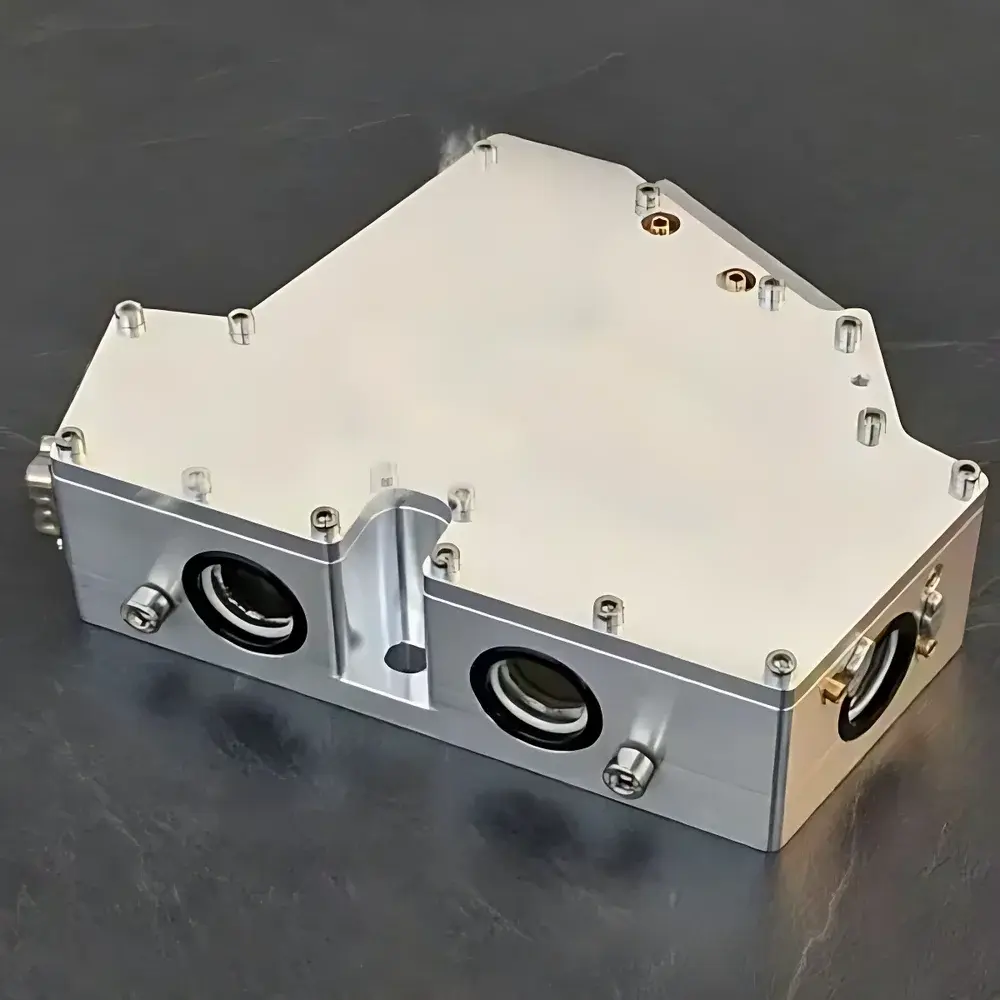
Auniontech Custom High-Efficiency UV Second-Harmonic Generation (SHG) Cavity
| Brand | Auniontech |
|---|---|
| Origin | Shanghai, China |
| Model | UV SHG Cavity |
| Configuration | Fully Customizable Resonant Cavity for Deep-UV Generation |
| Compliance | Designed for GLP/GMP-adjacent research environments |
| Software Interface | External analog/digital I/O for cavity length and temperature feedback control |
| Mechanical Standard | Compatible with 25 mm and 1-inch optical breadboard mounting patterns |
| Thermal Control | Integrated Peltier-based crystal heater with ±0.02 °C stability |
| Alignment Mechanism | External fine-thread micrometers (5 µrad resolution) for mirror and crystal angular adjustment |
| Sealing | Hermetically sealed housing with AR-coated fused silica windows (185–2000 nm transmission) |
| Gas Purge Port | Standard NPT 1/8" fitting for dry N₂ or Ar purge |
| Diagnostic Output | Dedicated 1% transmission tap for intracavity fundamental power monitoring |
| Long-Term Stability | <1% RMS intensity drift over 8-hour continuous operation (verified under lab-grade vibration isolation) |
Overview
The Auniontech Custom High-Efficiency UV Second-Harmonic Generation (SHG) Cavity is a precision-engineered resonant optical device designed for intracavity frequency doubling of near-infrared (NIR) and visible lasers into the deep-ultraviolet (DUV) spectral region (190–280 nm). It operates on the principle of continuous-wave (CW) intracavity second-harmonic generation in critically phase-matched nonlinear crystals—primarily β-BaB₂O₄ (BBO), lithium triborate (LBO), or cesium lithium borate (CLBO)—within a dynamically stabilized standing-wave or traveling-wave resonator. Unlike single-pass frequency conversion, this cavity-enhanced architecture amplifies the circulating fundamental field by two to three orders of magnitude, enabling efficient DUV generation from modest input powers (e.g., 2–5 W at 1044 nm yields >2 W at 261 nm). The system is not a turnkey laser source but a core subsystem engineered for integration into advanced quantum optics, atomic physics, and high-resolution spectroscopy platforms where wavelength flexibility, long-term amplitude stability, and environmental robustness are non-negotiable.
Key Features
- Monolithic Mechanical Architecture: All optomechanical components—including HR/OC mirrors, crystal mounts, and piezoelectric transducers—are rigidly integrated into a single aluminum alloy baseplate, minimizing thermal drift and acoustic sensitivity compared to discrete breadboard assemblies.
- External Sub-Microradian Alignment: Mirror tilt and crystal angle are adjusted via external differential micrometers with 0.5 µm linear resolution, eliminating cavity disassembly during routine optimization or crystal replacement.
- Hermetic Crystal Enclosure: Sealed cavity volume with fused silica vacuum windows prevents hygroscopic degradation of BBO/CLBO crystals and suppresses UV-induced surface contamination—critical for sustained >200 nm operation.
- Active Cavity Length Stabilization: Piezoelectric actuator coupled with Pound–Drever–Hall (PDH) locking electronics maintains resonance within λ/100 over 12+ hours, even under ambient temperature fluctuations of ±1 °C.
- Integrated Thermal Management: Dual-zone Peltier control (±0.02 °C setpoint accuracy) enables precise temperature tuning of phase-matching conditions across broad bandwidths (e.g., 30 nm tunability at 650 nm).
- Diagnostic & Integration Flexibility: A dedicated 1% transmission port provides real-time access to intracavity fundamental power; analog voltage outputs feed cavity error signals and heater status to external DAQ systems.
- Clean-Gas Compatibility: NPT 1/8″ purge port supports continuous dry nitrogen or argon flow (≤1 L/min), maintaining dew point < −40 °C around nonlinear crystals during extended DUV operation.
Sample Compatibility & Compliance
The cavity accepts standard Ø12.7 mm or Ø25.4 mm nonlinear crystals with AR coatings optimized for both fundamental and harmonic wavelengths. It has been validated with Ti:sapphire (700–1000 nm), fiber-amplified diodes (780–1064 nm), and tapered amplifier systems (845–856 nm). While not certified to ISO/IEC 17025 or FDA 21 CFR Part 11 as a standalone medical device, its design adheres to metrological best practices common in quantum laboratory infrastructure: traceable temperature calibration (NIST-traceable Pt100 sensors), low-noise analog signal conditioning (<100 nV/√Hz), and mechanical interfaces compliant with DIN 45019 and Thorlabs’ standard optical mounting specifications. Documentation includes full mechanical drawings, thermal expansion coefficients, and phase-matching angle tolerance maps per crystal batch.
Software & Data Management
No proprietary GUI is bundled; instead, the cavity delivers standardized analog voltage outputs (0–10 V) for cavity error signal, crystal temperature, and piezo drive voltage—fully compatible with LabVIEW, MATLAB Data Acquisition Toolbox, or Python-based control frameworks (e.g., PyVISA + NI-DAQmx). Optional OEM firmware enables RS-485 or Ethernet Modbus TCP communication for remote monitoring in multi-cavity quantum systems. Audit trails for temperature setpoints and lock acquisition events can be logged via external timestamped DAQ, satisfying GLP-aligned record-keeping requirements for reproducible cold-atom or ion-trap experiments.
Applications
- AlCl and AlF molecular laser cooling at 261 nm and 227.5 nm using cascaded SHG architectures
- Coherent excitation of Yb⁺ (369.5 nm) and Mg⁺ (280 nm) ions in Paul and Penning traps
- High-resolution Doppler-free spectroscopy of Zn (428 nm) and Ga (423 nm) atomic transitions
- Pump-probe studies requiring stable, narrow-linewidth UV sources below 250 nm
- Quantum frequency conversion for solid-state emitters (e.g., GaAs QDs at 850 nm → 425 nm)
- Photoionization detection in time-of-flight mass spectrometry
FAQ
What fundamental wavelengths are supported?
Standard configurations cover 794–1550 nm inputs; custom designs extend to 650–1064 nm for visible-to-UV conversion. Minimum input power depends on target UV output and crystal choice (typically ≥2 W CW for >500 mW UV).
Can the cavity be retrofitted with different nonlinear crystals?
Yes—modular crystal mounts accept standard dimensioned BBO, LBO, or CLBO wafers (5 × 5 × 10 mm³ typical); AR coating specifications must match the intended fundamental/harmonic pair.
Is vacuum operation possible?
The housing is rated for static vacuum down to 10⁻³ mbar; dynamic vacuum requires optional O-ring upgrades and bake-out validation—not included in standard configuration.
How is phase matching maintained during thermal cycling?
Crystal temperature is actively regulated via closed-loop Peltier control; phase-matching curves are pre-characterized per crystal lot and supplied with calibration tables.
What level of UV power stability is achievable?
With active cavity locking and thermal stabilization, RMS intensity noise is typically <0.5% over 1 hour and <1.2% over 8 hours under controlled lab conditions (vibration-isolated optical table, ±0.5 °C ambient stability).





