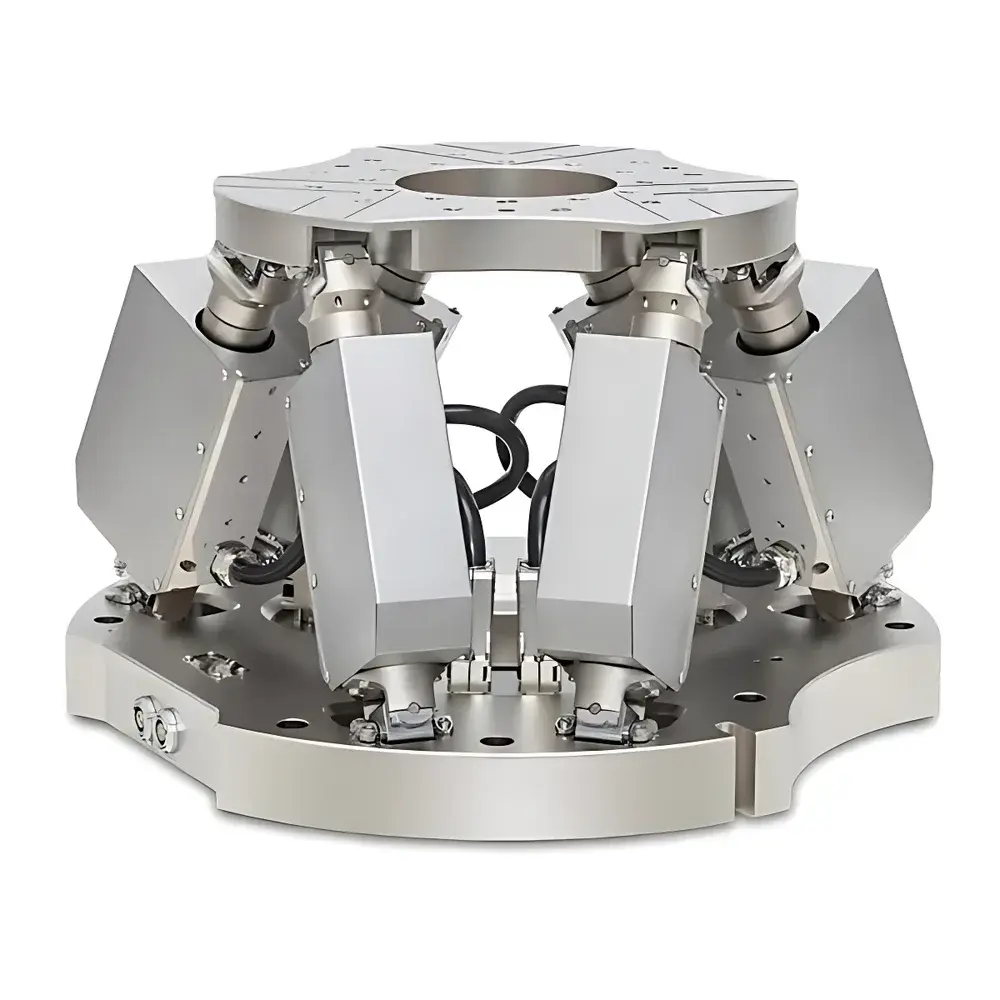
Auniontech Hexapod 6-Axis Precision Positioning Stage
| Brand | Auniontech |
|---|---|
| Model | Precision Positioning Platform |
| Type | Motorized 6-DOF Translation & Alignment Stage |
| Load Capacity | 30 kg (horizontal) / 15 kg (omnidirectional) |
| Travel Range | X/Y/Z ±25/±27.5/±14 mm |
| Angular Range | ΘX/ΘY/ΘZ ±10.5/±11.5/±19° |
| Repeatability | ±0.25 µm (X/Y), ±0.1 µm (Z), ±2 µrad (ΘX/ΘY), ±2.5 µrad (ΘZ) |
| Positioning Accuracy | 0.3 µm (X/Y), 0.25 µm (Z), 3.5–4 µrad (angular) |
| Backlash | 3 µm (X/Y), 1 µm (Z), 20–25 µrad (angular) |
| Max Velocity | 2.5 mm/s (linear), 27 mrad/s (angular) |
| Typical Velocity | 2 mm/s (linear), 5.5 mrad/s (angular) |
| Motor Type | Brushless DC with integrated gearmotor |
| MTBF | 20,000 hours |
| Materials | Stainless steel and aluminum alloy |
| Weight | 11 kg |
| Operating Temperature | −10 to +50 °C |
Overview
The Auniontech Hexapod 6-Axis Precision Positioning Stage is a parallel-kinematic Stewart platform engineered for sub-micrometer spatial control across all six degrees of freedom (3 translational: X, Y, Z; 3 rotational: ΘX, ΘY, ΘZ). Unlike serial-stage architectures, its six independently actuated, joint-coupled struts provide inherently high structural stiffness, dynamic response, and positional stability—critical for applications demanding simultaneous multi-axis alignment without cumulative error propagation. The platform operates on closed-loop motion control principles: real-time feedback from high-resolution encoders (integrated at each actuator joint) enables precise servo regulation of strut lengths, translating directly into nanoradian angular resolution and sub-250 nm repeatability in linear axes. Its compact monolithic frame—optimized via finite-element topology analysis—minimizes thermal drift and mechanical hysteresis, making it suitable for integration into vacuum chambers (optional configuration), cleanroom-compatible optical benches, and automated metrology workstations.
Key Features
- High-load capacity: Supports up to 30 kg in horizontal orientation and 15 kg under arbitrary mounting orientations, enabled by dual-material construction (austenitic stainless steel load-bearing joints + aerospace-grade aluminum alloy frame)
- Sub-micron repeatability: Achieves ±0.1 µm Z-axis and ±0.25 µm X/Y repeatability, validated per ISO 230-2 Annex B protocols using laser interferometric verification
- Ultra-low backlash: Linear axes exhibit ≤3 µm reverse-play; angular axes maintain ≤25 µrad hysteresis—ensuring deterministic trajectory execution during bidirectional scanning or step-and-settle operations
- Brushless DC geared motor drives: Provide high torque density, zero brush wear, and smooth commutation—essential for extended service life (MTBF ≥20,000 hours) and silent operation in vibration-sensitive environments
- Vacuum-ready variant: Optional stainless-steel hardware, low-outgassing lubricants, and hermetically sealed actuators compliant with ISO 10100 Class 5 clean vacuum standards (10−7 mbar base pressure)
- Thermally stable architecture: CTE-matched materials and symmetric strut layout reduce thermally induced misalignment to <0.5 µrad/°C over the full operating range (−10 to +50 °C)
Sample Compatibility & Compliance
The stage accommodates diverse payloads—from micro-optical components (e.g., lens mounts, fiber collimators) to semiconductor wafer carriers and bio-microfluidic chips—via standardized M4/M6 threaded mounting patterns on both top and base plates. It complies with electromagnetic compatibility requirements per EN 61326-1:2013 (industrial environment), safety standards IEC 61000-6-2/6-4, and mechanical interface specifications aligned with SEMI E10-0706 (semiconductor equipment). For regulated environments, firmware supports audit-trail logging and user-access-level permissions—facilitating alignment with GLP/GMP documentation workflows and FDA 21 CFR Part 11 electronic record integrity requirements when paired with validated host software.
Software & Data Management
Control is delivered via Auniontech’s HexaControl SDK—a cross-platform API supporting Windows/Linux/macOS with native bindings for Python, MATLAB, LabVIEW, and C/C++. Real-time command latency is <100 µs (host-to-actuator), enabling synchronized motion with external triggers (TTL/encoder input). The SDK includes built-in trajectory planners (S-curve, trapezoidal, custom spline interpolation), coordinate transformation libraries (Euler, quaternion-based), and live diagnostic dashboards displaying encoder residuals, motor current draw, and thermal status. All position logs are timestamped with microsecond precision and exportable in HDF5 or CSV formats—compatible with third-party analysis tools such as OriginLab and Python’s SciPy ecosystem.
Applications
- Optical alignment: Active compensation of beam path deviations in ultrafast laser systems, adaptive optics wavefront correction, and multi-element collimation in free-space quantum optics setups
- Semiconductor metrology: Wafer-level alignment during maskless lithography, probe station positioning for nanoscale electrical characterization, and die-level inspection stage stabilization
- Biophotonics: Precise manipulation of microfluidic cartridges during confocal fluorescence imaging, nanopipette positioning in patch-clamp electrophysiology rigs, and cell-targeted optogenetic stimulation
- Precision manufacturing: Tool-center-point calibration in 5-axis CNC inspection arms, real-time compensation of thermal expansion in diamond-turning lathes, and robotic end-effector pose refinement
- Aerospace component testing: Simulated gravity-gradient loading on inertial sensor test benches and dynamic attitude emulation for star tracker validation
FAQ
What is the difference between a hexapod and stacked XYZ-rotation stages?
Hexapods eliminate cumulative angular error and mechanical compliance inherent in serial kinematic stacks. Their parallel architecture delivers superior stiffness (>10× higher than equivalent stacked stages), faster settling times (<50 ms for 10 µm steps), and true 6-DOF coupling—enabling coordinated motions impossible with cascaded stages.
Is vacuum compatibility optional or standard?
Vacuum compatibility is an optional configuration requiring stainless-steel actuators, ceramic-coated leadscrews, and perfluoroether-based lubrication. Standard units are rated for ambient laboratory use only.
Can the stage be integrated into existing motion control ecosystems?
Yes—the SDK provides EtherCAT, RS-422, and USB 2.0 interfaces. Pre-certified drivers are available for NI Motion Controller PXI platforms and Beckhoff TwinCAT environments.
How is thermal drift mitigated during long-duration experiments?
The stage incorporates passive thermal mass balancing and uses CTE-matched aluminum/stainless assemblies. For sub-nanoradian stability over >8-hour runs, optional PID-controlled Peltier base-plate cooling is available.
What maintenance is required over its operational lifetime?
No scheduled lubrication or recalibration is required. The brushless motors and preloaded ball-screw joints are sealed and maintenance-free. Annual verification of encoder linearity via interferometric traceability is recommended for metrology-critical deployments.