
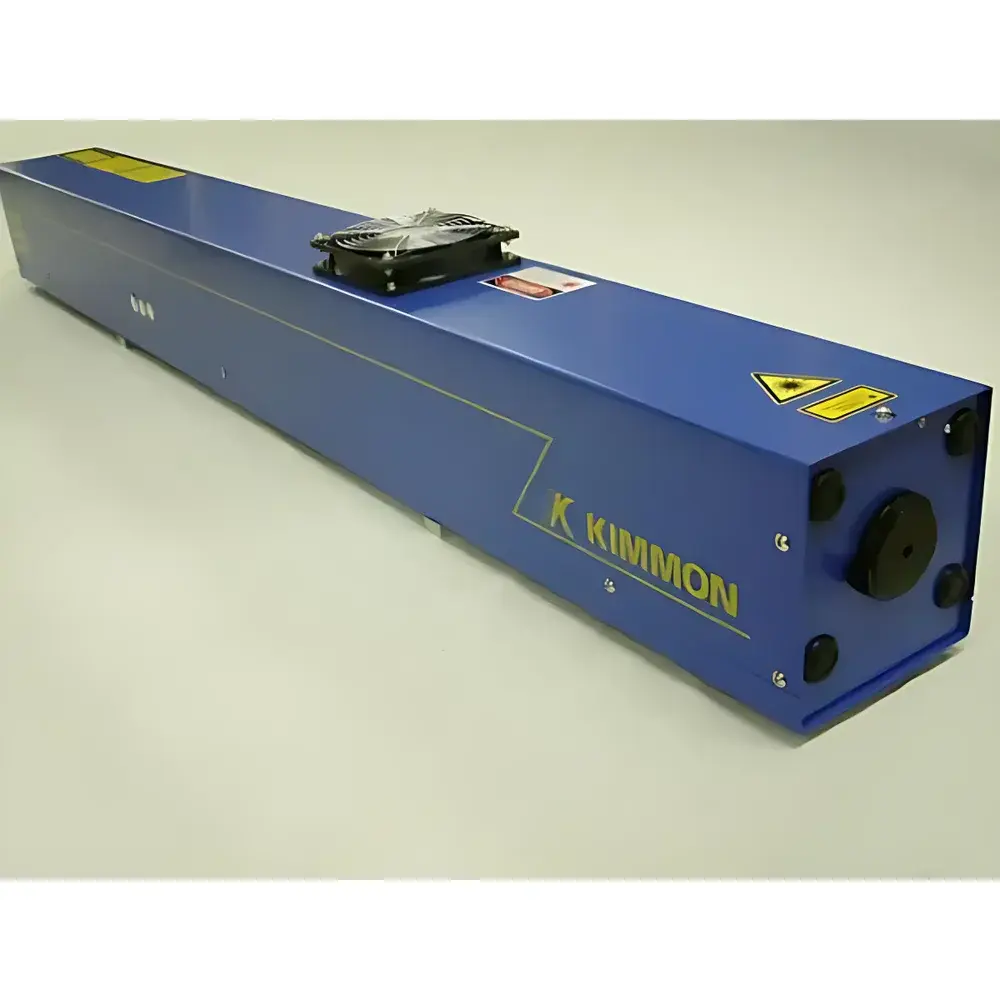
KIMMON Model 325nm He-Cd Continuous-Wave Single-Longitudinal-Mode Laser
| Brand | Auniontech |
|---|---|
| Origin | Shanghai, China |
| Manufacturer Type | Authorized Distributor |
| Product Origin | Domestic (PRC) |
| Laser Type | Single-Frequency, Single-Longitudinal-Mode (SLM) He-Cd |
| Wavelength | 325 nm (UV) |
| Output Power Options (325 nm) | 2–50 mW (discrete models) |
| Beam Mode | TEM₀₀ (fundamental transverse mode) |
| Operation | Continuous Wave (CW) |
| Cooling | Air-cooled or forced-air thermal management |
| Polarization | Linear, >100:1 extinction ratio |
| Beam Diameter | ~0.65 mm (1/e²) |
| Beam Divergence | <1.5 mrad |
| Long-Term Power Stability | ≤±3% over 8 h |
| Warm-up Time | <15 min to specified stability |
Overview
The KIMMON Model 325 nm He-Cd Continuous-Wave Single-Longitudinal-Mode Laser is a precision ultraviolet (UV) gas laser engineered for applications demanding high spectral purity, narrow linewidth (<1 MHz typical), and long-term amplitude stability. Based on the helium–cadmium (He–Cd) plasma discharge process, this laser generates coherent radiation at 325 nm via electronic transitions in ionized cadmium atoms, pumped by metastable helium atoms. Unlike pulsed UV sources, the CW operation enables time-resolved fluorescence lifetime measurements, continuous-wave Raman excitation, and interferometric alignment tasks where temporal coherence and minimal intensity noise are critical. Its single-longitudinal-mode (SLM) configuration ensures diffraction-limited beam quality (TEM₀₀) and eliminates mode-hopping artifacts—essential for holography, optical trapping, and high-finesse cavity experiments. Designed for integration into OEM systems and laboratory-grade instrumentation, the laser features a robust metal-ceramic plasma tube, hermetically sealed gas fill, and integrated thermal stabilization to maintain wavelength fidelity within ±0.005 nm over ambient temperature fluctuations of ±5 °C.
Key Features
- Stable 325 nm UV output with spectral linewidth <1 MHz (typical), enabling high-resolution spectroscopic interrogation of atomic and molecular transitions
- Single-longitudinal-mode (SLM) operation certified via scanning Fabry–Pérot interferometer validation; longitudinal mode spacing (FSR) ≥1.5 GHz
- Fundamental Gaussian beam profile (TEM₀₀) with M² <1.1, beam divergence 100:1
- Air-cooled architecture with active thermal regulation; no external chiller required for standard operation up to 50 mW
- Low RMS intensity noise (<0.5% over 10 Hz–10 MHz bandwidth) optimized for photon correlation spectroscopy and confocal microscopy
- Compliant with IEC 60825-1:2014 Class 3B laser safety requirements; integrated key switch, emission indicator, and interlock connector (24 V DC)
- Modular mechanical design supporting OEM integration: standardized 30 mm × 30 mm mounting footprint and SMA905 fiber coupling option (optional)
Sample Compatibility & Compliance
This laser system is compatible with standard UV-grade optics (fused silica, CaF₂, MgF₂), quartz cuvettes, and nitrogen-purged sample chambers to minimize ozone generation and photochemical degradation. It meets electromagnetic compatibility (EMC) requirements per EN 61326-1:2013 for laboratory use and conforms to RoHS Directive 2011/65/EU. For regulated environments—including clinical research labs operating under GLP or GMP frameworks—the laser supports audit-ready documentation packages (including factory calibration reports traceable to NIST standards) and optional 21 CFR Part 11–compliant software logging when paired with Auniontech’s LMS-325 control interface.
Software & Data Management
The laser operates via analog modulation input (0–5 V) for power control and TTL-compatible shutter triggering. Optional digital control is available through USB 2.0 or RS-232 interfaces using Auniontech’s Laser Management Software (LMS-325 v3.2), which provides real-time monitoring of tube current, cathode voltage, head temperature, and output power (via integrated photodiode feedback). All operational parameters are timestamped and exportable in CSV or HDF5 format. The software includes configurable alarm thresholds, automated warm-up sequencing, and event-logging compliant with ISO/IEC 17025 data integrity guidelines.
Applications
- High-resolution fluorescence spectroscopy: Excitation of tryptophan, tyrosine, and nucleic acid bases with minimal photobleaching due to low photon energy relative to 266 nm sources
- UV Raman microspectroscopy: Coupled with back-illuminated CCD detectors for enhanced quantum efficiency in the 300–400 nm detection window
- Holographic data storage: SLM coherence length >10 cm supports multiplexed angular and phase-encoded gratings
- Photolithography alignment: Used in mask aligners for sub-micron feature registration in semiconductor prototyping
- Flow cytometry calibration: NIST-traceable 325 nm source for verifying UV channel sensitivity and spectral response curves
- Optical tweezers in biophysics: Enables stable trapping of dielectric nanoparticles (e.g., polystyrene beads, silica spheres) with minimized UV-induced DNA damage
FAQ
What is the typical lifetime of the He–Cd plasma tube?
Rated mean time between failures (MTBF) is 5,000 hours under nominal operating conditions (25 °C ambient, 8 h/day duty cycle). Tube life is strongly dependent on start-stop cycling frequency and thermal soak duration.
Is vacuum pumping required during installation or maintenance?
No. The plasma tube is permanently sealed at factory pressure (~1–2 Torr He/Cd vapor mixture); end-user servicing is limited to optical alignment and electrical connections.
Can this laser be fiber-coupled?
Yes—optional SMA905 or FC/PC UV-grade quartz fiber pigtails (core diameter 50 µm or 105 µm) are available with coupling efficiency ≥65% (325 nm, TEM₀₀ matched).
Does the system include a power meter or beam profiler?
Not standard; however, calibrated UV photodiodes (e.g., Thorlabs S120VC) and beam profilers (e.g., Ophir NanoScan) are recommended accessories and supported in LMS-325 integration protocols.
Are custom wavelengths (e.g., 442 nm) available in the same platform?
Yes—multi-line configurations (325 nm + 442 nm) are offered as dual-wavelength variants with mechanically switched or dichroic beam combining options.




