
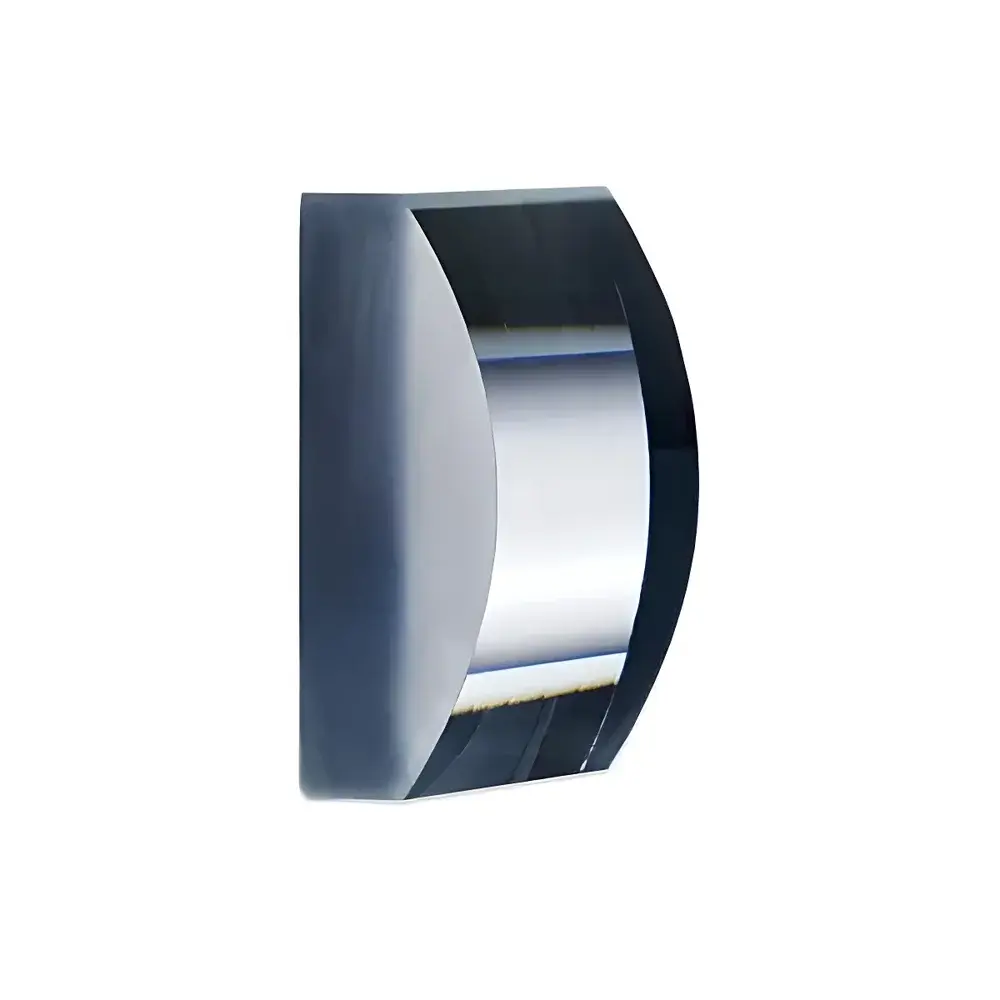
Asphericon CHL Series Aspheric Cylindrical Lenses
| Brand | Asphericon |
|---|---|
| Model | CHL Series |
| Material | S-LAH64 High-Refractive-Index Optical Glass |
| Surface Irregularity (RMSi) | ≤ 0.5 µm |
| EFL Tolerance | ≤ ±0.1% |
| Clear Aperture | ≥ 90% |
| Standard Coatings | A (400–600 nm), B (600–1050 nm), C (1000–1600 nm) |
| Laser Damage Threshold | 12 J/cm² @ 100 Hz, 6 ns, 532 nm |
| Conformance | ISO 10110-5 (Surface Form Tolerance) |
Overview
The Asphericon CHL Series Aspheric Cylindrical Lenses are high-precision optical components engineered for demanding laser beam shaping, collimation, and astigmatic correction in industrial, scientific, and medical applications. Unlike conventional spherical or standard cylindrical lenses, the CHL series integrates an aspheric profile on one surface and a cylindrical geometry on the other—enabling simultaneous control of wavefront error and line-focused irradiance distribution. Each lens is fabricated from S-LAH64, a high-refractive-index (nd ≈ 1.80) Schott optical glass selected for its exceptional homogeneity, low thermal expansion, and compatibility with high-power laser systems. The aspheric surface is generated using deterministic single-point diamond turning followed by magnetorheological finishing (MRF), achieving surface irregularity (RMSi) ≤ 0.5 µm per ISO 10110-5—a specification critical for diffraction-limited performance in interferometric setups and ultrafast laser amplifiers.
Key Features
- Surface form accuracy: RMSi ≤ 0.5 µm (ISO 10110-5 compliant), verified via full-aperture phase-shifting interferometry
- High numerical aperture design: NA up to 0.61, enabling tight line focus generation with minimal spherical and coma aberration
- Precision dimensional tolerances: EFL ±0.1%, width ±0.05 mm, length ±0.1 mm, diameter ±0.05 mm
- Three standard broadband anti-reflection coatings optimized for 400–600 nm (Coating A), 600–1050 nm (Coating B), and 1000–1600 nm (Coating C); all exhibit RMAX < 1.0% and RAVG ≤ 0.4% at normal incidence
- Laser damage resistance: Certified to 12 J/cm² (100 Hz, 6 ns pulse, 532 nm), supporting integration into Q-switched Nd:YAG and frequency-doubled Ti:sapphire systems
- RoHS-compliant manufacturing and traceable metrology documentation included with each shipment
Sample Compatibility & Compliance
The CHL series is compatible with standard optomechanical mounts (e.g., Thorlabs SM1-threaded lens tubes, Kinetic Systems kinematic bases) and supports integration into vacuum-compatible and cleanroom environments. All lenses meet ISO 9022-2 (optical component environmental testing) and undergo 100% visual inspection per MIL-PRF-13830B (scratch-dig 60–40). Documentation includes interferometric test reports, coating spectral reflectance curves, and material certification per DIN ISO 10110-3. For regulated applications—including clinical laser systems and pharmaceutical analytical instrumentation—the lenses support audit-ready compliance packages aligned with FDA 21 CFR Part 11 data integrity requirements when paired with Asphericon’s certified calibration workflows.
Software & Data Management
Asphericon provides Zemax OpticStudio-compatible .ZAR and .STEP files for all CHL models, including exact surface sag tables and measured wavefront error maps. Lens design data is archived in Asphericon’s secure cloud portal with version-controlled access, enabling traceability across product lifecycle revisions. For OEM integrators, API-accessible metadata (including serial-number-linked interferogram archives and coating deposition logs) is available under NDA. All measurement data adheres to ISO/IEC 17025-accredited laboratory practices, with uncertainty budgets documented per GUM (Guide to the Expression of Uncertainty in Measurement).
Applications
- Laser line generation for structured light illumination in machine vision and 3D profilometry
- Astigmatism compensation in high-NA microscope objectives and adaptive optics wavefront correctors
- Beam ellipticity correction in fiber-coupled diode laser modules and ultrafast amplifier pump stages
- Collimation of divergent emission from VCSEL arrays in LiDAR transceivers
- Spectral focusing in broadband OCT systems requiring chromatic dispersion management
- Optical pumping of alkali vapor cells in atomic clocks and magnetometers
FAQ
What is the difference between an aspheric cylindrical lens and a standard cylindrical lens?
An aspheric cylindrical lens features a non-spherical curvature along one axis—typically the cylinder axis—to eliminate spherical aberration and improve line focus sharpness. A standard cylindrical lens uses a purely circular arc profile, resulting in significant off-axis blur and reduced Strehl ratio under high-NA illumination.
Can CHL lenses be used in ultrafast laser systems?
Yes—CHL lenses are routinely deployed in femtosecond Ti:sapphire and Yb:fiber amplifier chains. Their low group delay dispersion (GDD) and high surface quality minimize pulse broadening; however, GDD characterization data must be requested separately for specific EFL/coating combinations.
Is custom coating available beyond the three standard options?
Yes—Asphericon offers custom AR, HR, and polarizing coatings with specified angle-of-incidence, polarization state, and environmental durability (e.g., MIL-C-48497A Class 1). Lead time and minimum order quantities apply.
Do you provide mounting solutions for CHL lenses?
Standard unmounted CHL lenses ship with precision-ground side faces for kinematic alignment. Asphericon also supplies pre-aligned, kinematically mounted versions (CHL-M series) with SM1-threaded housings and adjustable tip/tilt platforms, fully characterized for boresight stability under thermal cycling.
How is surface irregularity measured and validated?
Each lens undergoes full-aperture, phase-shifting interferometry using a Zygo Verifire MST system calibrated against NIST-traceable standards. RMSi is calculated over the clear aperture using ISO 10110-5 algorithms, excluding edge effects within 0.5 mm of the perimeter. Raw interferograms and analysis reports are supplied digitally with every unit.



