
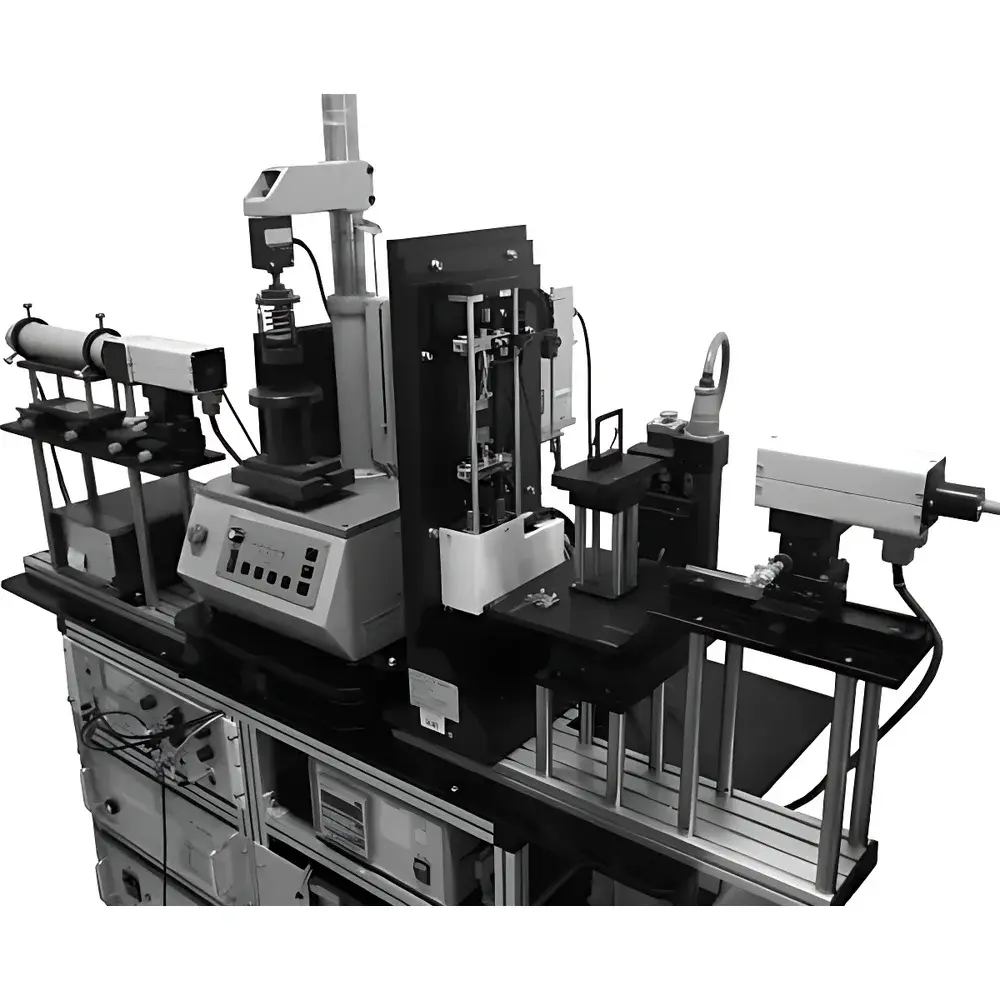
Auniontech STZL-Interferometric Photoelastic Coefficient Measurement System
| Brand | Auniontech |
|---|---|
| Origin | Imported |
| Manufacturer Type | Authorized Distributor |
| Model | STZL-Photoelastic Coefficient System |
| Price Range | USD 14,000 – 28,000 |
| Measurement Principle | Optical Heterodyne Interferometry with Dual-Frequency Orthogonal Polarization |
| Light Source | Stabilized He–Ne Laser (2 mW, 632.8 nm) |
| Sample Deformation Mode | Tensile & Compressive Loading |
| Max Load Capacity | 50 N (standard), upgradable to 200 N / 1000 N |
| Temperature Control Range | Ambient to 200 °C |
| Temp. Stability | ±1 °C |
| Sample Dimensions (Tension) | 10 × 80 mm |
| Sample Dimensions (Compression) | Ø20 mm × 15 mm max thickness |
| Thickness Range | 0.3 – 15 mm |
| Actuation | Dual-synchronized stepper-motor-driven lead screws |
| Stroke | 100 mm |
| Measured Outputs | Photoelastic Coefficient (C, nm/MPa), Retardation (δ, nm), Principal Axis Orientation (θ, deg), Young’s Modulus, Fracture Strength |
| Optical Resolution | Sub-nm retardation resolution (via Fourier-domain phase demodulation) |
Overview
The Auniontech STZL-Interferometric Photoelastic Coefficient Measurement System is a precision optical metrology platform engineered for quantitative, non-contact evaluation of stress-induced birefringence in transparent dielectric materials. It operates on the fundamental principle of photoelasticity: when isotropic transparent solids—such as optical glasses, polymers, fused silica, or crystalline substrates—are subjected to mechanical stress, they develop transient anisotropy, resulting in linear birefringence proportional to the applied stress tensor. The system quantifies this effect by measuring the induced optical retardation (in nanometers) and its principal axis orientation under controlled uniaxial loading, enabling direct calculation of the material-specific photoelastic coefficient C (units: nm/MPa). Unlike conventional polariscopic or monochromatic interferometric methods, this instrument employs a dual-frequency, orthogonally polarized STZL (Synchronous Two-Zero-Lag) laser source coupled with heterodyne interferometry—a technique that converts phase differences into measurable beat frequencies. This architecture delivers intrinsic immunity to environmental perturbations—including air turbulence, thermal drift, and low-frequency mechanical vibration—without requiring active isolation tables or vacuum enclosures. The measurement process is fully traceable to SI-based length and time standards via stabilized laser wavelength and RF-synthesized frequency references.
Key Features
- Optical heterodyne interferometry with sub-nanometer retardation resolution and real-time Fourier-domain phase demodulation
- Simultaneous acquisition of retardation magnitude (δ) and fast-axis orientation (θ) without prior knowledge of sample symmetry or pre-alignment
- Integrated high-stability He–Ne laser (632.8 nm, 2 mW) with active power regulation and mode-hop-free operation over 10,000+ hours
- Motorized, synchronized dual-lead-screw actuation system enabling precise tensile/compressive loading (0–100 mm stroke, ±0.5 µm positioning repeatability)
- Modular load cell options: 50 N (standard), 200 N, or 1000 N—each calibrated per ISO 376 and traceable to national metrology institutes
- Programmable temperature-controlled stage (ambient to 200 °C, ±1 °C stability) supporting thermo-mechanical photoelastic characterization
- Optical path symmetry design: identical beam paths for orthogonal polarization components ensure common-mode rejection of path-length noise
Sample Compatibility & Compliance
The system accommodates flat, optically homogeneous specimens with thicknesses from 0.3 mm to 15 mm. Standard configurations support tensile bars (10 × 80 mm) and compression discs (Ø20 mm × ≤15 mm thick), with optional custom fixtures for prismatic, cylindrical, or laminated geometries. All optical components comply with ISO 10110 surface quality specifications (scratch-dig 20–10), and the interferometric head meets IEC 61000-6-3 EMC emission limits. Data acquisition protocols are structured to support GLP/GMP-aligned workflows: metadata tagging includes operator ID, timestamp, environmental conditions (temperature/humidity logs), calibration certificate IDs, and raw interferogram archives. While not FDA-certified as a medical device, the system’s measurement traceability, audit trail logging, and electronic signature readiness align with 21 CFR Part 11 requirements for regulated R&D environments.
Software & Data Management
The proprietary Auniontech PhotoStress Suite v4.x provides full instrument control, real-time visualization of retardation maps, and automated C-coefficient regression analysis. Raw heterodyne signals are digitized at 250 MS/s with 16-bit resolution and processed using windowed FFT algorithms optimized for SNR > 85 dB. Each measurement session generates a self-contained .psd file containing calibrated retardation vs. load curves, Young’s modulus extraction (via linear fit in elastic regime), fracture strength detection (first derivative discontinuity), and uncertainty propagation per GUM (JCGM 100:2019). Export formats include CSV (for MATLAB/Python post-processing), PDF reports compliant with ASTM E1452-22 (Standard Guide for Photoelastic Stress Analysis), and HDF5 for large-scale dataset archiving. Audit trails record all parameter changes, user logins, calibration events, and software updates—retained for ≥36 months unless manually purged under retention policy.
Applications
This system serves critical roles across optics manufacturing, polymer science, semiconductor packaging, and aerospace materials development. In lens fabrication, it validates residual stress distribution in molded aspheric PMMA or polycarbonate lenses—directly correlating with wavefront error and MTF degradation. For OLED encapsulation films, it quantifies stress relaxation kinetics during thermal cycling, informing barrier layer adhesion models. In fiber-optic preform analysis, it measures radial birefringence gradients induced by draw tension—enabling predictive correction of polarization mode dispersion. Academic users apply it to validate micromechanical constitutive models for bioresorbable polymers (e.g., PLLA, PCL) under physiological strain rates. Industrial QA labs deploy it for batch certification of optical-grade fused quartz wafers per MIL-PRF-17401, verifying compliance with maximum allowable C-value tolerances (< ±0.3 nm/MPa for Class A substrates).
FAQ
What physical quantity does the photoelastic coefficient C represent?
It is the linear proportionality constant between induced optical retardation δ (nm) and applied mechanical stress σ (MPa), defined as δ = C·σ·d, where d is sample thickness (mm). Units are nm/MPa.
Can the system measure birefringence in curved or non-planar samples?
No—optical alignment requires planar, parallel faces with surface flatness ≤λ/4. Curved surfaces introduce wavefront distortion that degrades heterodyne signal coherence.
Is calibration required before each measurement?
A full system calibration (laser frequency lock, load cell zero/span, retardation offset) is performed automatically at startup and may be repeated manually; no daily recalibration is needed under stable lab conditions.
Does the software support automated pass/fail criteria against material specifications?
Yes—users define upper/lower bounds for C, modulus, or fracture strength; the report generator flags outliers and exports summary statistics per ISO 22514-2.
How is vibration immunity achieved without optical isolation?
By using identical optical paths for both polarization states, all path-length fluctuations induce equal phase shifts—canceling out in the heterodyne beat signal while preserving stress-induced differential phase.




