
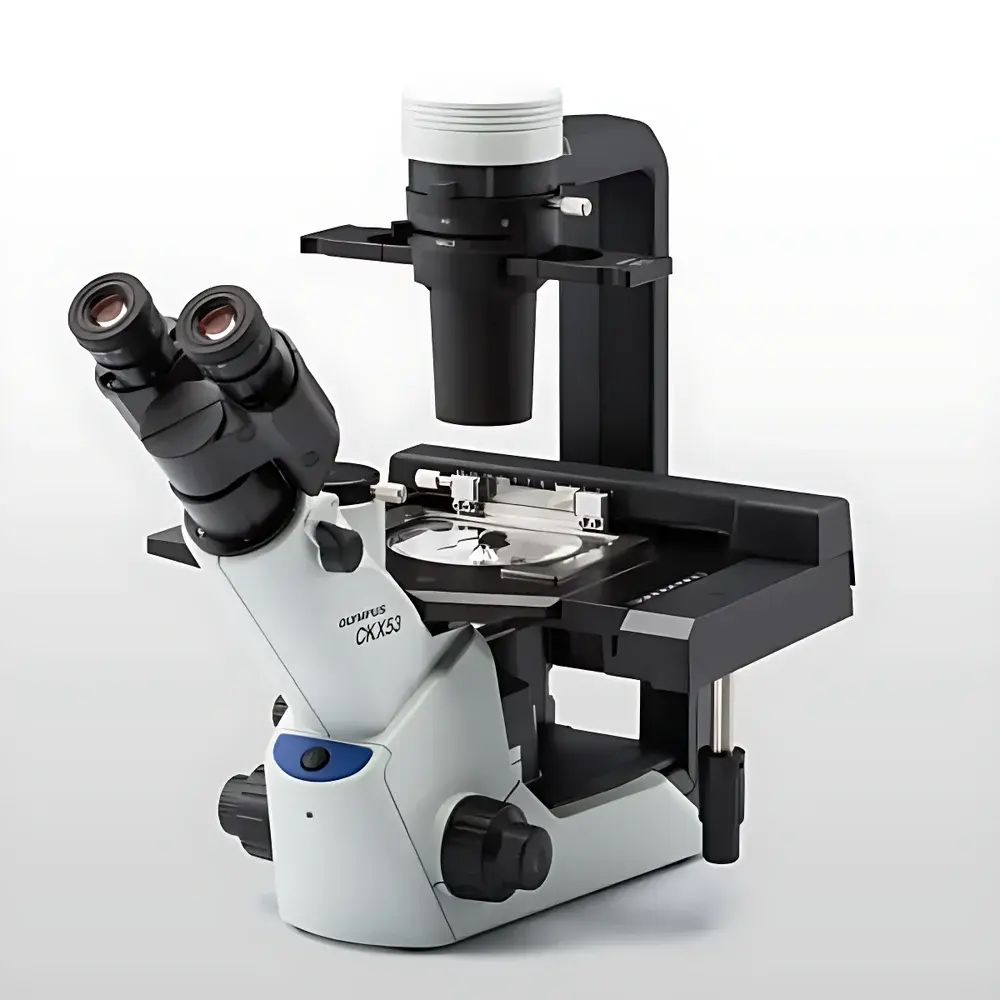
Olympus EVIDENT CKX53 Inverted Microscope
| Brand | Olympus/EVIDENT |
|---|---|
| Origin | Japan |
| Model | CKX53 |
| Weight | ~7 kg |
| Footprint | Compact design optimized for laminar flow hoods |
| UV-Resistant Coating | Yes |
| Eyepiece Angle | 45° |
| Focusing Mechanism | Coaxial coarse/fine focus knobs |
| Condenser | Removable, height-adjustable |
| Maximum Specimen Height Clearance | 190 mm |
| Objective Working Distance (PLCN4×) | ≥24 mm |
| Stage Expansion | ±70 mm lateral extension |
| Compatibility | 35 mm dishes (triple adapter optional), multi-well plates (6–96-well), T-flasks, multilayer cell culture vessels |
Overview
The Olympus EVIDENT CKX53 Inverted Microscope is an engineered solution for routine and advanced live-cell observation under sterile conditions. Designed specifically for integration into biosafety cabinets and laminar flow hoods, the CKX53 employs a compact, low-profile architecture with UV-resistant surface coating—enabling direct placement and full-cycle UV sterilization without disassembly. Its inverted optical configuration positions objectives beneath the specimen stage, allowing unobstructed access to cell culture vessels during imaging and manipulation. This geometry supports real-time monitoring of adherent and suspension cultures while maintaining aseptic integrity—a critical requirement in primary cell isolation, stem cell expansion, transfection workflows, and quality control of biomanufactured cell lines. The system’s modular mechanical design emphasizes operational continuity in GxP-aligned environments, where spatial constraints, ergonomic fatigue, and procedural reproducibility directly impact assay validity.
Key Features
- UV-Compatible Enclosure: All external surfaces—including structural housing and focusing mechanisms—are coated with a proprietary UV-stable polymer, permitting uninterrupted 254 nm irradiation within Class II biosafety cabinets without degradation or outgassing.
- Compact & Portable Form Factor: At approximately 7 kg and with a minimized footprint (W × D ≈ 280 × 360 mm), the CKX53 fits standard laminar flow workstations and can be repositioned manually using the ergonomic neck grip on the binocular tube.
- Ergonomic Optical Pathway: A fixed 45° eyepiece inclination and butterfly-shaped observation tube reduce cervical strain during prolonged sessions; controls—including power switch, coaxial coarse/fine focus knobs, and beam-splitter selector—are positioned within natural reach zones.
- Enhanced Stage Flexibility: The mechanical stage features ±70 mm lateral extension capability, enabling precise positioning of large-format vessels; removable condenser assembly accommodates specimens up to 190 mm in height (e.g., triple-layer flasks).
- Universal Vessel Compatibility: Standardized adapters support 35 mm Petri dishes (up to three simultaneously), 6–96-well microplates (no adapter required), T-25 to T-225 flasks, and multilayer culture systems; PLCN4× objective provides 24 mm working distance for deep-vessel imaging.
Sample Compatibility & Compliance
The CKX53 accommodates a broad spectrum of cell culture formats without optical compromise: standard polystyrene dishes, glass-bottom microwell plates, gas-permeable membranes, and stacked bioreactor inserts. Its open-stage architecture facilitates pipette access during time-lapse imaging and manual intervention—essential for passaging, transfection, or microinjection protocols. From a regulatory standpoint, the instrument meets ISO 13485-aligned manufacturing standards (as supplied by EVIDENT), and its mechanical stability, repeatability of focus position, and consistent illumination output support documentation requirements under GLP and GMP frameworks. While not intrinsically 21 CFR Part 11 compliant, the system interfaces seamlessly with third-party image acquisition software that supports audit trails, electronic signatures, and secure data export—enabling traceability in regulated QC/QA laboratories.
Software & Data Management
The CKX53 operates as a hardware platform compatible with Olympus’ cellSens Dimension software suite (sold separately), which provides calibrated measurement tools (area, intensity, particle counting), time-lapse scheduling, Z-stack acquisition, and multi-channel fluorescence registration. Export formats include TIFF (16-bit), JPEG2000, and AVI—fully compatible with downstream analysis pipelines (e.g., ImageJ/Fiji, MATLAB, Python-based scikit-image). Metadata embedding (objective ID, magnification, exposure time, stage coordinates) follows EXIF and OME-TIFF conventions, ensuring interoperability with LIMS and ELN systems. For laboratories requiring validation, cellSens offers IQ/OQ documentation templates aligned with ASTM E2500 and ISO/IEC 17025 guidelines.
Applications
- Routine morphology assessment of mammalian, insect, and primary cell lines during expansion and cryopreservation cycles
- Monitoring confluence, viability, and morphological changes in response to drug candidates or cytokine stimulation
- Supporting CRISPR editing workflows via visual confirmation of transfection efficiency and clonal isolation
- Quality assurance of therapeutic cell products (e.g., CAR-T, MSCs) prior to release testing
- Teaching laboratory instruction in cell biology, pharmacology, and tissue engineering curricula
FAQ
Can the CKX53 be used inside a CO₂ incubator?
No—the CKX53 is not designed for humidified, temperature-controlled incubator environments. It is intended for use in ambient lab settings or laminar flow hoods.
Is fluorescence imaging supported natively?
Yes, when equipped with optional fluorescence modules (e.g., U-HGLGPS light source and appropriate filter cubes), the CKX53 supports epi-fluorescence imaging of common fluorophores including DAPI, FITC, and TRITC.
Does the microscope support motorized stage or autofocus?
No—motorized components are not part of the base CKX53 configuration. These capabilities require integration with third-party automation platforms or higher-tier models such as the CKX54.
What maintenance intervals are recommended for routine operation?
Olympus recommends annual calibration of illumination uniformity and focus repeatability; cleaning of optical surfaces with lens-grade solvents every 2–4 weeks depending on usage frequency and environmental particulate load.
Is service documentation available in English for international users?
Yes—EVIDENT provides comprehensive English-language technical manuals, spare parts catalogs, and firmware update advisories via their global support portal.
Related Products




