
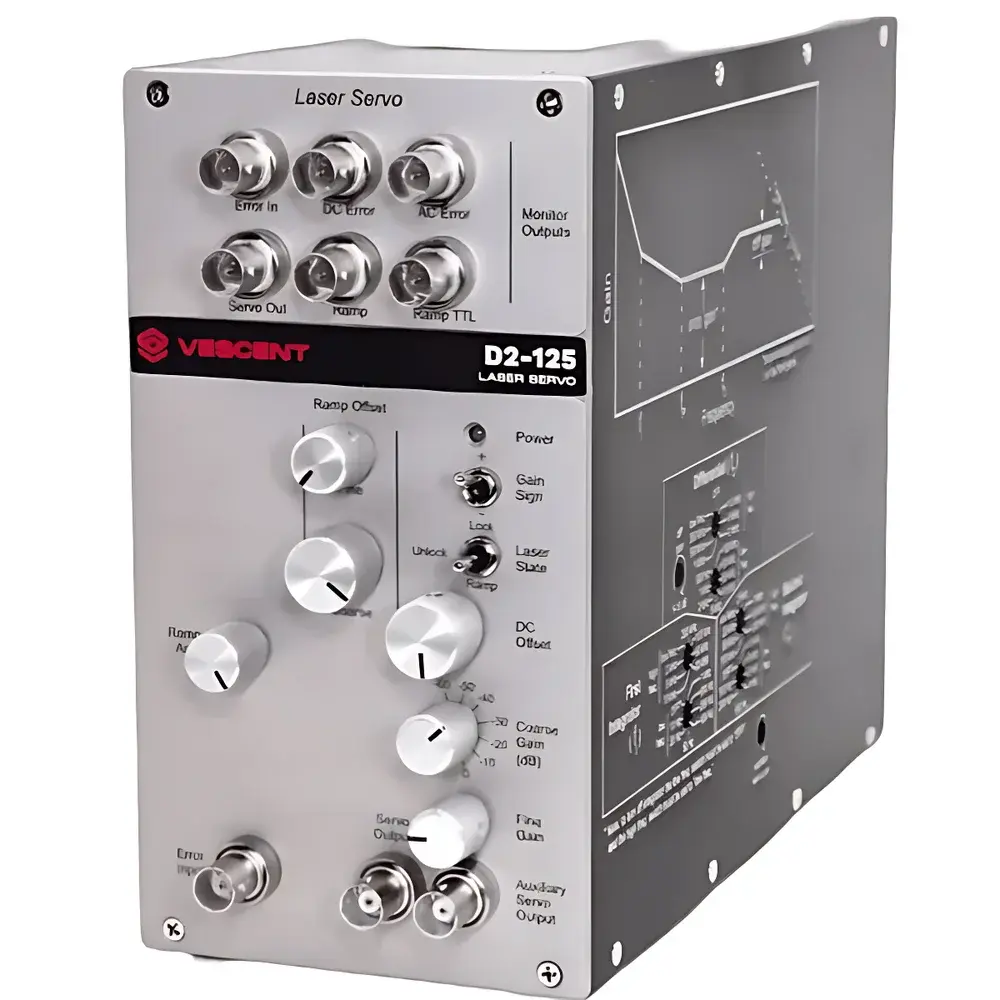
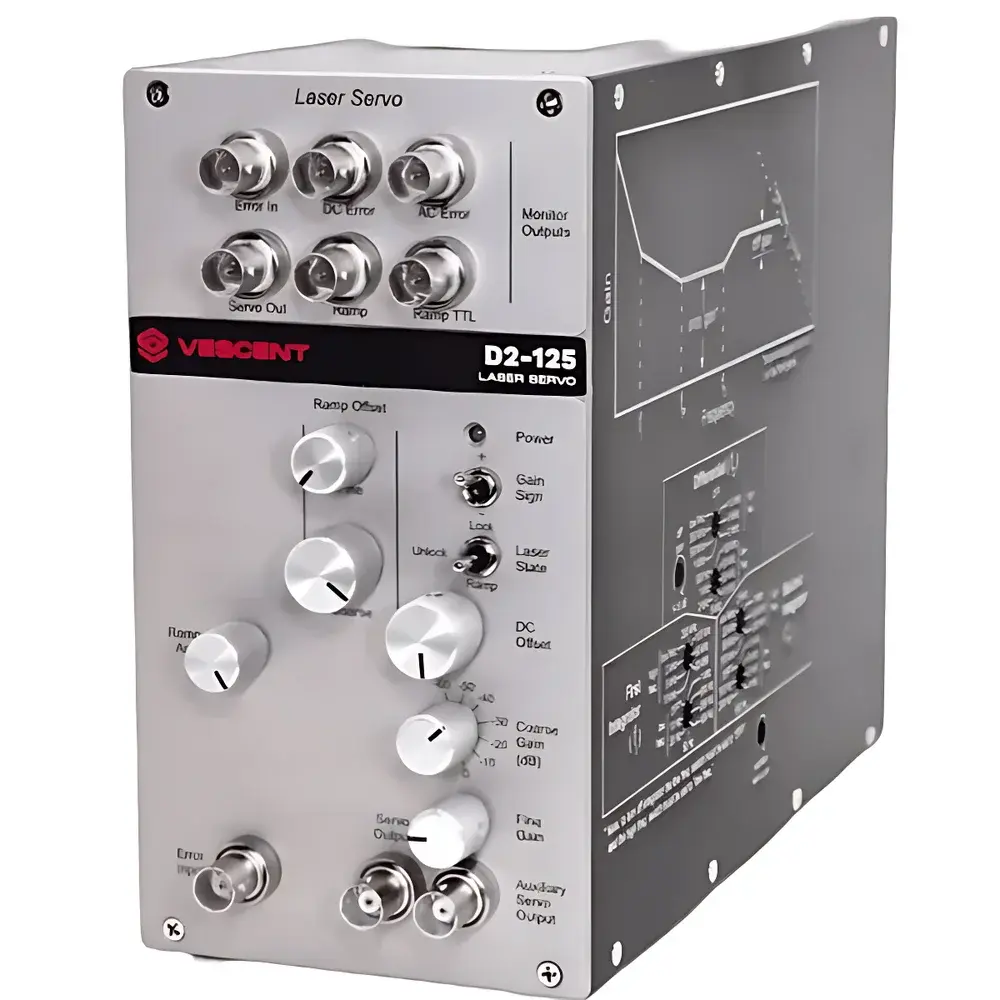
Vescent D2-125 Laser Servo Controller
| Brand | Vescent |
|---|---|
| Model | D2-125 |
| Type | High-Bandwidth Analog Laser Servo Controller |
| Input Impedance | 50 Ω |
| Output Voltage (Main/Aux) | ±10 V |
| Input Voltage Noise | <5 nV/√Hz |
| DC Offset Range | ±500 mV |
| Error Input Max Amplitude | ±500 mV |
| Closed-Loop Bandwidth | >10 MHz |
| Proportional Gain (ref. DC Error) | –66 to +6 dB |
| Proportional Gain (ref. Input Error) | –40 to +32 dB |
| First Integrator Cutoff | Off, 10 Hz–200 kHz |
| Second Integrator Cutoff | Off, 100 Hz–500 kHz |
| Differential Mode | Off, 500 Hz–10 MHz |
| Differential Gain | 5–15 dB |
| Ramp Amplitude (Max) | ±5 V |
| Ramp Frequency (Main) | 500 Hz |
| Ramp Frequency (Aux) | 50 Hz |
| Ramp Centering Range | ±5 V |
| Dither Frequency | 4 MHz |
| RF Output Max Amplitude | ±75 mV |
| RF Output Impedance | 50 Ω |
| Peak-Lock Option | Yes (–PL variant) |
Overview
The Vescent D2-125 Laser Servo Controller is a high-performance, analog-based feedback system engineered for ultra-stable, low-noise frequency and intensity stabilization of diode lasers, external cavity lasers, and other tunable optical sources. Operating on the principle of proportional-integral-double-integral (PI²D) control architecture, the D2-125 delivers exceptional closed-loop bandwidth exceeding 10 MHz—enabling rapid correction of fast laser fluctuations arising from current noise, thermal drift, or mechanical vibration. Its design targets demanding applications in atomic physics, quantum optics, precision spectroscopy, and cavity stabilization where sub-kHz linewidths and long-term frequency stability are critical. Unlike digital controllers with inherent latency and quantization artifacts, the D2-125’s fully analog signal path ensures deterministic response, minimal phase lag, and superior rejection of high-frequency noise—making it the preferred choice for locking to narrow atomic transitions (e.g., Rb, Cs, Sr), Fabry–Pérot cavities, or saturated absorption features.
Key Features
- PI²D Loop Architecture: Dual-stage integrators eliminate long-term drift while preserving high-frequency gain margin; first integrator optimized for mid-band suppression (10 Hz–200 kHz), second for ultra-low-frequency error accumulation (100 Hz–500 kHz).
- LockGuard™ Auto-Reacquisition: Monitors servo output voltage in real time; detects loss-of-lock events via rapid output transients, disables control, holds output at a safe known value, waits user-defined hold/settle times, then re-engages lock—fully configurable without software dependency.
- Smooth Lock Acquisition: Ramp centering function (±5 V range, 500 Hz main / 50 Hz aux ramp rate) aligns operating point prior to engagement, preventing overshoot or transient excursions during lock initiation.
- Peak-Lock Option (–PL): Integrated 4 MHz dither source (±75 mV, 50 Ω) and phase-adjustable demodulator enable direct peak locking to dispersion-like error signals—eliminating need for external modulation hardware and lock-in amplifiers.
- Fully Analog Signal Path: 50 Ω input/output impedance, <5 nV/√Hz input noise floor, ±10 V output swing, and DC offset tuning (±500 mV) ensure compatibility with laser diode drivers, TEC controllers, PZT amplifiers, and AOM RF stages.
- Flexible Feedback Modalities: Supports current, temperature, piezoelectric, and acousto-optic actuation; differential error mode (500 Hz–10 MHz bandwidth, 5–15 dB gain) enhances common-mode noise rejection in multi-sensor configurations.
Sample Compatibility & Compliance
The D2-125 interfaces seamlessly with commercial and custom laser systems requiring analog feedback—particularly diode lasers (Toptica, New Focus, Stanford Research Systems), ECDLs (Moglabs, Sacher Lasertechnik), fiber lasers, and electro-optic modulators. It complies with standard laboratory grounding and shielding practices per IEC 61326-1 (EMC for measurement/control equipment). While not certified for medical or industrial safety standards (e.g., IEC 60601 or UL 61010), its design adheres to GLP-aligned operational rigor: all user-adjustable parameters—including integrator cutoffs, proportional gain, LockGuard thresholds, and ramp timing—are retained in non-volatile memory across power cycles. Audit trails are maintained manually via lab notebook documentation; for regulated environments requiring 21 CFR Part 11 compliance, integration with validated third-party data acquisition systems is recommended.
Software & Data Management
The D2-125 operates as a standalone analog instrument with no embedded firmware or USB/Ethernet interface. All configuration is performed via front-panel rotary encoders and toggle switches—ensuring immunity to computer-induced jitter, driver conflicts, or OS-level instability. Parameter settings are saved automatically in EEPROM. For experimental reproducibility, users are advised to record knob positions and switch states in standardized lab logs. Optional Python- or LabVIEW-compatible analog monitoring modules (e.g., National Instruments DAQ devices) may be used to digitize error signals, servo outputs, or LockGuard status flags for time-stamped analysis and automated reporting—though such integration lies outside the device’s native scope.
Applications
- Stabilization of diode laser frequency to atomic vapor cells (Rb D2 line at 780 nm, Cs D2 at 852 nm) or molecular iodine references.
- Cavity locking for ultra-stable optical frequency combs and Pound–Drever–Hall (PDH) interferometric systems.
- Intensity stabilization via fast current modulation in quantum memory and single-photon source experiments.
- Active suppression of low-frequency noise in gravitational wave detector pre-stabilization chains.
- Multi-laser synchronization in coherent Raman scattering (CARS) and dual-comb spectroscopy setups.
- Feedback control of piezoelectric transducers in scanning probe microscopy and adaptive optics wavefront correctors.
FAQ
What is the maximum achievable closed-loop bandwidth?
The D2-125 supports closed-loop bandwidths exceeding 10 MHz when paired with low-capacitance actuators (e.g., laser diodes with <10 pF junction capacitance) and properly terminated 50 Ω cabling.
Can the D2-125 lock to a derivative-shaped error signal without external modulation?
Yes—the optional –PL (Peak-Lock) variant includes an integrated 4 MHz dither oscillator and phase-tunable demodulator, enabling direct peak locking to dispersion-type error signals using only the controller’s analog circuitry.
Is the LockGuard function compatible with slow thermal drifts?
LockGuard is designed to detect abrupt unlock events (e.g., mode hops, sudden beam misalignment), not gradual drift. For thermal stabilization, the dual integrator architecture inherently suppresses low-frequency errors below ~100 mHz.
Does the D2-125 support remote parameter adjustment?
No—it is a fully manual, analog-only instrument. Remote control requires external analog voltage sources or DACs interfaced to its front-panel potentiometer inputs (available on request via OEM configuration).
How is calibration traceability maintained?
The D2-125 does not require periodic factory calibration; its gain accuracy and bandwidth specifications are determined by precision thin-film resistors and low-drift op-amps. Users may verify performance using calibrated signal generators and spectrum analyzers per ISO/IEC 17025 metrology guidelines.




