
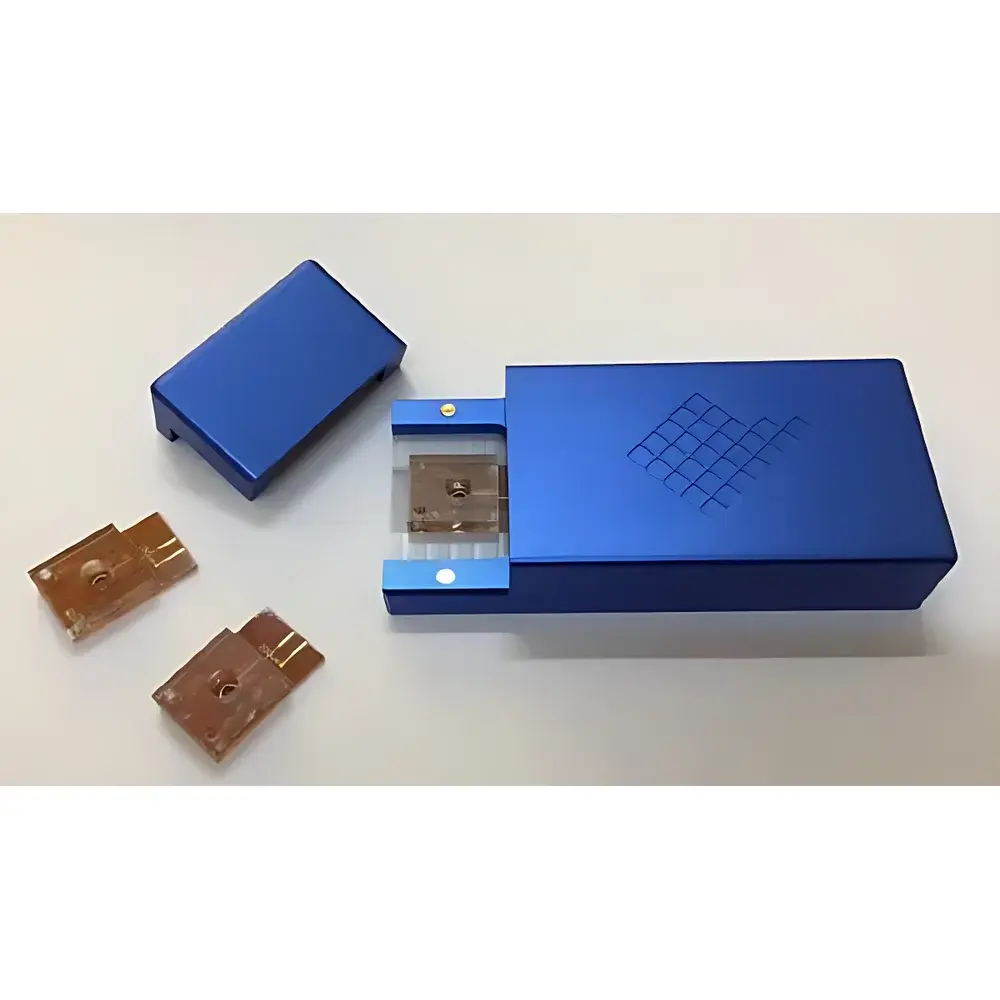
Auniontech NanoPore Reader
| Brand | Auniontech |
|---|---|
| Origin | Imported |
| Manufacturer Type | Authorized Distributor |
| Model | NanoPore Reader |
| Pricing | Available Upon Request |
Overview
The Auniontech NanoPore Reader is a compact, benchtop-grade electrophysiological signal acquisition system engineered for high-fidelity, low-noise ionic current measurement across biological and solid-state nanopores. It operates on the principle of resistive-pulse sensing: when a voltage bias is applied across a nanoscale pore—embedded in a lipid bilayer or a freestanding SiNx membrane—charged analytes (e.g., DNA strands, proteins, or metal ions) translocate under electrophoretic force, inducing transient modulations in the baseline ionic current. These current blockades are resolved with sub-picoampere sensitivity and microsecond temporal resolution, enabling label-free, real-time discrimination of molecular identity, conformation, and concentration at the single-molecule level. As a core platform for third-generation sequencing and single-molecule biophysics, the NanoPore Reader supports both proteinaceous pores (e.g., α-hemolysin, MspA) and synthetic solid-state nanopores, making it suitable for academic research, diagnostic assay development, and GMP-aligned method validation.
Key Features
- Ultra-low-noise analog front-end: <1.5 pA RMS noise (1–100 kHz bandwidth), optimized for sub-50 pA blockade detection
- Portable form factor: Handheld design (185 × 95 × 45 mm) with integrated lithium-ion battery (≥6 h continuous operation)
- Plug-and-play flow cell interface: Standardized 3.5 mm diameter chamber accepts reusable lipid bilayer chips and SiNx-based solid-state nanopore chips
- Real-time data streaming: USB 3.0 and Bluetooth 5.0 connectivity for synchronized acquisition with host PC or mobile device
- Modular architecture: Compatible with external patch-clamp amplifiers, temperature-controlled stages, and microfluidic perfusion modules
- Firmware-upgradable signal processing: Onboard FPGA enables configurable filtering, baseline correction, and event-triggered sampling
Sample Compatibility & Compliance
The NanoPore Reader accommodates aqueous electrolyte solutions (e.g., 1 M KCl, 10 mM Tris-HCl pH 7.5) and supports sample volumes as low as 20 µL per measurement. It is validated for use with native and engineered biological nanopores—including α-hemolysin, CsgG, and aerolysin—as well as electron-beam fabricated SiNx nanopores (diameter range: 1.2–8 nm). The system meets IEC 61010-1 safety requirements for laboratory electrical equipment and complies with electromagnetic compatibility standards EN 61326-1. For regulated environments, raw current trace files (.bin/.dat) support audit trails and metadata tagging aligned with GLP and FDA 21 CFR Part 11 requirements when used with compliant acquisition software.
Software & Data Management
The included NanoPore Studio Suite (v3.2+) provides cross-platform acquisition, visualization, and analysis tools for Windows, macOS, and Linux. Key capabilities include adaptive threshold-based event detection, dwell-time histogramming, amplitude distribution fitting, and principal component analysis (PCA) of multi-parameter blockade features. Export formats include HDF5 (for FAIR-compliant data archiving), CSV (for integration with Python/R workflows), and standardized MDF4 (ASAM) for interoperability with LIMS systems. All software binaries are digitally signed; version history, user access logs, and parameter change records are automatically preserved to support ISO/IEC 17025 and CLIA audit readiness.
Applications
- DNA/RNA sequencing and epigenetic base modification detection (e.g., 5mC, 6mA)
- Single-protein folding/unfolding kinetics and ligand-binding stoichiometry
- Quantitative detection of cancer biomarkers (e.g., exosomal miRNA, ctDNA fragments)
- Heavy metal ion sensing (e.g., Pb2+, Hg2+) via aptamer-functionalized nanopores
- Characterization of synthetic nanoparticles (e.g., polymeric micelles, lipid nanoparticles) by size and surface charge
- Educational use in biophysics laboratories for teaching stochastic sensing principles
FAQ
What types of nanopores are supported?
The reader supports both biological nanopores (e.g., α-hemolysin reconstituted in planar lipid bilayers) and solid-state nanopores (e.g., SiNx, graphene, or MoS2 membranes) with diameters from 1.0 to 10 nm.
Is the flow cell reusable?
Yes—the standard flow cell is chemically inert (borosilicate glass/Pt electrodes) and designed for ≥50 measurement cycles with proper cleaning and storage protocols.
Can the system be integrated into automated workflows?
Yes—it offers TTL-compatible trigger I/O and SCPI command set for synchronization with autosamplers, syringe pumps, and environmental control units.
Does the software support batch processing of long-read datasets?
Yes—NanoPore Studio includes parallelized event segmentation and GPU-accelerated feature extraction for datasets exceeding 10 GB.
What regulatory documentation is available?
CE Declaration of Conformity, RoHS compliance certificate, and full traceable calibration report (NIST-traceable current source verification) are provided with each unit.
Related Products



