
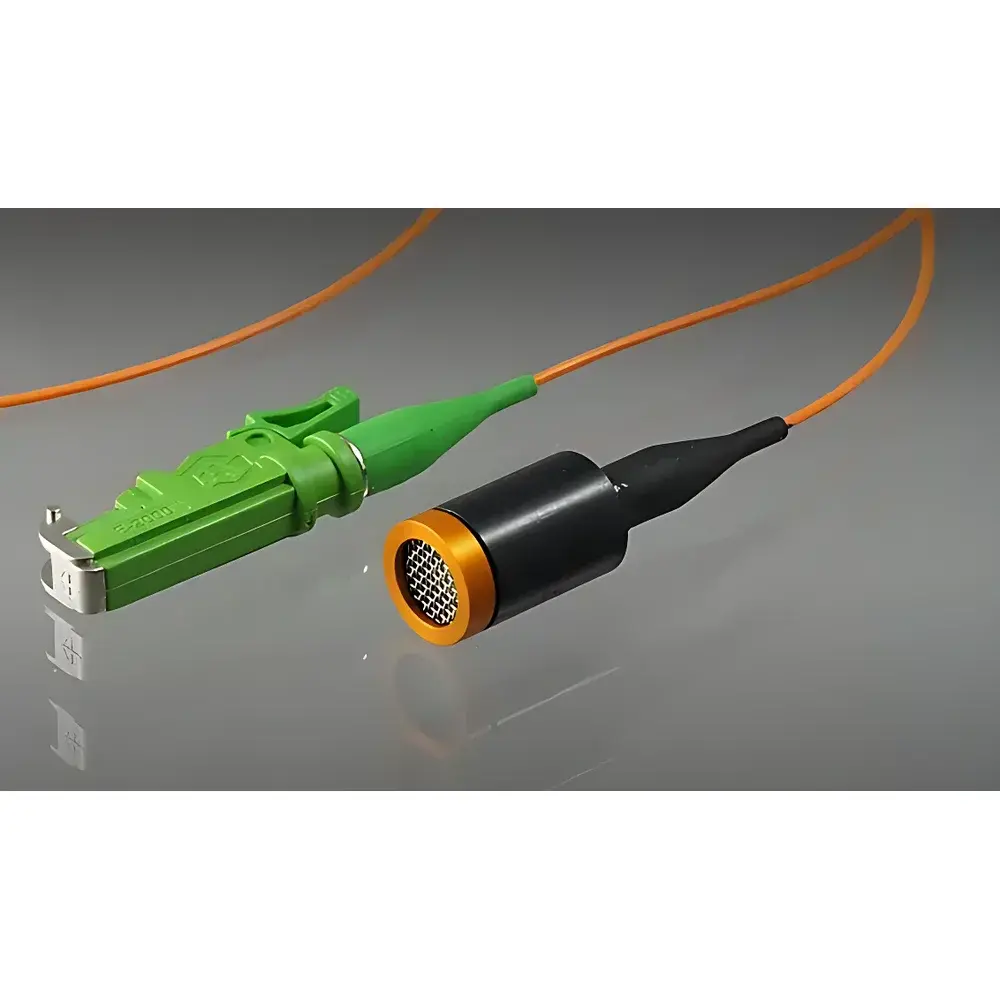
Phonoptics MYOTIS 1300 Fiber-Optic Acoustic Sensor System
| Origin | Imported |
|---|---|
| Manufacturer Type | Authorized Distributor |
| Spectral Range | Visible (400–700 nm) |
| Detector Type | Interferometric Fiber-Optic Transducer |
| Operating Temperature (Standard Sensor) | −25 °C to +120 °C |
| Operating Temperature (High-Temp Sensor) | −55 °C to +250 °C |
| Pressure Sensor Max Temp | Up to 1000 °C |
| Acoustic Sensitivity (Standard/Plastic) | 50 mV/Pa |
| Acoustic Sensitivity (High-Temp) | 10 mV/Pa |
| Acoustic Bandwidth | 20 Hz – 16 kHz |
| Dynamic Pressure Bandwidth | 40 kHz / 100 kHz |
| Digital Sampling | 44.1 kHz, 16-bit USB DAQ |
| Power Supply | Integrated Rechargeable Battery & 5 V micro-USB |
Overview
The Phonoptics MYOTIS 1300 Fiber-Optic Acoustic Sensor System is a high-fidelity, immunity-hardened measurement platform engineered for precision acoustic and dynamic pressure sensing in electromagnetically hostile, thermally extreme, or physically constrained environments. Unlike conventional piezoelectric or condenser microphones, this system employs interferometric fiber-optic transduction—where acoustic pressure modulates the optical path length within a single-mode fiber embedded in a miniature Fabry–Pérot or Michelson configuration. This principle delivers intrinsic electrical isolation, zero electromagnetic interference (EMI/RFI) susceptibility, and immunity to high-voltage transients, making it suitable for applications ranging from jet engine combustion monitoring to MRI-compatible physiological acoustics and high-energy physics diagnostics. The MYOTIS 1300 serves as both a signal conditioner and a fully integrated digitizer, enabling real-time analog monitoring (BNC AC, SMA DC), headphone-based listening, and synchronized 16-bit digital acquisition via USB without external DAQ hardware.
Key Features
- Triple-sensor compatibility: Standard metallic (Inconel/Kovar), EMI-shielded plastic-body, and high-temperature ceramic/Kovar variants—each with identical 10 mm × 20 mm cylindrical form factor and 3 g mass.
- Interferometric transduction architecture ensures >120 dB dynamic range, minimal phase distortion, and long-term calibration stability under thermal cycling.
- MYOTIS 1300 controller integrates a stabilized broadband light source, low-noise photodetector, 3-stage programmable gain amplifier (±12 dB steps), and on-board thermal protection via embedded thermistor.
- Dual-output architecture: Simultaneous analog outputs (BNC AC for spectral analysis, SMA DC for envelope tracking) and USB 2.0 streaming at 44.1 kHz / 16-bit resolution.
- E2000 APC optical connectors with dust caps ensure repeatable coupling loss <0.3 dB and compliance with IEC 61754-18 standards.
- Battery-powered operation enables portable, intrinsically safe deployment in hazardous locations (ATEX Zone 2 / IECEx compliant when paired with appropriate enclosures).
Sample Compatibility & Compliance
The MYOTIS 1300 system is compatible with all Phonoptics-certified fiber-optic acoustic and dynamic pressure sensors—including those rated for continuous operation up to 250 °C (high-temp acoustic) or transient exposure to 1000 °C (pressure). Its passive sensor design eliminates grounding loops and satisfies stringent EMC requirements per EN 61326-1 (industrial environments) and ISO 10816-3 (vibration and acoustic instrumentation). For regulated industries, the controller’s firmware supports audit-trail logging of gain settings, sensor ID registration, and timestamped metadata export—facilitating alignment with GLP, GMP, and FDA 21 CFR Part 11 data integrity expectations when deployed in pharmaceutical process monitoring or aerospace qualification testing.
Software & Data Management
The system ships with Phonoptics’ proprietary MYOTIS Control Suite—a cross-platform application (Windows/macOS/Linux) supporting real-time FFT analysis, time-domain waveform capture, trigger-based recording, and export to HDF5, CSV, or MATLAB .mat formats. The software implements automatic sensor identification via optical reflectance signature, configurable anti-aliasing filtering, and built-in calibration file management (NIST-traceable sensitivity coefficients stored in EEPROM). For integration into LabVIEW, Python (via PyVISA or custom DLL), or MATLAB environments, comprehensive API documentation and example scripts are provided. All digital streams include embedded sample-clock synchronization and hardware-timestamped frame headers—critical for multi-sensor array coherence analysis.
Applications
- Combustion dynamics monitoring in gas turbines and rocket propulsion systems—where EMI resilience and high-temperature tolerance are non-negotiable.
- MRI-compatible acoustic source localization during functional neuroimaging studies, eliminating RF-induced artifacts.
- In-situ acoustic emission (AE) detection in composite material fatigue testing under vacuum or corrosive atmospheres.
- High-bandwidth pressure fluctuation mapping in supersonic wind tunnels and detonation wave characterization.
- Industrial predictive maintenance of rotating machinery—especially in variable-frequency drive (VFD)-rich facilities where conventional microphones fail due to conducted noise.
FAQ
Is the MYOTIS 1300 compatible with third-party DAQ systems?
Yes—its BNC AC output provides a buffered, low-impedance analog signal compatible with standard oscilloscopes and modular DAQ platforms (e.g., National Instruments PXI, Keysight U2300A).
Can the high-temperature acoustic sensor operate continuously at 250 °C?
Yes—the ceramic-and-Kovar construction is qualified for continuous exposure at 250 °C; short-term excursions to 350 °C are permissible with derated sensitivity.
Does the system support multi-sensor synchronization?
Yes—external TTL trigger input and hardware clock-out signals enable sub-microsecond inter-channel alignment across up to 16 MYOTIS units using daisy-chained optical timing distribution.
What calibration documentation is included?
Each sensor is supplied with a NIST-traceable calibration certificate specifying sensitivity (mV/Pa), frequency response deviation (±0.5 dB, 100 Hz–10 kHz), and phase linearity (±2°).
Is firmware update capability available?
Yes—field-upgradable firmware is delivered via secure signed binary packages through the MYOTIS Control Suite, with version rollback and integrity verification.





